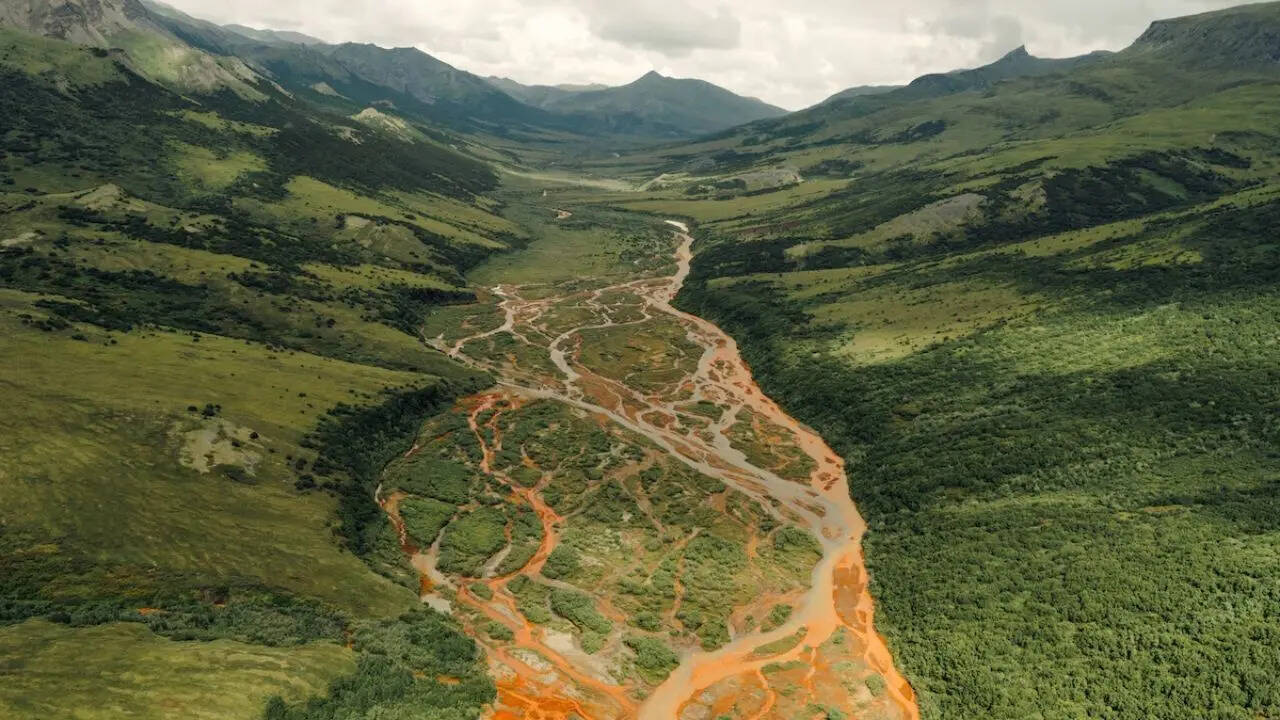
Alaska’s pristine, glacial rivers are turning the color of cheap tomato soup, and the media has officially entered its favorite state of being: hysterical panic.
If you have scrolled through any news feed recently, you have seen the apocalyptic headlines. Images of the Brooks Range looking like an industrial runoff zone. The narrative handed down by mainstream science reporting is beautifully simple, terrifying, and wrong. They claim that because the climate is warming, permafrost is melting, releasing thousands of years of trapped iron and acid into the waterways.
The underlying message? Humans broke the north, the Arctic is bleeding, and we are witnessing an unprecedented ecological collapse.
It is a great story. It sells clicks. It fits perfectly into the established doom-loop.
It also fundamentally misunderstands how Earth’s geochemistry actually works.
As someone who has spent years tracking environmental data and watching billions of dollars in public funding get funneled into reactive, hand-wringing research, I am here to tell you that the "orange river" panic is a textbook case of viewing a natural, localized chemical transition through a lens of existential dread.
The rivers are turning orange. That is a fact. But it is not a harbinger of the end times. It is a massive, planet-scale plumbing shift that we need to understand, not mourn.
The Lazy Consensus of Permafrost Doom
Let us dismantle the mainstream thesis. The current media darling theory relies on a study published by researchers who documented dozens of orange streams in Alaska's Brooks Range. The consensus explanation goes like this: melting permafrost exposes iron sulfide minerals (like pyrite) to oxygen and water for the first time in millennia. This triggers acid rock drainage, leaching heavy metals into the water and killing off macroinvertebrates and fish.
The implication is that this is an artificial anomaly—a sudden, catastrophic breakdown of a fragile system.
This is where the logic fails.
First, let us correct the definition of what is happening. This is not a synthetic toxic spill. This is a classic, terrestrial geochemical feedback loop. The iron is not a pollutant; it is a fundamental building block of the Earth's crust. Calling a river "polluted" because it is interacting with the bedrock beneath it is like calling the ocean polluted because it contains salt.
Second, the assumption that this is entirely "unprecedented" is historically blind. Geochemical records and core samples show that Arctic rivers have fluctuated in composition for millions of years. The landscape of northern Alaska is not a static postcard. It is a highly dynamic chemical reactor.
What we are seeing is not the death of an ecosystem. It is an accelerated phase change.
The Irony of the Iron Problem
The narrative tells you that iron oxidation is a pure negative. Let us look at what the mainstream reporting conveniently leaves out: iron is a primary limiting nutrient in global ecosystems.
Imagine a scenario where these iron-rich waters eventually make their way downstream into the North Pacific. What happens when you inject massive amounts of dissolved iron into iron-deficient marine environments? You trigger phytoplankton blooms.
Phytoplankton are the literal engine of the ocean's carbon cycle. They consume carbon dioxide at a staggering rate. For decades, geoengineers have seriously debated "ocean iron fertilization" as a viable mechanism to artificially capture carbon and restore marine food webs. Now, the Arctic is doing it on a macro scale, for free, and we are treating it like a localized tragedy.
Yes, in the immediate, upstream tributaries, the high acidity and heavy iron concentration are brutal for local trout and salmon populations. It disrupts the gills; it blocks out the light. I am not denying the localized ecological cost. If you are a grayling in a freshly rusted creek, your week just got a lot worse.
But zooming out to the macro level reveals a different story. Ecosystems do not collapse permanently when one variable shifts; they reconfigure. While the upper reaches of these streams become hostile to certain species, they become breeding grounds for iron-oxidizing bacteria, creating entirely new micro-economies of biological activity.
The media focuses entirely on the subtraction while completely ignoring the addition.
| Mainstream Narrative | Geochemical Reality |
|---|---|
| Arctic rivers are permanently ruined by toxic runoff | Rivers are undergoing a natural, localized acid rock drainage phase |
| Iron-orange water is a sign of ecological death | Iron is a vital nutrient that drives biological productivity downstream |
| The phenomenon is entirely unprecedented | Earth’s crust has engaged in these feedback loops across every interglacial period |
Dismantling the People Also Ask Panics
The public search intent around this topic is driven by pure anxiety. Let us address the most common queries with some cold, hard data instead of emotional platitudes.
"Is the orange water in Alaska safe to drink?"
Absolutely not. But let us stop pretending this is a new restriction. You should not have been drinking untreated wild river water in the Brooks Range anyway, unless you enjoy a side of Giardia with your morning hike. The water contains elevated levels of iron, manganese, nickel, and copper, alongside high acidity. It is undrinkable right now. But guess what? Earth has thousands of miles of naturally undrinkable, highly mineralized rivers. The Rio Tinto in Spain has been a glowing, acidic red-orange for millennia due to its geology, and it hosts a thriving ecosystem of extremophile life that has rewritten our understanding of biology.
"Will the orange rivers destroy the Arctic salmon population?"
This is the wrong question. The right question is: Where will the salmon adapt? Salmon are incredibly resilient, dynamic creatures. They do not sit in an acidic river and wait to perish; they migrate, adapt, and seek out unaffected tributaries. The Brooks Range is vast. Not every river is turning orange. The streams that are changing will see a temporary drop in fish density, but to claim this will "destroy" Arctic fisheries is a massive, unscientific leap that ignores basic evolutionary biology.
"Can we stop or fix the rusting rivers?"
This is where the corporate sustainability crowd chimes in, wanting to throw billions of dollars at "remediation" strategies. Stop trying to fix it. You cannot dump enough lime into the entire Arctic wilderness to neutralize the pH of an entire mountain range's groundwater. It is logistically impossible, financially insane, and ecologically arrogant.
I have seen environmental tech firms blow millions of dollars trying to engineer solutions for natural planetary shifts, only to realize that nature operates on a scale that renders human engineering laughable. We cannot "fix" the thawing of a geographic region the size of a continent. We adapt to it.
The Real Danger: Misallocating Our Scientific Capital
The true risk of the orange river panic is not environmental; it is intellectual.
When we frame every single natural shift as an artificial catastrophe, we lose the ability to prioritize real, anthropogenic crises. We treat a geochemical reaction in the Alaskan wilderness with the same tone of voice we use for a catastrophic chemical spill in an urban waterway.
This creates a culture of scientific defeatism. If everything is broken, nothing can be saved.
We need to stop viewing the Arctic as a fragile, frozen museum piece that must be preserved exactly as it was in 1950. The Arctic has been a swamp; it has been an ice sheet; it has been a boreal forest. Right now, it is transitioning into a highly active, mineral-rich, dynamic hydrological system.
The turning of these rivers is a massive, real-time demonstration of Earth’s internal chemistry at work. It is fascinating. It is complex. It is a testament to the planet's raw, unyielding power to reshape itself.
Stop mourning a static landscape that never truly existed. Start studying the one that is actually being born.