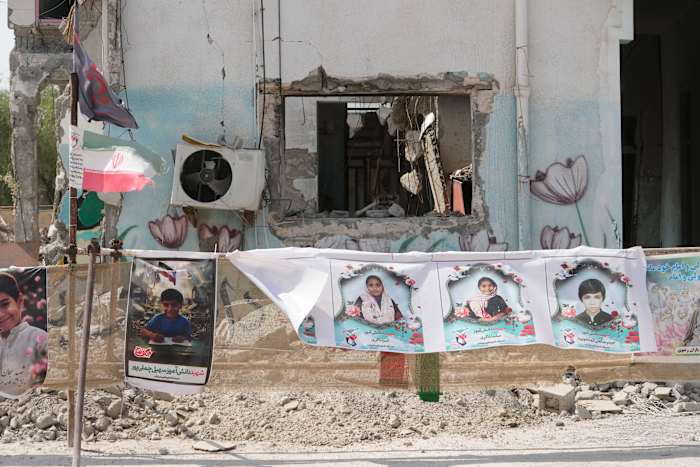
The bright blue gate in the southern Iranian town of Minab still features cheerful painted symbols of oversized pencils, maps, and portraits of literary icons. But nobody is walking through it to learn math or science anymore. When the Shajareh Tayyebeh elementary school took direct hits during the opening salvos of the military conflict launched by the United States and Israel on February 28, it instantly became one of the most devastating single civilian tragedies of the war.
Official figures place the death toll at over 100 students, with international bodies like UNICEF noting that the vast majority of the children killed were between seven and twelve years old. Months later, the physical structure has transitioned into something entirely different: a permanent war memorial and museum.
Walking past that blue gate today means navigating a sobering corridor of grief. The pathway guides visitors past framed photographs of young students captured during everyday moments, birthday parties, and school functions, which abruptly shift into stark black banners of mourning. Inside the two-story building, the devastation remains frozen in time. Classrooms show collapsed concrete ceilings, half-buried student desks, and dust-covered notebooks scattered across the floor.
Hormozgan Governor Mohammad Ashouri Taziani and local officials confirmed that preserving the ruins serves as an unvarnished historical record of the attack. Just outside the town, a dedicated section of the Minab cemetery features rows of graves covered in artificial grass, where families quietly gather. Local residents report that despite months of recovery efforts, several bodies remain unaccounted for.
The international accountability gap surrounding the incident remains wide. Independent investigations, including analyses by open-source researchers and media outlets like the Associated Press, have pointed to evidence that U.S. munitions struck the facility. Yet, the administration has yet to formally accept direct responsibility or publicly release comprehensive Pentagon findings detailing how an active primary school became a target during the early morning aerial campaigns.
Minab's tragedy returned to global headlines as subsequent regional air raids continued to impact civilian infrastructure across southern Iran, compounding the trauma for communities already burying their youngest members. As the ruined campus transforms from a crime scene into a solemn site of remembrance, it stands as a grim monument to the immediate human cost borne by civilians when military campaigns intersect with everyday civilian life.


