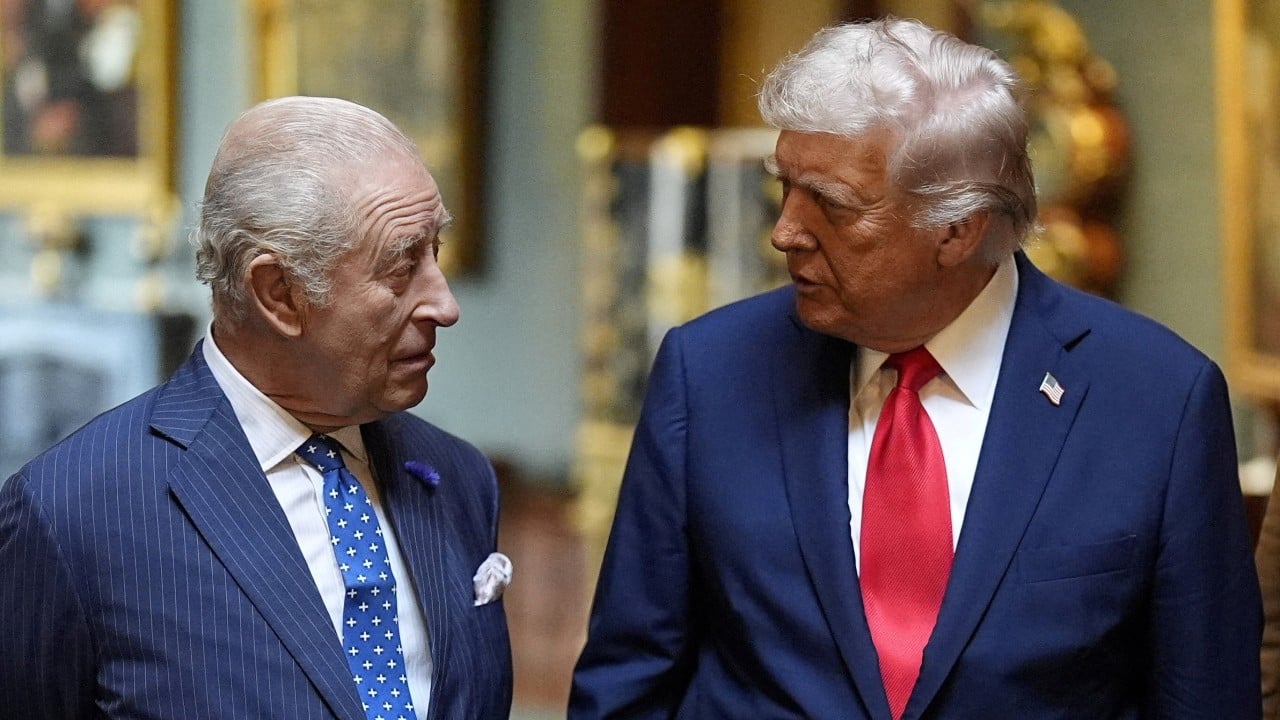
Donald Trump believes a visit from King Charles III can "absolutely" fix the fractured bond between Washington and London. It is a bold claim, typical of a president who views international diplomacy through the lens of personal chemistry and televised spectacle. But as the King prepares to land in the United States this Monday, the reality on the ground suggests that no amount of royal pageantry can easily paper over the deepest strategic divide in seventy years.
The visit arrives at a moment of profound friction. The "Special Relationship" is currently being tested by a high-stakes disagreement over the war in Iran and a lingering cloud of scandal that refuses to dissipate. While the President offers warm words for the monarch, his relationship with Downing Street has soured into open hostility.
The Iran Schism and the Chamberlain Comparison
The primary engine of the current discord is the war on Iran, launched by the Trump administration on February 28. British Prime Minister Keir Starmer has notably refused to commit British forces to the offensive, a decision that has drawn the public ire of the Oval Office. Trump has gone so far as to compare Starmer to Neville Chamberlain, the British leader synonymous with pre-World War II appeasement.
This is not merely a spat between politicians. It represents a fundamental divergence in how the two nations view global security. Under Trump, the United States has moved toward unilateral action, exemplified by the strike that killed Iran’s supreme leader and the subsequent invasion. London, meanwhile, has clung to the remains of international law and multilateralism, leaving the UK isolated in Washington’s eyes.
Trump’s recent comments to the BBC underscore this dismissive attitude. While praising the King as "fantastic" and "brave," he took the opportunity to twist the knife into Starmer, suggesting the Prime Minister's only path to recovery involves a radical reversal on energy policy and immigration. By decoupling the monarch from the elected government, Trump is attempting to engage with the symbol of Britain while ignoring its leadership.
Soft Power in a Hard Power Era
King Charles III faces a nearly impossible task. He arrives in a Washington that largely disdains the "velvet glove" of traditional diplomacy in favor of the "iron fist." The state visit, timed to coincide with the 250th anniversary of the Declaration of Independence, is designed to celebrate historic ties, yet it feels more like a salvage operation.
The King’s greatest asset is his perceived standing above the political fray. Trump’s respect for the monarchy is well-documented; recent reports suggest this personal regard may have even stalled more radical American impulses regarding territorial interests in the North. However, the King is a constitutional monarch who acts on the advice of his government. He cannot negotiate trade deals or sign military pacts.
The Epstein Factor and the Andrew Shadow
The visit is also haunted by the ghost of Jeffrey Epstein. The King’s brother, Prince Andrew, remains a focal point of US House Committee investigations. The appointment of Peter Mandelson as UK Ambassador—a man with his own historic links to the Epstein circle—has only added fuel to the fire.
Survivors of Epstein’s abuse have called for the King to acknowledge their plight while on American soil. Buckingham Palace has remained characteristically silent, citing ongoing police inquiries. This silence creates a vacuum that critics, including US Congressman Ro Khanna, argue could damage the monarchy’s credibility. If the King is seen as a shield for his brother rather than a symbol of justice, the trip’s "soft power" benefits could evaporate instantly.
The Economic Price of Sovereignty
The friction isn't just about bombs and scandals; it’s about bread and butter. Trump has made it clear that he views the UK’s current economic path as a failure. He has publicly pressured Starmer to "open the North Sea" for oil and gas, effectively demanding that Britain align its environmental and energy policies with his own "America First" agenda.
For the UK, this presents a sovereignty crisis. Accepting Trump’s "advice" would mean abandoning domestic climate goals and alienating European allies. Refusing it keeps the UK in the diplomatic freezer. The King’s visit provides a temporary distraction from these hard truths, but the underlying economic tension remains.
- Military Divergence: The UK's refusal to join the Iran offensive has led to American mockery of the Royal Navy's capabilities.
- Diplomatic Lows: Former NATO chief Lord Robertson has described the current relationship as being at a "historic low point."
- Energy Pressure: Washington is actively pushing for a reversal of British environmental regulations to favor fossil fuel extraction.
A Decoupled Relationship
We are witnessing a new era where the President of the United States treats the British head of state and the British head of government as two entirely separate entities. Trump’s strategy is to charm the King while strangling the Prime Minister’s influence.
This creates a dangerous precedent for the UK. If the Special Relationship becomes purely a matter of personal affinity between a President and a King, it loses its institutional stability. When the King departs on Thursday, the military and economic realities will still be there. The Royal Navy will still be viewed as insufficient by the Pentagon, and Downing Street will still be at odds with the White House over the Middle East.
The King can offer the President a photo opportunity and a sense of historical weight. He cannot offer him a fleet of destroyers or a change in British law. Trump says the visit can "absolutely" repair the relationship, but he is likely defining "repair" as "submission."
True restoration requires more than a state dinner and a toast to the 250th anniversary of a revolution. It requires a shared strategic vision that currently does not exist. The King is doing his part, but the heavy lifting remains the burden of the politicians, and they aren't even speaking the same language.