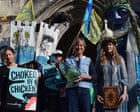
The water used to speak in a language of silver and stone. If you stood on the banks of the River Wye twenty years ago, you would see the Atlantic salmon—muscular, persistent, and ancient—leaping against the current like polished chrome blades. It was a rhythmic, thriving pulse. Today, that pulse is thready. The riverbed, once a mosaic of clean pebbles, is often smothered under a thick, suffocating blanket of emerald slime.
Algae. It sounds harmless, like something you’d find in a decorative pond. But in the Wye and its sister, the Usk, it is a strangler. It blooms with a toxic enthusiasm, blocking the light and starving the water of oxygen until the fish literally drown in their own home.
When people look for a villain, they usually point toward the massive metal sheds dotting the hillsides of the Welsh borders. These are the intensive poultry units, the engines of a cheap chicken industry that feeds a nation’s insatiable appetite for Sunday roasts and mid-week nuggets. Inside, millions of birds produce a mountain of manure. Outside, that manure is spread on fields as fertilizer. When the rain comes—and in this part of the world, it always comes—the phosphorus in that waste leaches into the soil and bleeds into the veins of the river.
But the giants of the industry are fighting back against the narrative that they are the sole authors of this ecological eulogy.
Avara Foods, one of the UK’s largest poultry producers, recently found itself in the crosshairs of a massive legal claim. The accusation is simple: that their industrial-scale operations have systematically poisoned the river system. Their response, however, isn't a quiet admission of guilt. It is a sharp, defensive cry of "not just us."
The Weight of the Invisible
To understand the tension, you have to look at the bird on your plate. We have been conditioned to expect chicken to be the most affordable protein available. It is the invisible miracle of modern logistics. However, that low price tag at the supermarket checkout doesn't account for the "externalities"—a dry, bureaucratic word for the death of a river.
Avara argues that the legal claims against them are "unsupported" and "plainly wrong." They point to a complex web of contributors: aging sewage systems that overflow during storms, run-off from other types of farming, and the historical buildup of minerals in the soil that predates their modern expansion. They aren't just defending their balance sheet; they are defending a model of food production that we, the consumers, built with our wallets.
Imagine a farmer named David. He isn't a corporate mogul; he’s a man who transitioned from cattle to chickens a decade ago because the margins on beef were killing his family’s legacy. He was told poultry was the future. He built the sheds, followed the regulations, and became a cog in a massive, efficient machine. Now, when he walks down to the water's edge, he sees the film on the surface. He hears the protesters. He feels the weight of being a guardian who might be accidentally destroying the thing he loves.
This isn't just a corporate PR battle. It’s a civil war between our desire for cheap abundance and our need for a living world.
The Math of an Algal Bloom
The chemistry is unforgiving. Phosphorus is a nutrient. In small doses, it helps things grow. In the concentrations now found in the Wye, it acts like a fuel injection into a fire.
When the phosphorus levels hit a certain threshold, the river’s ecosystem flips. The water becomes "eutrophic." This is a fancy way of saying the river is eating itself. The algae grow so fast they die off in massive cycles, and the bacteria that decompose them consume all the oxygen.
Data from environmental monitors suggests that agriculture is responsible for roughly 60% to 70% of the phosphorus load in the Wye. Avara’s critics argue that because they control the sheer volume of birds in the catchment—millions at any given time—they are the primary lever that can be pulled to fix the problem.
Avara’s counter-argument hinges on the idea of shared responsibility. They have introduced a "Soil Protection Strategy," claiming they are now shipping a significant portion of poultry litter out of the catchment area entirely. They want the world to know they are moving, evolving, and cleaning up. But for the campaigners who have spent years watching the water turn from crystal to pea soup, these measures feel like putting a bandage on a severed artery.
The Ghost in the Current
There is a specific kind of grief that comes with watching a river die. It’s a slow-motion tragedy. Unlike a forest fire or a flood, a polluted river doesn't always look like a disaster at first glance. It just looks slightly duller. The birds stop diving. The silence gets heavier.
The legal battle currently unfolding isn't just about fines or compensation. It is a test case for the future of British land use. If a major corporation can be held liable for the cumulative environmental impact of its supply chain, the entire structure of industrial farming will have to shift. The "standard" way of doing business—where the profit is private but the cleanup is public—would be under threat.
Consider the irony of our modern pantry. We want the "Green Revolution," we want sustainable labels, and we want to feel good about our choices. Yet, we rarely want to pay the true cost of a chicken that doesn't cost a river its life. The industry hits out at the claims because the claims suggest that the very foundation of their efficiency is a crime.
A Choice Between Two Hungers
The river doesn't care about legal filings. It doesn't care about Avara’s quarterly reports or the fiery rhetoric of environmental lawyers. The river only responds to what we put into it.
We are currently at a crossroads where two types of hunger meet. There is the literal hunger of a population that needs affordable food in a cost-of-living crisis. And there is the spiritual, ecological hunger for a world that isn't stripped of its natural beauty for the sake of a slightly cheaper breast of chicken.
The tragedy of the Wye and the Usk is that they are being asked to carry a burden they were never meant to hold. They are being used as open-air sewers for the waste of an industrial dream. Avara’s defense—that they are being unfairly singled out—might hold some factual water in a courtroom full of technicalities. But in the court of the living world, the evidence is written in the slime on the rocks.
The silver salmon don't come back because of a well-worded press release. They come back when the water is clear enough to see the sky. Until then, every time we look at the Wye, we aren't just seeing a river in distress. We are seeing a mirror of our own refusal to acknowledge that nothing is ever truly cheap; someone, or something, is always paying the difference.
The sun sets over the valley, casting long shadows across the metal roofs of the poultry units. Down below, the water flows on, dark and thick, carrying the quiet, heavy secrets of our dinner plates toward the sea.