The sound starts as a low, structural groan. You think it is thunder, or perhaps the heavy chassis of a cargo truck shifting gears on the gravel tracks above the valley floor. But then the ground beneath your boots vibrates with a rhythmic, malicious pulse.
Water does not usually sound like a living thing. In the high-altitude cradles of the Himalayas, streams are typically glass-clear ribbons that sing over smooth river stones, fed by ancient snowpacks that melt with slow, predictable grace. But on a monsoon morning when the clouds drop anchor against the jagged ridges of Nepal, the mountain does not weep. It unzips.
To understand what happens when a bridge gives way under the weight of brown, churning floodwaters, you have to look past the macro lens of satellite data. You have to shrink the catastrophe down to the width of a single wooden plank.
Consider a hypothetical shopkeeper named Ramesh, whose corrugated iron storefront sits fifty paces from the edge of a swollen tributary in the Sindhupalchowk district. Ramesh knows the monsoon. He respects it the way a sailor respects a winter gale. He has reinforced his doorframes, stacked his sacks of salt and lentils on elevated concrete blocks, and watched the water rise past the warning marks year after year.
Yet, routine is a dangerous narcotic.
When the rain began this week, it did not fall in drops. It fell in sheets, dense and grey, welding the sky to the earth until the horizon simply vanished. By midnight, the sound of the river had transitioned from a murmur to an industrial roar. It was the sound of millions of tons of topsoil, uprooted pine trunks, and boulders the size of utility vehicles grinding against one another in a frantic rush toward the plains.
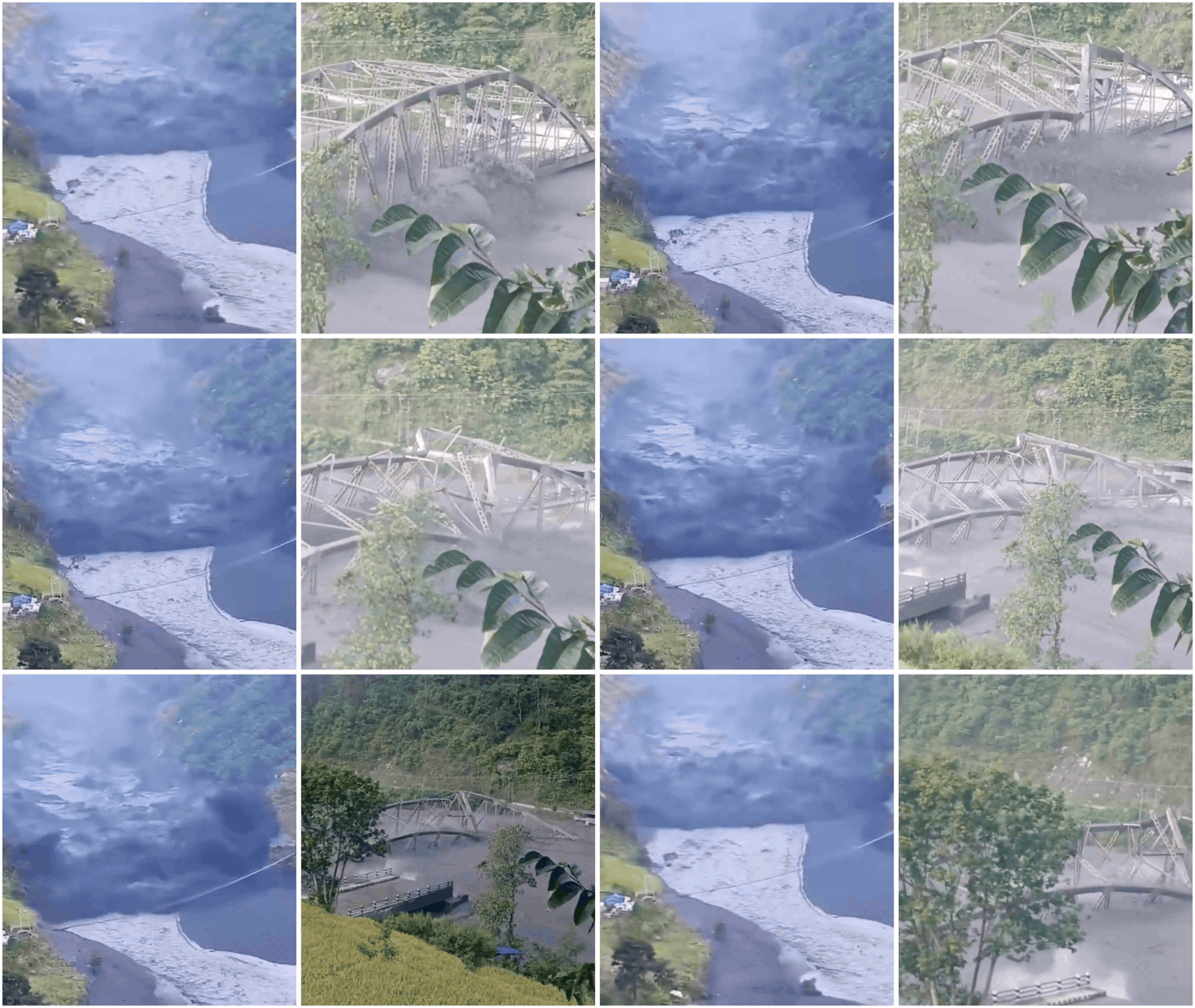
At 3:00 AM, the concrete suspension bridge—the umbilical cord connecting Ramesh’s village to the regional market town—did not collapse gracefully. It simply vanished.
One second, the span cut a clean line across the void. The next, a wall of debris slammed into the central pylons with the kinetic energy of a freight train. There was no dramatic creak of metal. There was only a sharp, pistol-crack snap, a sudden spray of sparks as severed reinforcement bars whipped through the dark, and then a heavy, wet splash that was instantly swallowed by the roar of the current.
In an instant, isolation became absolute.
The Anatomy of a Flash Flood
Meteorologists and disaster management experts speak in terms of precipitation rates, millimeter thresholds, and saturated catchments. They will tell you that the topography of Nepal makes it uniquely vulnerable. With its steep vertical gradients—dropping from the roof of the world to tropical plains in the span of a hundred kilometers—rainwater does not merely accumulate; it accelerates.
Gravity is the primary architect of disaster here.
When cloudbursts dump hundreds of millimeters of rain onto deforested hillsides, the soil lets go. It is a simple, brutal physics equation. Without deep-rooted vegetation to anchor the earth, the hillsides liquefy. Mudslides choke narrow river gorges, creating temporary, unstable dams of earth and timber.
Villages downstream live beneath these invisible, ticking time bombs.
When a natural debris dam finally bursts, it releases a wall of water known locally as a flash flood, though that word feels entirely too clinical for what actually occurs. It is a slurry. It is half liquid, half battering ram. It carries away entire homesteads, livestock pens, and centuries-old terraced fields as if they were made of matchsticks.
Chilling videos circulating from recent downpours capture this terrifying reality with horrifying clarity. You watch a multi-story concrete home sway for a fraction of a second on the riverbank, its yellow walls bright against the gloom, before the earth beneath its foundation dissolves. The house does not fall apart; it slides intact into the torrent, tilting sideways like a sinking ship before breaking apart against a rocky bend fifty yards downstream.
The cameras stop rolling because the person holding the phone has to run for higher ground. But the imagination keeps watching.
The Invisible Stakes
We live in a world obsessed with metrics. We count the dead, tally the economic losses in millions of rupees, and map the displacement numbers on bureaucratic spreadsheets. But statistics are cold things. They fail to capture the invisible architecture of rural survival that gets washed away in the muddy brown tide.
When a bridge collapses in rural Nepal, the immediate casualty is physical mobility. But the secondary casualties are far more insidious.
How do you transport a pregnant woman in labor when the nearest district hospital is on the other side of a raging, impassable chasm? How do you get children to school when the path they walked yesterday now terminates at a sheer, thirty-foot drop of churning water? How do long-suppressed supply chains survive when fuel, medicine, and cooking gas cannot cross the gap?
The psychological toll is heavier still.
Every monsoon season now carries an unspoken terror. Families do not sleep deeply. They keep their bags packed near the door, their most precious documents wrapped in plastic sheeting, their ears tuned to the frequency of the river. Is that rumble just the normal thunder, or is it the sound of the upper ridge giving way?
It is a exhausting way to exist. It forces communities into a perpetual cycle of rebuilding only to watch their labor undone by the next atmospheric anomaly.
Rethinking Resilience
For decades, the standard response to these disasters has been reactive. Helicopters are dispatched when the weather clears. Tarpaulins and sacks of dry rice are distributed. Engineers draft plans for heavier, wider, more reinforced concrete bridges to replace the ones that were lost.
Yet, building stronger concrete is no longer enough when the very mountains are shifting beneath our feet.
True resilience requires a fundamental shift in how we inhabit these landscapes. It means recognizing that rivers have memories and rights of way. When we constrain them with narrow embankments or build dense settlements on low-lying alluvial fans, we are picking a fight with geology. And geology always wins.
Across vulnerable districts, local innovators and community groups are starting to pioneer low-tech, highly adaptable defenses. They are mapping ancient flood lines with oral histories passed down by elders, moving critical infrastructure away from active floodplains, and installing early-warning sensor networks linked to simple SMS sirens that give villagers precious minutes to climb the ridge before the surge arrives.
These measures are unglamorous. They do not make international news headlines the way dramatic drone footage of collapsing bridges does. But they save lives. They keep families intact.
The Final Current
Back in Sindhupalchowk, the rain eventually eases. The sky shifts from bruised purple to a pale, exhausted grey.
The river will eventually recede, leaving behind a thick, gray crust of silt that coats everything it touches—cars, doorsteps, vegetable patches, and memories. The water will clear, returning to its deceptive, emerald-clear state, whispering over the smooth stones as if nothing ever happened.
Ramesh and his neighbors will walk down to the edge of the gap where the bridge used to be. They will look across the chasm at relatives and friends stranded on the opposite bank, waving through the mist.
They will not wait for official decrees or heavy machinery. Someone will haul out a thick coil of steel cable. Someone else will wade into the freezing, knee-deep shallows with a guide rope. They will begin, hand over hand, to rebuild the connection.
Because in the high valleys of the Himalayas, the only option greater than the flood is the stubborn, unbroken human will to cross to the other side.