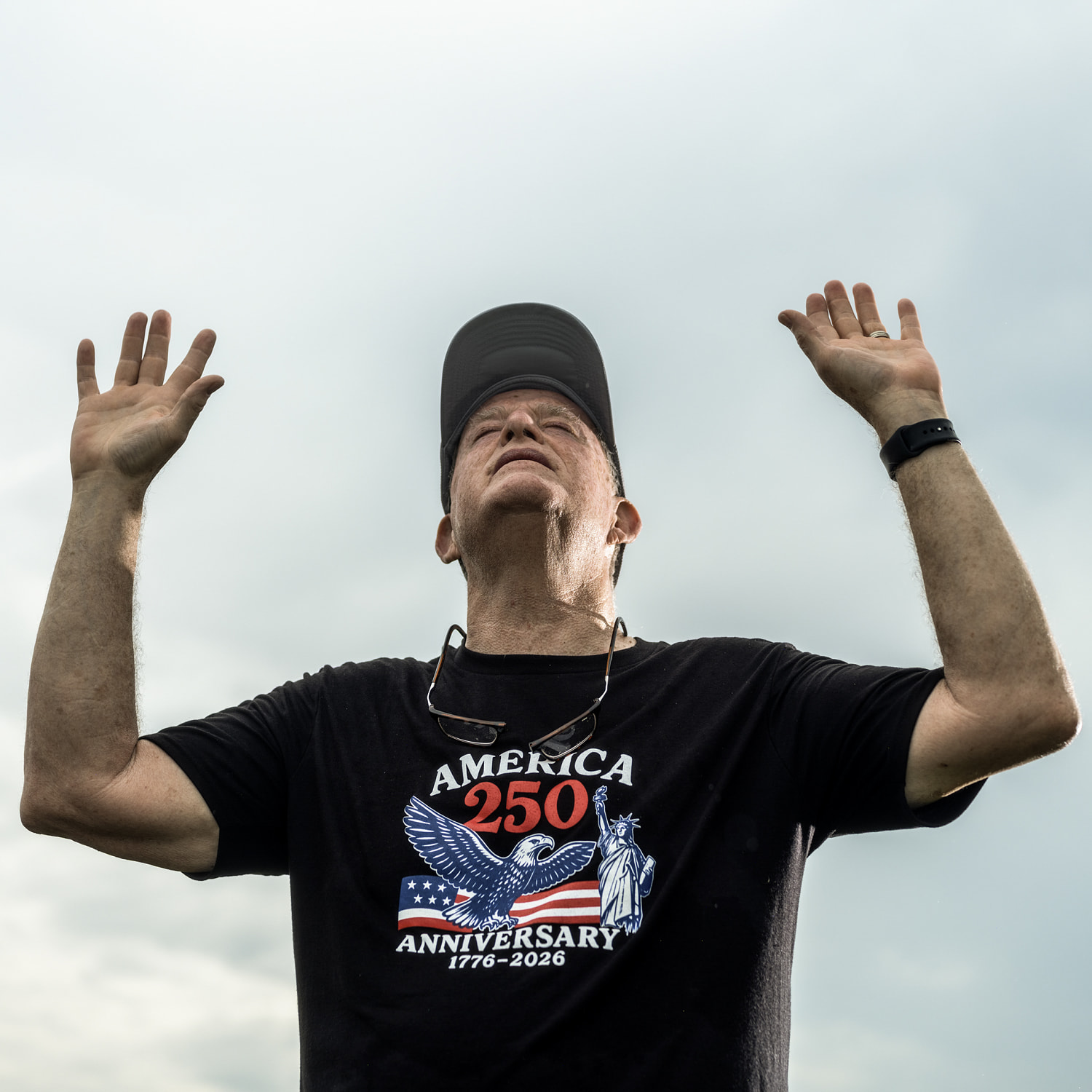
Thousands of people flooded the National Mall under a sweltering sun for the "Rededicate 250" prayer rally, billed as the spiritual opening salvo for America’s semiquincentennial. The mainstream media is already running its predictable scripts. On one side, conservative outlets are framing the event—heavy with Trump administration officials, evangelical icons, and a solitary rabbi—as a return to the righteous path of the Founding Fathers. On the other, progressive critics are panicking over a massive wave of Christian nationalism, projecting slogans like "Democracy not theocracy" onto museum walls and floating golden calves to signal idolatry.
Both sides are entirely missing the point.
The lazy consensus dominating this entire conversation is the assumption that America was once a cohesive, uniformly devout Christian nation that can simply be "rededicated" like an old church building. This premise is historically hollow. What happened on the Mall was not a restoration of the American founding. It was a thoroughly modern political theatrical production utilizing an engineered version of history that never existed.
The Myth of the Monolithic Founding
Listen to House Speaker Mike Johnson or Defense Secretary Pete Hegseth, and you will hear a clear narrative: the founders knelt, begged for God’s mercy, and built a republic directly on top of orthodox Christian theology.
This is bad history. I have spent decades analyzing the intersection of governance and public theology, and if there is one certainty in American history, it is that the founders were a chaotic mix of deists, epicureans, traditionalists, and rationalists who could barely agree on the definition of a deity, let alone a national denomination.
When John Adams signed the Treaty of Tripoli in 1797, the document explicitly stated that "the Government of the United States of America is not, in any sense, founded on the Christian religion." Thomas Jefferson famously used a razor blade to cut the miracles out of the New Testament because he found them intellectually offensive. To claim that a 21st-century evangelical worship festival—complete with stadium-grade subwoofers and Christian pop star Chris Tomlin—represents a continuation of the founders' intent is an exercise in pure fantasy.
The organizers of Rededicate 250 built a stage featuring grand federal columns intertwined with stained-glass windows and a massive white cross. This visual synthesis implies that American civic architecture and Christian dogma are identical. They are not. The founders went to extreme lengths to ensure that the federal state remained a neutral arena, specifically to protect religious practice from being corrupted by state power, and vice versa.
The Flawed Premise of Rededication
People frequently ask: "Can America return to its founding faith?"
The question itself is broken. You cannot return to a place you never inhabited. The idea of "rededicating" the country assumes there was a singular moment of dedication.
There was not. Colonial America was highly fractured. The Puritans in Massachusetts banned Christmas and hanged Quakers. The Virginia establishment jailed Baptists. The founders did not create a Christian nation; they engineered a secular framework specifically because a Christian nation was entirely unworkable. They realized that if any single sect gained control of the levers of state power, civil warfare would inevitably follow.
When modern political figures quote 2 Chronicles 7—"If my people... shall humble themselves, and pray... then will I hear from heaven... and will heal their land"—they are applying an ancient covenant made with a specific ancient Near Eastern monarchy to a secular, multi-ethnic, pluralistic republic established in 1776.
The mechanics do not translate. A constitutional republic cannot repent. Only individuals can. When a political coalition attempts to repent on behalf of a state, it is invariably an exercise in enforcing their own specific theological framework onto their political opponents.
The Political Mechanics of Selective Pluralism
Let’s look at the actual program of the rally. Out of nearly twenty scheduled speakers, almost every single one was an evangelical Christian closely aligned with the current administration. To provide a veneer of pluralism, the organizers included exactly one non-Christian speaker: Orthodox Jewish Rabbi Meir Soloveichik.
This tokenism exposes the structural weakness of the entire enterprise. True religious liberty is not a selective alliance designed to validate a political platform. If the event were truly about honoring the full scope of American faith over 250 years, the stage would have included Native American spiritual leaders, Muslims, Buddhists, and secular humanists—all of whom have been part of the American fabric since the beginning.
Instead, the lineup functioned as a political clearinghouse. When Pastor Robert Jeffress stood on stage and declared, "If being a Christian nationalist means loving Jesus Christ and loving America, count me in," he dropped the mask. The event was not an open spiritual invocation for a diverse nation. It was a branding exercise designed to merge religious identity with a specific partisan agenda ahead of the upcoming election cycles.
The False Panic of the Left
While the conservative right is guilty of manufacturing historical fiction, the progressive left is equally guilty of overreacting with counter-productive histrionics.
Projecting "Reject Christian Nationalism" onto the National Gallery of Art does nothing to dismantle the arguments of the religious right. In fact, it feeds their persecution narrative perfectly. The progressive counter-protests treat the Mall rally as an existential threat to democracy, failing to realize that this brand of religious-political theater is as old as the republic itself.
We saw similar movements during the First and Second Great Awakenings, the temperance movement, and the Moral Majority of the 1980s. Every generation of Americans experiences a panic that the country has lost its soul and must be saved by a specific religious crusade. The system survived those movements because the structural architecture of the U.S. Constitution is far more resilient than a single afternoon of speeches on the Mall.
The danger of Rededicate 250 is not that it will miraculously transform America into a handmaid-style theocracy overnight. The danger is that it cheapens both faith and history. It reduces complex theological traditions into bumper-sticker slogans like "Jesus Make America Godly Again" and transforms the National Mall—a space explicitly designed by Pierre Charles L'Enfant to be a shared civic forum for all citizens—into an exclusive, privatized sanctuary for a single political constituency.
Stop asking how to restore America’s Christian heritage. Start looking at the structural reality of the American founding: a brilliant, fragile, entirely secular experiment designed to keep theological factions from tearing the country apart. The moment we try to anchor the state to a single altar, the entire experiment begins to unravel.