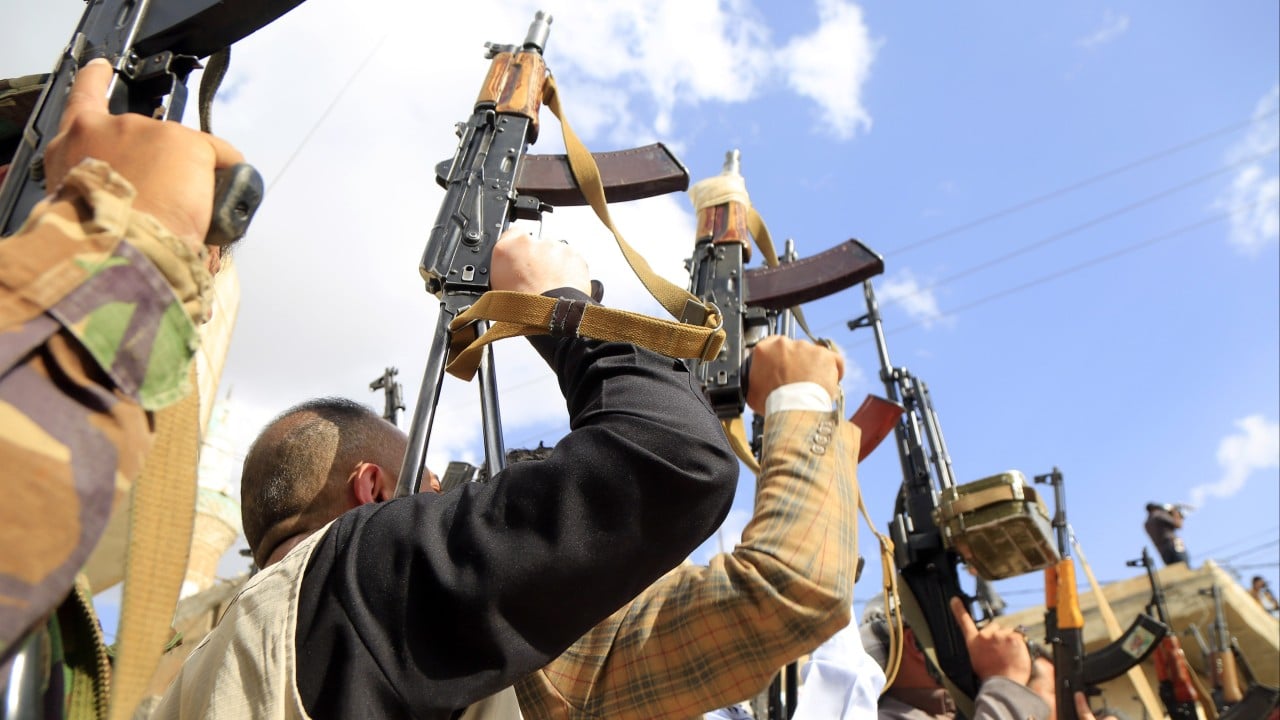
The global energy market is currently ignoring a mathematical certainty regarding Middle Eastern logistics. While headlines focus on the immediate exchange of fire between Israel and Iranian proxies, a far more surgical threat is maturing in the Yemeni highlands. The Houthi movement, officially known as Ansar Allah, has moved beyond opportunistic harassment of container ships. They are now signaling a strategic pivot toward the systematic dismantling of Saudi Arabia’s oil export infrastructure. This isn't just about regional spite. It is a calculated attempt to break the financial backbone of the Saudi Vision 2030 initiative by proving that the Kingdom’s "safe" transit routes are anything but secure.
For decades, the Saudi strategy relied on the East-West Pipeline. This massive 745-mile artery was designed specifically to bypass the Strait of Hormuz, allowing crude to flow from the Eastern Province to the Red Sea port of Yanbu. The logic was simple: if Iran closed the Persian Gulf, the Kingdom could still supply the West. But the Houthis have effectively inverted that logic. By establishing a persistent strike zone in the southern Red Sea and the Bab al-Mandab Strait, they have turned the Saudi "escape hatch" into a bottleneck.
The Geography of Vulnerability
The threat to Saudi oil exports is often mischaracterized as a simple matter of ship-to-ship missiles. It is deeper than that. To understand the risk, one must look at the topography of the Petroline. The infrastructure is static. It is a collection of pump stations and storage tanks that are easily tracked via commercial satellite imagery.
In 2019, the Houthis demonstrated their ability to hit these inland targets using long-range suicide drones. At the time, the world viewed it as a one-off provocation. Today, the technological gap has closed. The proliferation of Iranian-designed components has allowed the Houthis to mass-produce precision munitions that cost a fraction of the Patriot missiles used to intercept them. This creates a war of attrition where the defender loses money even when they successfully stop an attack.
The Myth of the Yanbu Safety Net
Yanbu was supposed to be the crown jewel of Saudi energy security. Instead, it is now within the "Red Zone" of Houthi flight paths. If the Houthis follow through on their threats to sever exports, they won't necessarily target the tankers themselves—at least not exclusively. They will target the loading terminals and the desalination plants that provide the water necessary for the industrial processes surrounding oil refinement and transport.
Without those terminals, the oil remains stuck in the desert. The Kingdom’s daily export capacity of roughly seven million barrels rests on a fragile web of coastal facilities that were never built to withstand a sustained, multi-domain siege.
The Economic Leverage of Chaos
The Houthis are not acting in a vacuum. Their threats serve a dual purpose for Tehran. First, they provide Iran with "plausible deniability" while exerting pressure on Riyadh to finalize a permanent ceasefire in Yemen on terms favorable to the Houthi leadership. Second, it keeps the global oil price floor high, providing a much-needed revenue stream for an Iranian economy battered by sanctions.
Saudi Arabia is in a bind. Crown Prince Mohammed bin Salman needs stability to attract the foreign direct investment required to diversify the Saudi economy. Investors hate rockets. Even if the actual damage to oil flow remains minimal, the insurance premiums for vessels docking at Saudi Red Sea ports have climbed significantly. This "war risk" surcharge is a silent tax on Saudi crude, making it less competitive compared to barrels coming out of West Africa or the United States Gulf Coast.
A Failure of Western Deterrence
Operation Prosperity Guardian, the U.S.-led maritime coalition, has struggled to find a permanent solution. The reason is simple: you cannot solve a land-based problem with a purely sea-based solution. Intercepting drones at sea is a reactive tactic. To truly secure the oil flow, the coalition would need to degrade Houthi launch capabilities deep inside Yemeni territory, a move that risks reigniting a full-scale regional war that no one in Washington or Riyadh currently wants.
The Houthis know this. They are exploiting the West's fear of escalation. By threatening Saudi exports, they are essentially taking a hostage that the global economy cannot afford to lose. If Saudi exports were to drop by even 15% due to terminal damage or a total blockade of the Bab al-Mandab, the $100 barrel of oil would become a permanent reality rather than a temporary spike.
The Logistics of a Blockade
A formal blockade by a navy is an act of war. A "de facto" blockade by a non-state actor using asymmetric tools is a legal and military gray area. The Houthis do not need to sink every tanker. They only need to sink one every month.
The psychological impact on Greek and Chinese ship owners—who handle a massive portion of the world's chartered tonnage—cannot be overstated. When a captain perceives a route as "non-insurable," that route effectively ceases to exist. We are seeing a realignment of global trade where the Cape of Good Hope is no longer an alternative, but a requirement. This adds 10 to 14 days to a round trip, tying up global tanker capacity and squeezing the supply chain until it cracks.
The Chinese Factor
One of the most overlooked elements in this escalation is the role of Beijing. China is the primary customer for both Iranian and Saudi oil. Up until now, the Houthis have largely spared Chinese-flagged vessels, but as the conflict intensifies, the risk of "friendly fire" or accidental targeting increases.
If the Houthis actually cripple Saudi export infrastructure, they risk alienating their patron's biggest customer. However, the Houthi leadership has shown a persistent streak of independence from Tehran. They have their own domestic agenda, and if they feel that threatening Saudi oil is the only way to secure their survival and legitimacy at home, they will pull the trigger regardless of the geopolitical fallout in Asia.
Modern Siege Warfare
The weapons being used in this theater represent a fundamental shift in how wars are fought over resources. We are moving away from the era of massive naval blockades toward the era of "distributed denial of access."
- Loitering Munitions: Small, cheap drones that can circle a target area for hours before striking.
- Anti-Ship Ballistic Missiles: A capability previously reserved for superpowers, now being fired from mobile launchers hidden in Yemeni caves.
- Underwater Unmanned Vehicles (UUVs): The next frontier in the Houthi arsenal, capable of targeting the subsea pipelines and fiber optic cables that run along the Red Sea floor.
The Saudi response has been a mix of diplomatic maneuvering and frantic upgrades to their air defense "bubble" around key sites like the Ras Tanura and Abqaiq facilities. But defense is always more expensive than offense. The Kingdom is spending millions to shoot down drones that cost $20,000.
The Internal Saudi Pressure
Inside Riyadh, the mood is one of calculated frustration. The government has spent billions on a "Yemenization" of their security posture, trying to build a buffer zone that clearly isn't working. The threat to oil exports isn't just a threat to the budget; it's a threat to the social contract. The Saudi population has been promised a future of high-tech cities and global tourism. That vision relies on the world viewing the Arabian Peninsula as a stable hub.
The Houthis are effectively holding a match to that vision. By proving they can threaten the export terminals at Yanbu or the tankers in the Jizan refinery’s waters, they are telling the world that the Kingdom’s borders are porous and its primary product is vulnerable.
Redefining Regional Security
The old security architecture—where the U.S. Fifth Fleet guaranteed the free flow of energy—is dead. The U.S. is increasingly hesitant to commit the carrier strike groups necessary for a sustained campaign in Yemen, and the regional players are beginning to realize they are on their own. This has led to a strange paradox: Saudi Arabia is simultaneously talking peace with the Houthis while bracing for the possibility that those same Houthis will destroy their most valuable assets.
The complexity of the drone swarms currently being deployed suggests a level of coordination that far exceeds what we saw only three years ago. We are looking at a battle-hardened force that has spent a decade learning how to survive the most advanced aerial bombardment in history. They aren't intimidated by Western hardware.
The Inevitability of the Strike
We must look at the incentive structures. The Houthis have realized that attacking Israel directly yields limited results due to the distance and the sophistication of the Arrow and Iron Dome systems. However, attacking Saudi oil—an "easy" target just across the border—causes immediate global ripples. It forces the international community to take Houthi demands seriously.
The threat to sever Saudi oil exports is the ultimate leverage. If the diplomatic track fails, or if the Houthis feel cornered by a lack of international recognition, the target will shift from generic merchant shipping to the specific valves and manifolds that keep Saudi crude flowing to the world.
The vulnerability of the East-West Pipeline and the Red Sea terminals is the single biggest "unpriced" risk in the current market. Traders are betting on a quick resolution or continued successful interceptions. They are ignoring the reality that in asymmetric warfare, the attacker only has to be right once. The defender has to be right every single time, 24 hours a day, across a coastline that spans over a thousand miles.
Stop looking at the missiles and start looking at the maps. The proximity of Houthi launch sites to the critical nodes of the Saudi energy machine is the only metric that matters. This is no longer a regional skirmish; it is a direct assault on the mechanics of global energy distribution, and the defenses are thinner than the Kingdom cares to admit.