A Ghost in the Machinery
The screen in the basement lab was dark, save for a few stray pixels of static. For decades, we stared into the deep ink of the universe and saw exactly what we expected to see: a vast, cold emptiness punctuated by the occasional flare of a mature galaxy. We thought we had the timeline figured out. We assumed that the monsters of the cosmos—the supermassive black holes that anchor entire civilizations of stars—took billions of years to grow, feeding slowly and methodically like ancient trees.
Then the James Webb Space Telescope (JWST) looked back.
It didn't find the orderly, predictable nursery we anticipated. Instead, it found the "Little Red Dots." They appeared on the monitors as tiny, unassuming rubies scattered across the earliest epochs of time. At first, some thought they were just distant galaxies, small and struggling to form. But the math didn't hold up. They were too bright. They were too concentrated. Most importantly, they were far too old for a universe that was supposedly still in its infancy.
These dots are the cosmic equivalent of finding a fully built skyscraper in the middle of a prehistoric forest. They shouldn't be there. Yet, there they sit, mocking our blueprints of reality.
The Weight of a Shadow
To understand why a few red pixels are causing sleepless nights for astrophysicists, you have to understand the sheer, terrifying scale of a supermassive black hole. Imagine something with the mass of millions, or even billions, of suns. It is a point of infinite density where gravity is so strong that even light, the fastest thing in existence, cannot escape its grip.
Usually, these giants are found in the centers of old, "settled" galaxies like our own Milky Way. We assumed they grew alongside their hosts. A little gas here, a stray star there—a slow, steady diet over eons.
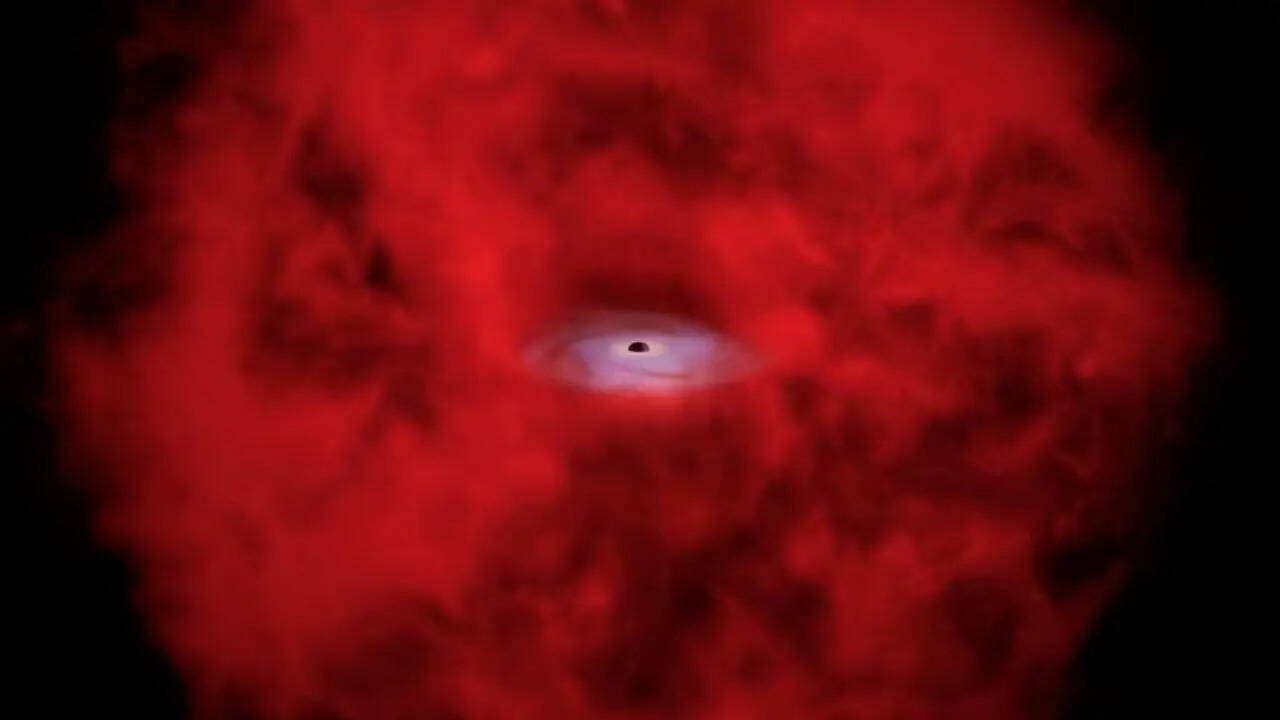
But the Little Red Dots are different. New data combining the infrared vision of the JWST with the X-ray eyes of the Chandra Observatory suggests these dots aren't just galaxies. They are cocoons. Inside them, hidden behind thick veils of celestial dust, sit supermassive black holes that are already gargantuan, despite the universe being only a fraction of its current age.
It is a biological impossibility in cosmic terms. It’s as if you walked into a nursery and found a newborn infant that already weighed two hundred pounds and spoke three languages.
The X-Ray Fingerprint
Light can be deceptive. Dust can redden a distant object, making a small star look like a massive explosion. To find the truth, researchers had to look for the "scream" of matter being torn apart. When a black hole feeds, the gas spiraling into the abyss heats up to millions of degrees, releasing high-energy X-rays.
Chandra caught those X-rays.
The detection confirmed that these weren't just dusty clusters of stars. The energy output was unmistakable. Something massive was eating, and it was eating with a ferocity we have never witnessed in the modern universe. This discovery bridges a gap that has haunted astronomy for years: how did the first black holes get so big, so fast?
The Great Cosmic Shortcut
We are currently facing a crisis of timing. In the standard model of cosmology, the universe began with the Big Bang. Shortly after, the first stars formed. These stars eventually died and collapsed into "stellar-mass" black holes—small things, maybe ten or twenty times the mass of the Sun. For one of these to grow into a supermassive giant, it would need to feed continuously at its maximum theoretical limit for billions of years.
The Little Red Dots don't have billions of years. They only had a few hundred million.
This suggests that the universe didn't start with small seeds. It suggests a shortcut. Scientists are now forced to consider "Direct Collapse." In this scenario, massive clouds of gas in the early universe didn't bother forming stars at all. Instead, the entire cloud—vast enough to swallow a thousand solar systems—simply gave up under its own weight and collapsed directly into a massive black hole.
They were born big.
It changes the narrative of our origins. If the anchors of galaxies were formed through sudden, violent collapses rather than slow growth, then the structure of everything we see today—every star, every planet, every carbon atom in your body—was dictated by these early, invisible heavyweights.
The Human Side of the Lens
It is easy to get lost in the numbers. We talk about parsecs, solar masses, and redshift values as if they are tangible things. But for the men and women sitting in windowless rooms in Baltimore or Munich, the Little Red Dots represent a profound moment of vulnerability.
There is a specific kind of silence that falls over a room when a piece of data contradicts a career’s worth of work. It’s not a Hollywood moment of "Eureka!" It’s a slow, sinking realization that the map you’ve been using to navigate the dark is missing an entire continent.
One researcher described the feeling of looking at the JWST data as "vertigo." You are looking at light that has traveled for over 13 billion years. By the time that light reached the telescope's golden mirrors, the stars that emitted it were long dead. The black holes that created those X-rays have likely merged with others, growing into even larger monsters or drifting into the lonely corners of a cooling universe.
We are looking at ghosts. But these ghosts have the power to dismantle our understanding of physics.
Why It Matters to the Rest of Us
You might wonder why we spend billions of dollars to find red dots in a void that has no impact on our daily lives. The answer isn't in the physics; it's in the lineage.
Everything we are is a result of the universe's early architecture. If those black holes hadn't formed the way they did, galaxies might not have coalesced. Stars might have drifted apart instead of clustering into the shimmering islands we see at night. The Sun, the Earth, and the very chemical bonds that hold your DNA together are the leftovers of a process that started with those red pinpricks.
We are investigating the foundations of the house we live in. Currently, we’ve just discovered that the foundation is made of a material we didn't know existed.
The Invisible Stakes
The hunt is now shifting. Every time JWST pivots to a new patch of sky, it risks finding something even more impossible. The synergy between infrared and X-ray observations has opened a door that cannot be closed. We are no longer just cataloging stars; we are witnessing the raw, unrefined power of a universe that was much more efficient at creating chaos than we ever gave it credit for.
There is a persistent myth that science is a steady climb toward total knowledge. In reality, it’s more like stumbling through a dark mansion. Every time we think we’ve found the light switch, the room gets bigger.
The Little Red Dots are a reminder of that expansion. They are the friction between what we know and what actually is. They represent the beautiful, terrifying fact that the universe is under no obligation to make sense to us.
As we peer deeper into the infrared glow, we aren't just looking for black holes. We are looking for the moment the lights turned on. We are looking for the "Direct Collapse" that set the stage for everything that followed. And in those tiny, blood-red smears of light, we are seeing the violent, brilliant birth of the reality we now call home.
The pixels on the screen are no longer static. They are a heartbeat. A very old, very heavy heartbeat, pulsing from a time when the universe was small, hot, and full of monsters that grew up much too fast.