A standard bucket of water-based trade paint holds about five liters. When mixed with the right amount of pigment, it takes on the exact visceral shade of arterial blood. For five years, the activist group Palestine Action used this substance to coat the glass facades, concrete steps, and security gates of British defense contractors. The act of throwing it was designed to be loud, messy, and fundamentally impossible to ignore.
On a rainy morning in London, that red residue has hardened into something far more permanent than a stain on a corporate wall. It has become a line in the sand of British constitutional law.
The Court of Appeal has ruled that the government’s decision to ban Palestine Action under the Terrorism Act 2000 was entirely lawful. In a sweeping decision led by Lady Chief Justice Sue Carr, a five-judge panel overturned a previous High Court ruling that had briefly thrown the ban into question. The verdict does not just change how one specific group operates. It reshapes what it means to dissent in the modern world.
Consider the reality of this transition. Yesterday, an individual carrying a bucket of paint or a pair of bolt cutters near a weapons factory faced charges of criminal damage or aggravated trespass. Today, that same individual, by virtue of their affiliation with Palestine Action, is legally classified in the same category as members of Al-Qaeda or ISIS. Supporting them, funding them, or simply holding a sign bearing their name carries a maximum prison sentence of fourteen years.
The legal machinery of a state does not move in a vacuum. It reacts to friction. To understand how a direct-action group targeting factory roofs became a prohibited terrorist organization, one has to look at the slow, steady escalation between the state and the street.
The Chemistry of Disruption
For years, the UK's defense industrial base operated in relative obscurity. Factories tucked into industrial estates across the Midlands and the South West quietly manufactured the sensors, components, and high-tech targeting systems utilized by modern militaries across the globe. To the average passerby, these were just gray buildings with high fences.
Then came the activists. Palestine Action did not rely on traditional marches or petitions. They targeted factories owned by companies like Elbit Systems, Israel's largest private defense contractor. Their tactics were blunt. They scaled roofs, chained themselves to assembly lines, shattered windows, and poured gallons of red paint down the sides of buildings to symbolize the human cost of the weaponry produced inside.
To the defense firms and the Ministry of Defence, this was not political expression. It was an expensive, dangerous campaign of economic sabotage that threatened national security and corporate supply chains. To the activists, it was a moral imperative, a desperate bid to throw a wrench into the machinery of global warfare.
But the state has a long memory and an incredibly broad set of tools. When ordinary public order laws failed to deter the disruptions, the Home Office turned to a piece of legislation drafted at the turn of the millennium: the Terrorism Act 2000.
The statutory definition of terrorism in the United Kingdom is intentionally vast. Under the text of the Act, an action qualifies as terrorism if it involves serious damage to property, is designed to influence a government or intimidate the public, and is carried out for a political, religious, or ideological cause.
Think about that definition for a moment. It is so wide that a strict reading could encompass a broad swath of historic protest movements, from the Suffragettes to the anti-apartheid activists of the 1980s. For decades, legal scholars argued that this overbreadth was kept in check by prosecutorial discretion. The government, the theory went, would know the difference between a political vandal and a genuine threat to human life.
That assumption evaporated in July 2025, when the Home Office officially proscribed Palestine Action, making it the first direct-action protest group in modern British history to be banned under counter-terrorism laws.
The Reversal at the Strand
The legal battle that culminated in the Court of Appeal was essentially an argument about proportion.
In February, three senior judges at the High Court took a look at the government's ban and shook their heads. They ruled that the proscription was unlawful and disproportionate. They noted that out of hundreds of protests, demonstrations, and direct actions organized by the group, only three isolated incidents technically met the statutory threshold for a terrorism charge. The rest was ordinary, albeit aggressive, civil disobedience. Banning the entire movement, the High Court argued, was like using a sledgehammer to swat a fly, causing severe and unjustifiable damage to fundamental rights of free speech and assembly.
But that victory was fleeting. The government appealed, and the higher court viewed the exact same landscape through a completely different lens.
Lady Chief Justice Carr made the court's position clear. Palestine Action, she stated, was not a traditional civil disobedience group. She described them as a covert organization operating through secret cells to systematically destroy property and evade law enforcement. The court ruled that the Home Secretary is uniquely positioned, guided by counter-terrorism experts, to assess future threats to national security and public safety. In the eyes of the law, the potential risk to third-party property and corporate infrastructure outweighed the rights of individuals to gather under the group's banner.
The ruling establishes a profound precedent. It means that the state no longer needs to prove a group poses a risk to human life to invoke its ultimate domestic weapon. Systematic, ideologically driven property damage is now officially enough to justify the total erasure of an organization from civil society.
The Ripple on the Pavement
Away from the mahogany benches of the Court of Appeal, the human mechanics of this legal shift are already playing out on the streets.
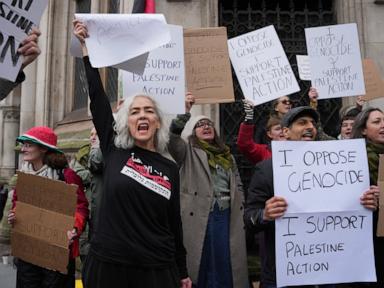
Since the ban was first introduced, the police have arrested thousands of people during demonstrations. Many of these individuals were not scaling roofs or breaking windows. They were arrested for holding signs that read, "I oppose genocide, I support Palestine Action."
Imagine the sheer confusion of a young activist or an elderly protestor who stepped onto a sidewalk to voice dissent, only to find themselves processed under laws originally designed to stop suicide bombers. Over seven hundred people have been charged under the Terrorism Act in connection with these protests. While convictions are still winding their way through the court system, the immediate consequence is a chilling effect that extends far beyond one specific cause.
Just last week, four activists convicted of criminal damage at an Elbit Systems facility were sentenced using specific terrorism provisions, adding years to their prison terms. The jury that convicted them of breaking windows was never told they were being tried under a terrorism framework until after the verdict was delivered.
This is where the abstract arguments of constitutional lawyers hit the cold concrete of reality. The boundary between a radical protester and a terrorist has been blurred, possibly forever.
Huda Ammori, the co-founder of the group who initiated the legal challenge, has vowed to take the fight to the Supreme Court and, if necessary, the European Court of Human Rights. She calls the ruling one of the most extreme attacks on free speech in modern British history. The government, conversely, views it as a vital restoration of order, a clear signal that political conviction does not grant a license to systematically destroy private property and disrupt vital national industries.
The legal battle will continue, but the immediate reality is stark. The red paint has dried, the cell doors have turned, and the definition of what is permissible in the pursuit of political change has shrunk a little further into the dark.