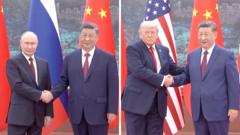
Beijing does not orchestrate diplomatic theater by accident. When Donald Trump and Vladimir Putin arrived in the Chinese capital within days of each other, the visual similarities were striking. Both men walked down red carpets, looked at rows of precisely aligned military honor guards, and listened to children chanting rehearsed greetings. Yet beneath this carefully managed spectacle lay a stark divergence in geopolitical reality. The Chinese leadership is playing two entirely different games with Washington and Moscow, using the same ceremonial backdrop to mask fundamentally mismatched agendas.
The superficial media focus on runway handshakes misses the structural machinery of Chinese diplomacy. For Trump, the pageantry serves as a tactical cushion to absorb shock and manage an unpredictable adversary. For Putin, the presentation represents an ideological alignment aimed at rewriting global governance. Understanding how Beijing differentiates between these two leaders requires looking past the standard state television footage and examining the cold calculus of trade, territory, and technological survival.
The Tarmac Calculus
Diplomatic protocol in China is a rigid language where the rank of an airport greeting official signals the exact temperature of a bilateral relationship. When Trump landed, he was met by Vice President Han Zheng. On paper, this was an upgrade from his 2017 arrival, when a lower-ranking state councillor met him on the tarmac. This elevation was a deliberate Chinese effort to flatter a American president known to value personal respect and grand gestures. It was a calculated investment in bilateral stability at a time when global commerce is highly volatile.
Putin, arriving immediately afterward, was met by Foreign Minister Wang Yi. While Wang holds a lower formal state rank than Vice President Han, he is a member of the elite 24-person Politburo. More importantly, Wang is the architect of China's aggressive global diplomacy. The choice of Wang Yi was not a downgrade for Putin. It was a signal of operational intimacy. Beijing sent a seasoned geopolitical strategist to meet a wartime ally, rather than a ceremonial state representative.
The underlying differences became clearer during the opening statements inside the Great Hall of the People. The language used for each leader revealed the structural boundaries of their respective relationships.
- The Message to Trump: Xi Jinping used guarded, conditional language. He noted that the United States and China should be partners rather than rivals. He explicitly raised the issue of Taiwan, calling it a highly dangerous flashpoint if mishandled. The tone was professional, transactional, and cautionary.
- The Message to Putin: Xi used emotional, historical prose. He described the partnership with Moscow as unyielding and asserted that both nations upheld international fairness and justice. Putin responded in kind, using traditional idioms to describe their closeness.
Transaction Versus Alliance
The true disparity between the two visits is found in the substance of the bills signed and the agreements reached behind closed doors. Trump’s agenda was defined by immediate economic transactions and crisis management. The primary achievements included a Chinese commitment to purchase 200 Boeing aircraft and discussions regarding energy transit security through the Middle East. These are classic transactional wins. They are tangible, easily quantifiable, and designed to satisfy domestic audiences back home, but they do not alter the competitive dynamic between Washington and Beijing.
Putin’s meetings focused on long-term structural integration. The discussions centered on the Power of Siberia 2 gas pipeline, a project designed to permanently reroute Russian energy infrastructure away from European markets and toward the Chinese mainland. China also granted visa-free entry for Russian citizens, a move that encourages deeper integration between the two societies.
+------------------------+-------------------------------------+-------------------------------------+
| Metric                 | Donald Trump's Visit                | Vladimir Putin's Visit              |
+------------------------+-------------------------------------+-------------------------------------+
| Primary Greeting       | Vice President Han Zheng            | Foreign Minister Wang Yi (Politburo)|
| Core Strategic Focus   | Tariff management & trade deals     | Structural economic integration     |
| Notable Outcome        | Purchase agreement for 200 Boeing   | Progress on Power of Siberia 2      |
| Rhetorical Tone        | Guarded, warning on flashpoints     | Ideological partnership alignment   |
+------------------------+-------------------------------------+-------------------------------------+
This contrast demonstrates China's dual approach to the current world order. Beijing treats its relationship with the United States as a high-stakes commercial rivalry that must be managed to avoid open conflict. It treats the relationship with Russia as a strategic buffer against Western pressure.
The Limits of the Unyielding Partnership
It is easy to misinterpret the warmth shown to Putin as a blank check from Beijing. That would be an error. China's embrace of Russia is deeply pragmatic and limited by its own economic self-interest.
China remains heavily integrated into the global financial architecture. Its banks and major corporations are deeply exposed to Western consumer markets, making them cautious about triggering secondary sanctions by providing direct military assistance to Moscow. Xi Jinping wants a weakened, dependent Russia that provides cheap oil and gas, but he cannot afford to completely sever economic ties with Europe and North America to achieve that goal.
During his meetings with Trump, Xi made sure to keep channels open on key global issues, including energy security and trade stability. This dual strategy shows that Beijing is not interested in forming a rigid Cold War-style bloc that cuts off the West. Instead, China uses its relationship with Russia to gain leverage over the United States, while using its discussions with Washington to preserve the economic stability it needs to grow.
Theater as Statecraft
The red carpet treatment extended to both Donald Trump and Vladimir Putin confirms that protocol remains a powerful tool in Chinese foreign policy. Pageantry is used to disarm rivals and reassure allies.
By treating Trump with imperial-level pomp at historical sites like the Temple of Heaven, Beijing sought to reduce the likelihood of sudden tariff escalations or unpredictable diplomatic maneuvers. By greeting Putin with ideological warmth, China signaled its commitment to a multi-polar world where Western influence is balanced by regional partnerships.
The critical lesson from these back-to-back visits is that identical diplomatic imagery can carry entirely opposite meanings. The red carpets were the same, but the strategic trajectories could not be further apart. Trump walked away with commercial concessions meant to stabilize an adversarial relationship. Putin departed with structural agreements designed to deepen an enduring strategic alignment. For Beijing, both outcomes represent a successful execution of a foreign policy meant to balance competing global powers.


