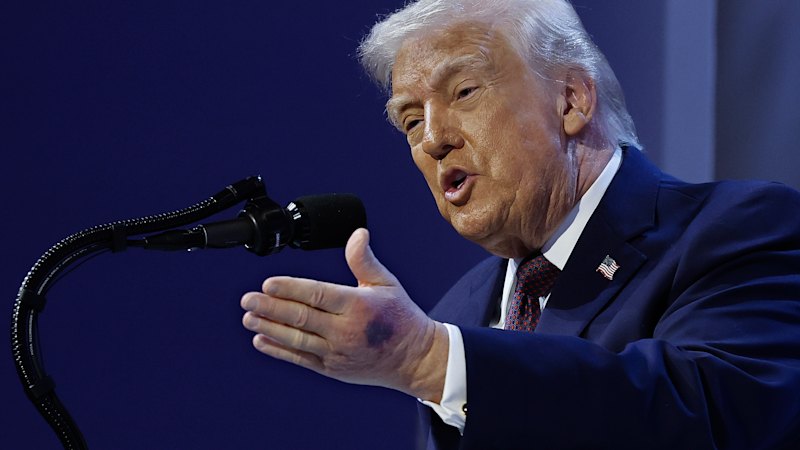
White House medical summaries are not genuine clinical records. They are carefully engineered piece of political theater designed to project invulnerability. This week, Donald Trump returns to Walter Reed National Military Medical Center for his third major medical checkup in just thirteen months. The White House insists this visit is a routine annual medical and dental assessment, but the sheer frequency of these trips tells a vastly different story. For an administration trying to project absolute vigor, the rapid succession of hospital visits indicates that managing the health of the oldest president in American history has become a constant, high-stakes operation.
Public scrutiny has intensified due to visible physical signs. Observers have repeatedly noted distinct swelling in the president's lower limbs and unusual bruising on his hands. While the press office bats away inquiries by pointing to a brief, three-page medical memo from last autumn that declared Trump to be in exceptional health, independent medical experts are looking past the adjectives. The reality of presidential medicine is that the public only sees what the political apparatus allows them to see.
The Anatomy of the Selective Medical Disclosure
Under the current system, a sitting commander-in-chief possesses total authority over their own medical data. The White House physician, despite holding military rank, operates under a unique conflict of interest. They are a doctor treating a patient, but they are also a subordinate reporting to a commander who can reassign them at a moment's notice. Consequently, the letters released to the press corps read less like diagnostic charts and more like corporate press releases.
The diagnostic history released over the past year illustrates this pattern perfectly. Last summer, after intense speculation regarding his physical stamina, the White House admitted Trump had been diagnosed with chronic venous insufficiency. This condition occurs when the tiny, one-way valves inside the leg veins weaken, causing blood to pool in the lower extremities instead of flowing efficiently back to the heart.
[Image of chronic venous insufficiency]
The administration immediately downplayed the diagnosis, framing it as a minor issue common among older adults. They paired the announcement with a reminder that the president had previously scored a perfect 30 out of 30 on the Montreal Cognitive Assessment. This classic public relations tactic pairs a negative physical update with an enthusiastic mental health endorsement to neutralize the political damage.
Reading Between the Lines of the Walter Reed Timeline
The frequency of the current medical schedule undermines the official narrative of routine maintenance. Trump underwent a full annual physical in April 2025. By October 2025, he was back at Walter Reed for what was initially labeled a routine yearly checkup, despite occurring only six months after the previous one. When pressed on the timeline, Trump shrugged it off to reporters as a semiannual physical.
Months later, the administration quietly acknowledged that the October trip included an advanced CT scan of the president's cardiovascular and abdominal systems. This sequence of events reveals a predictable pattern of crisis management.
- Step One: A medical anomaly or symptom becomes visible to the press corps or public.
- Step Two: A sudden, unannounced or accelerated hospital visit occurs under the guise of preventive care.
- Step Three: Weeks or months later, specific diagnostic tests are acknowledged only after independent journalists obtain leaks or ask highly specific questions.
- Step Four: The administration releases selected statistics, such as low cholesterol levels or weight loss, to shift the media narrative back to physical vitality.
This cycle is not unique to the current administration. Historically, White House medical teams have gone to extraordinary lengths to hide the physical decline of sitting executives. Grover Cleveland underwent secret surgery on a friend's yacht to remove a cancerous tumor from his jaw. John F. Kennedy's severe battle with Addison's disease was hidden behind a wall of denials and heavily medicated public appearances. The modern iteration of this deception simply uses sophisticated medical jargon and selective data points to achieve the same result.
The Physical Realities of the Eighty Year Old Executive
Cardiologists who evaluate the public data note that while specific numbers appear favorable, the broader picture requires careful monitoring. The president's official weight was listed last year at 224 pounds, reflecting a twenty-pound reduction from his 2020 baseline. His lipid panel showed an LDL cholesterol level of 51 mg/dL, which is considered optimal. This low number is achieved through an aggressive daily regimen of Rosuvastatin and Ezetimibe, paired with a preventive dose of daily aspirin.
Maintaining these metrics becomes significantly more complex as a patient approaches age eighty. Chronic venous insufficiency might not be inherently life-threatening, but it requires active management to prevent complications like skin ulcerations or deep vein thrombosis. The standard medical protocol involves prolonged leg elevation, the consistent use of heavy compression garments, and regular physical movement. For a president engaged in grueling international summits and lengthy domestic schedules, the opportunities to elevate one's legs above heart level are virtually non-existent.
Furthermore, outside specialists point out that advanced imaging like a coronary CT calcium scan provides a clearer picture of long-term risk than basic cholesterol scores. A high calcium score indicates the presence of plaque within the coronary arteries, a condition that requires continuous monitoring regardless of how low a medication pushes the patient's circulating LDL levels. The White House medical unit has never disclosed the specific results of the president's historical calcium scoring, choosing instead to issue generalized statements regarding normal heart function.
The Illusion of the Outdated Cognitive Score
Political allies frequently point to past cognitive screenings as definitive proof of executive readiness. During a recent media appearance, officials noted that external advisers had reviewed the president's historical files and praised his mental acuity. These claims rely heavily on the Montreal Cognitive Assessment administered during his previous term and repeated in early 2025.
Neurologists routinely emphasize that a cognitive screening test is a snapshot, not a permanent certificate of health. The test is designed to detect obvious impairment, not subtle, age-related executive decline. Passing a basic screening test years ago offers zero predictive value regarding a patient's neurological state today. In geriatric medicine, cognitive capabilities can shift over the course of twelve months, particularly when a patient is subjected to the acute sleep deprivation and chronic psychological pressure inherent to the presidency.
The institutional problem is that the American public possesses no mechanism to compel a transparent medical review. Independent panels of non-military physicians have been proposed for decades to conduct objective annual assessments of sitting presidents. These proposals are invariably blocked by both major political parties, each eager to protect their own leaders from genuine medical scrutiny.
The upcoming visit to Walter Reed will undoubtedly yield another signed memorandum from the White House physician declaring the president fully fit for duty. The document will list optimal vital signs and repeat well-worn phrases about an active lifestyle. Experienced observers will watch the footage of the arrival and departure, looking closely at the gait, the posture, and the hands. The true condition of the president will remain hidden within the secure wings of the military hospital, obscured by a political apparatus that views medical transparency as an unacceptable national security risk.