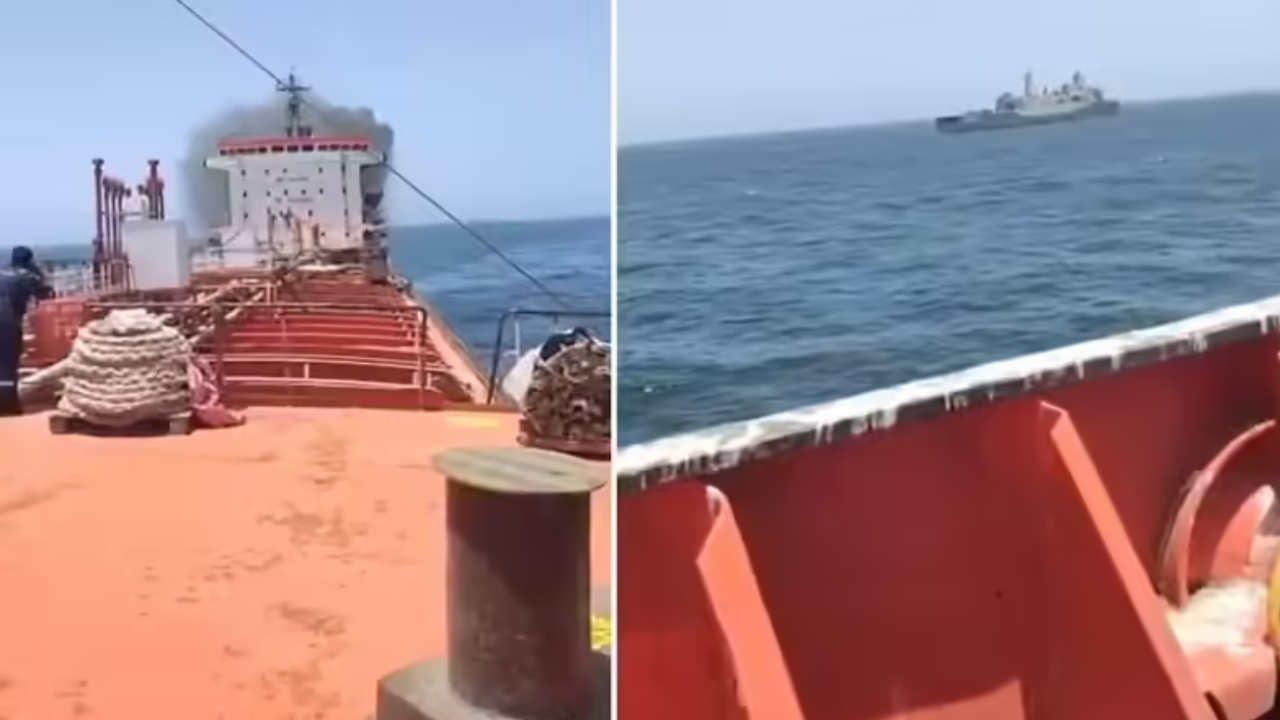
A U.S. Navy F/A-18 Super Hornet launched from the USS Abraham Lincoln and fired a precision-guided munition directly into the engineering and steering spaces of the Palau-flagged oil tanker MT Marivex. The strike, which took place in international waters within the Gulf of Oman, disabled the ship’s propulsion system and triggered a severe onboard fire. All 24 crew members, all Indian nationals, were successfully evacuated with the assistance of Omani and Indian naval forces. U.S. Central Command confirmed the kinetic action, stating the unladen vessel had repeatedly defied radio orders and maneuvered to run an ongoing maritime blockade against Iranian ports.
While initial reports frame this as a standard, albeit dramatic, enforcement of maritime sanctions, the reality is far more complex. This kinetic engagement marks an aggressive escalation in how the U.S. military polices the seas, transitioning from economic containment to active warfare against the merchant fleet.
Inside the Kinetic Shift in Maritime Sanctions Enforcement
For years, the global shipping industry viewed the Office of Foreign Assets Control blacklists as a regulatory headache. It meant compliance paperwork, legal risks, and potential bans from Western banking systems. It did not mean dodging precision-guided munitions from American fighter jets.
The targeting of the MT Marivex changes that calculation completely. The vessel was not carrying cargo; it was unladen, heading toward an Iranian port to likely load crude. According to maritime tracking data and regional intelligence sources, the ship had spent several days attempting to outmaneuver U.S. naval warnings. It turned back three times before making a final run through Omani territorial waters with its automatic identification system transponders switched off.
The U.S. military did not wait for the vessel to load or enter Iranian waters. By striking the steering and engineering compartments, the Navy neutralized the ship's physical capability to move without sinking it. This surgical kinetic intervention is a stark departure from standard maritime interdiction, which traditionally relies on boardings, inspections, and legal seizures.
The Shadow Fleet and the Limits of Bureaucracy
The MT Marivex is part of what the shipping industry calls the dark fleet or shadow fleet. These are aging vessels, often operating under flags of convenience like Palau, Gabon, or St. Kitts and Nevis, owned by opaque shell companies designed to hide their true beneficiaries. They exist for a single purpose: to transport sanctioned oil from regimes like Iran and Russia to buyers willing to look the other way.
Paper sanctions have failed to stop this trade. When the U.S. blacklists a hull, the owners simply change the ship's name, register it under a new shell corporation, and continue operations.
Shadow Fleet Evasion Tactics:
1. Frequent flag hopping (changing national registries)
2. Spoofing or disabling AIS transponders
3. Ship-to-ship transfers in international waters
4. Using unrated, obscure maritime insurance providers
By deploying an F/A-18 to physically destroy a ship's rudder and engines, the U.S. is signaling that corporate obfuscation no longer provides protection. If Washington cannot stop a ship through the courts or the banks, it will stop it with a missile.
The Collateral Cost of Maritime Brinkmanship
While the U.S. military achieved its tactical objective—the Marivex is no longer sailing to Iran—the strategic fallout is growing. The immediate victims of this economic proxy war are not the billionaire owners hiding behind shell companies, but the merchant mariners who staff these vessels.
The 24 Indian seafarers aboard the Marivex found themselves in the crosshairs of a geopolitical conflict they had no part in making. The maritime union movement has raised immediate alarms over the incident. The Forward Seamen’s Union of India had issued urgent appeals for assistance just hours before the strike as tensions climbed.
While New Delhi has chosen not to publicly condemn the U.S. airstrike, focusing instead on praising the swift rescue operation by Omani authorities, the underlying anger in diplomatic corridors is palpable. India relies heavily on its vast diaspora of merchant mariners, who dominate the global commercial shipping workforce. Treating civilian-crewed merchant vessels as legitimate military targets, even those violating blockades, sets a terrifying precedent for international trade.
The Broader Middle East Blockade
The strike on the Marivex cannot be viewed in isolation. It is part of an aggressive, undeclared maritime blockade managed by U.S. Central Command amid the broader regional escalation involving Israel and Iran.
According to recent operational data released by CENTCOM, the military has intercepted or interacted with hundreds of vessels in these waters over the last two months.
| Actions Taken | Number of Vessels |
|---|---|
| Non-compliant vessels physically disabled | 7 |
| Ships redirected after complying with orders | 134 |
| Humanitarian aid vessels permitted transit | 42 |
These numbers reveal a massive, systematic naval operation designed to choke off Iran's economic lifeline completely. The use of physical force against a commercial hull shows that the U.S. is willing to risk environmental disasters and international diplomatic friction to enforce its red lines. The Marivex caught fire after the strike, and while no major oil spill occurred because the tanker was empty, an identical strike on a fully laden vessel would devastate the marine ecosystem of the Gulf of Oman.
The shipping industry must now adapt to a reality where international waters are no longer neutral territory for commerce. Insurers are already recalculating risk premiums for the region, and major maritime hubs are bracing for the reality that a blacklisted hull is now a kinetic target.