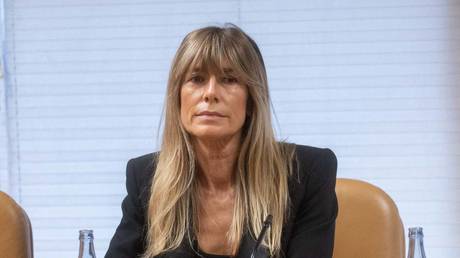
A Madrid judge ordered Begoña Gómez, the wife of Spanish Prime Minister Pedro Sánchez, to stand trial on a sweeping indictment of business corruption, influence peddling, and the embezzlement of public funds.
The judicial decree went far beyond a mere scheduling order. Magistrate Juan Carlos Peinado stripped Gómez of her passport, explicitly banned her from leaving Spain, and ordered her to report to a courthouse twice a month.
The decision has immediate, severe consequences for the stability of Sánchez’s fragile minority coalition government. The prime minister’s defenders have already denounced the move as an unprecedented overreach by a highly politicized wing of the Spanish judiciary.
The escalation has effectively shattered the political equilibrium in Madrid, pushing a long-simmering battle between the executive branch and the courts into open constitutional warfare.
To understand how a European democracy arrived at a point where the premier’s spouse is treated as a flight risk by her own country’s legal system, it is necessary to parse the mechanics of the specific contracts under scrutiny.
The two-year criminal probe into Gómez does not center on briefcases of cash, but rather on the subtle, systemic mechanics of institutional access.
The prosecution’s case hinges primarily on her tenure at Madrid’s Complutense University, specifically within a master’s degree program focused on social impact and corporate initiatives.
Investigators allege that Gómez utilized her unique status and proximity to power to secure government-funded contracts for specific private entities that had actively supported her academic projects.
The concrete focus of the judicial police involves three primary public procurement contracts awarded between 2020 and 2023. These agreements, which focused on digital transformation and technical consulting, were worth millions of euros.
According to data scrutinized by investigators, the technical criteria required for the public tenders aligned with unexpected precision with the qualifications of private firms tightly intertwined with Gómez’s university department.
A critical component of the evidentiary file involves "letters of recommendation" reportedly signed by Gómez on behalf of a private enterprise managed by businessman Juan Carlos Barrabés.
Barrabés has now been formally charged alongside her. While the defense maintains these letters were merely standard, non-binding professional networking endorsements, the investigating magistrate concluded they carried the coercive weight of Moncloa Palace.
The financial roadmap used by the judicial police reveals an average 15 percent increase in the total value of these specific government contracts during the period under review.
An increase in contract pricing during an inflationary period does not inherently constitute criminal guilt. However, it provided the magistrate with the leverage needed to demand the disclosure of private bank statements and internal university communications.
The court is currently attempting to trace whether any direct or indirect financial benefit ever reached the prime minister's immediate household.
The defense strategy, backed aggressively by Sánchez and the senior leadership of the Spanish Socialist Workers’ Party (PSOE), rests on the origins of the initial criminal complaint.
The case was kicked off in early 2024 by Manos Limpias (Clean Hands), a self-styled anti-corruption pressure group with deep ties to conservative and far-right causes.
Historically, the group has utilized Spain's distinct legal mechanism known as the acusación popular (popular accusation), which allows ordinary citizens or independent organizations to initiate criminal complaints even if they are not the direct victims of the alleged crime.
Sánchez has consistently claimed that his family is the target of a coordinated media and judicial witch hunt designed to achieve through the courts what the conservative opposition failed to secure at the ballot box.
The political vulnerability for Sánchez is that this trial does not exist in a vacuum. It represents one of at least five parallel corruption inquiries currently eroding the credibility of his administration.
Next month, the prime minister’s brother, David Sánchez, is scheduled to face his own separate trial concerning influence peddling and tax anomalies linked to his appointment as a cultural director in a provincial government.
Simultaneously, the high court is aggressively pursuing a kickback scandal involving Santos Cerdán and former Transport Minister José Luis Ábalos, who was once Sánchez’s most trusted political operator.
That specific probe involves allegations of illicit commissions taken from state contracts for sanitary equipment during the height of the COVID-19 pandemic.
The legal gridlock deepens with an ongoing investigation into former Socialist Prime Minister José Luis Rodríguez Zapatero regarding allegations of money laundering and improper influence related to a €53 million state bailout awarded to Plus Ultra Airlines in 2021.
The cumulative weight of these simultaneous prosecutions has effectively paralyzed Spain’s legislative capacity. The conservative People’s Party (PP) and the right-wing Vox party have seized on the travel restrictions imposed on Gómez to demand an immediate snap general election.
Sánchez has vowed to defy the pressure and serve out his full mandate until 2027. His ability to do so depends entirely on the continued support of volatile Catalan and Basque nationalist parties, groups that are already recalculating the political cost of remaining tied to a prime minister whose inner circle is under constant judicial surveillance.
The most extraordinary development of the recent court order was the judge's formal justification for seizing Gómez’s passport.
Judge Peinado noted that because Gómez is accompanied at all times by a highly trained, state-funded police security detail, her flight risk was paradoxically elevated.
The magistrate argued that these officers, acting either on their own initiative or following conflicting orders from superiors within the executive branch, could inadvertently or intentionally facilitate a swift departure from the country.
The rationale drew an immediate, furious rebuke from Spanish police unions, who called the suggestion that professional officers would violate their constitutional oaths a profound insult to the integrity of the security forces.
The trial order has exposed a deep, ideological rift within the Spanish state apparatus itself. Minister of the Presidency and Justice Félix Bolaños took the highly unusual step of publicly condemning the court’s decision on social media, calling it a disastrous day for the legal system and an outright disgrace.
The public pushback from senior cabinet ministers against an active judicial order underlines the complete breakdown of institutional protocol between the government and the judiciary.
Spain now faces months of highly publicized pre-trial arguments that will ensure the prime minister's household remains the focal point of criminal proceedings.
The defense has five days to formally appeal the magistrate's order, a move that will push the final decision on whether to seat a jury into the autumn.
Regardless of the eventual courtroom verdict, the immediate casualty is the functioning of the state. With a premier consumed by the legal defense of his immediate family and a judiciary openly accused of running a political campaign from the bench, Spain's democratic architecture is facing its most volatile stress test since the transition to democracy.
/LouvresengchyeteoGettyImages-5a14669aaad52b00370c599e.jpg)