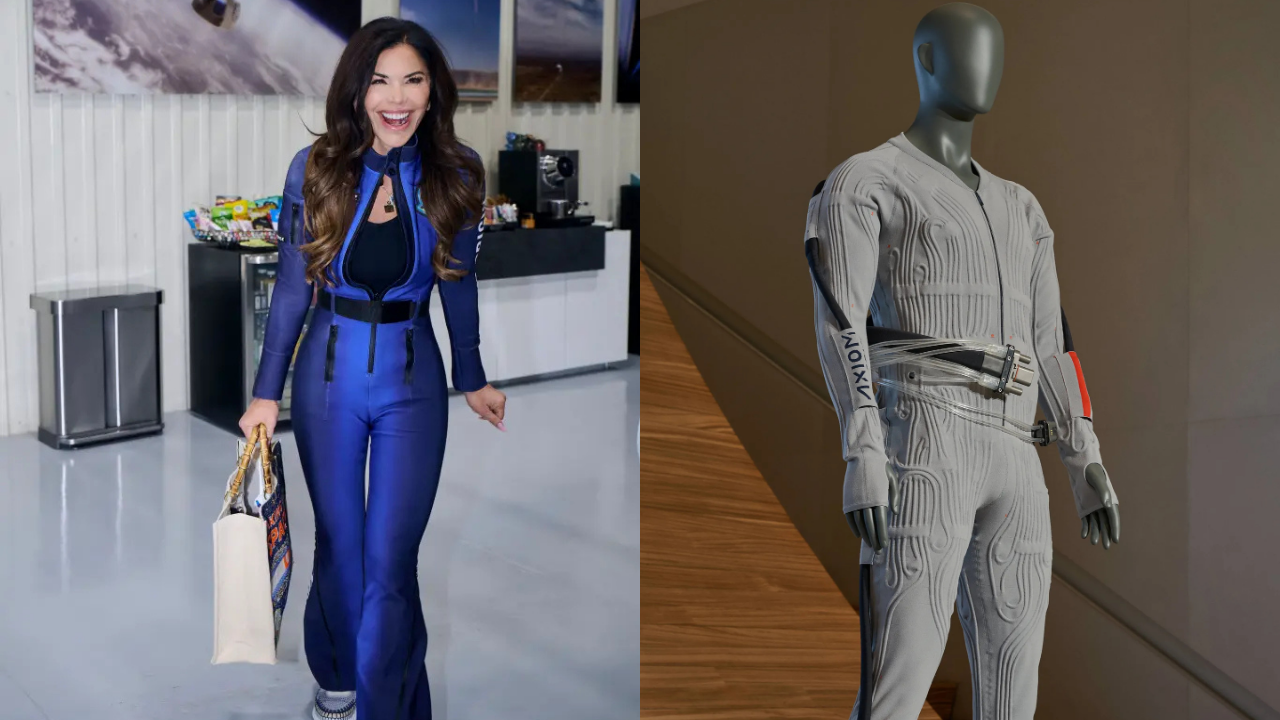
When Axiom Space and Italian luxury powerhouse Prada unveiled the inner layer of NASA’s next-generation lunar spacesuit in New York, mainstream headlines naturally swirled around the glitz of runway branding. Critics dismissed it as a supreme marketing stunt, a continuation of the high-fashion vanity projects seen during Lauren Sánchez’s recent suborbital joyride on Blue Origin wearing custom-tailored Monse flight suits. But equating a ten-minute suborbital tourist cruise to an eight-hour crewed spacewalk at the lunar South Pole is a fundamental misunderstanding of modern aerospace engineering.
NASA is not letting Prada onto the Moon for a logo placement. The reality is far grittier. Traditional aerospace defense contractors have spent decades building reliable, rigid, but notoriously unyielding hardware. They are brilliant at life support systems, but historically terrible at the complex, mobile ergonomics required for a new era of diverse astronaut bodies. By embedding Prada’s proprietary knowledge of engineered knitting and advanced textile architecture directly into the Liquid Cooling and Ventilation Garment (LCVG), Axiom Space solved a critical engineering bottleneck that legacy aerospace firms have struggled to overcome for generations.
The Ergonomic Crisis of the Lunar South Pole
To understand why a fashion house is in the room, look at the brutal physics of the upcoming Artemis missions. The Apollo missions targeted the lunar equator, exposing astronauts to relatively uniform, harsh sunlight. Artemis III and IV are targeting the lunar South Pole, an unforgiving terrain of permanent shadows and blinding sun.
An astronaut steps into a crater, and one side of their body drops to $-200^\circ\text{C}$ while the other face bakes in raw solar radiation at over $100^\circ\text{C}$.
Managing that radical thermal gradient requires an absolute masterpiece of fluid dynamics right next to the skin. The newly unveiled LCVG handles this by circulating chilled water through a network of flexible tubes mapped tightly against major muscle groups.
But a suit that cannot move is a coffin.
If a cooling garment bunches up, pinches, or shifts during an eight-hour deployment, it causes severe chafing, limits blood flow, or creates localized hot spots that can trigger thermal panic. Traditional spacesuits were essentially heavy canvas bags wrapped around rubber bladders. They were built around a default, historical male frame. When NASA had to cancel its historic all-female spacewalk in 2019 due to a lack of properly fitting medium suits, it exposed a structural flaw in how the old guard approached textile manufacturing.
Prada’s contribution isn't cosmetic trim. It is structural expertise in 3D modeling and specialized fiber selection. They brought a highly sophisticated understanding of how fabrics stretch, breathe, and retain structural integrity under continuous mechanical strain.
Why the Tech sector is Outsourcing to High Fashion
Aerospace companies excel at metal, software, and life-support loops. They use rigorous, slow-moving qualification processes that ensure safety but often stifle material innovation. Conversely, high-end textile manufacturing—spurred by the extreme performance demands of competitive yacht racing and elite athletics—has spent the last twenty years radically advancing fabric technology.
"The work we have done with Prada has taken that capability to a level we could not have achieved alone," noted Russell Ralston, Senior Vice President of Spacecraft Development at Axiom Space.
🔗 Read more: The Silent Retreat From Reading and What it Costs Us
Prada’s decades of material R&D through its Luna Rossa sailing syndicate yielded vast datasets on how synthetic fibers behave under intense moisture, friction, and environmental pressure. By utilizing engineered knitting, the joint engineering team created a highly tailored, form-fitting silhouette that maximizes skin contact with the cooling tubes without restricting the articulation of joints.
[Legacy Apollo LCVG] -------> Rigid, standard sizing, prone to shifting/chafing
[Axiom-Prada AxEMU]  -------> 3D-modeled, engineered knitting, redundant cooling loops
Furthermore, the new LCVG features a fully redundant cooling circuit. If the primary fluid loop takes hit or fails, a secondary backup system instantly takes over. It also incorporates a separate oxygen ventilation loop designed to wash fresh gas directly across the astronaut’s face to sweep away exhaled carbon dioxide before routing it to the portable life-support scrubbers.
Beyond the Billionaire Vanity Project
The comparison to Lauren Sánchez’s recent Blue Origin mission is inevitable but deeply flawed. Sánchez collaborated with New York fashion label Monse and a Hollywood special effects house to redesign the flight suits for her all-female crew. It was a historic moment that successfully highlighted the historical neglect of female proportions in aviation gear.
However, those flight suits were designed for a pressurized cabin experience. They were meant to look striking on camera and provide emergency protection in case of cabin depressurization. They were passive garments.
The Axiom Extravehicular Mobility Unit (AxEMU), featuring Prada's technical interior, is an active spacecraft shaped like a human body. It must withstand micrometeoroids, abrasive lunar dust that behaves like shards of glass, and structural vacuum.
This isn't about injecting "spice" into the space race. It is a calculated business decision by Axiom Space to utilize external commercial sectors to lower development costs and accelerate production timelines. NASA’s shift away from owning its hardware to purchasing services from commercial providers like Axiom and SpaceX has forced these companies to look outside traditional, hyper-expensive military contractors.
The Material Monopolies of the New Space Race
By relying on commercial partnerships, the aerospace industry is quietly challenging the old monopoly of defense manufacturing. Companies that spent fifty years stitching parachutes and spacesuits using legacy techniques are finding themselves outpaced by digital garment patternmaking and advanced composite weaving.
The integration of non-traditional supply chains introduces unique challenges. Merging the fast-paced, iteration-heavy culture of a luxury design house with the hyper-regulated, risk-averse environment of NASA safety qualifications is an ongoing cultural friction point. Every single thread, adhesive, and zipper pull provided by Prada’s suppliers must undergo rigorous outgassing, flammability, and structural testing in vacuum chambers. A single chemical impurity in a fiber could contaminate the pure oxygen loop of the life-support system.
The true test of this cross-industry marriage will occur when the first boots hit the lunar regolith. If the partnership proves successful, it will change the playbook for how space hardware is engineered. Future space exploration won't just look different; it will be built by companies that cut their teeth on the runway and the open ocean, proving that survival in the cosmos requires more than just heavy metal.