Every decade, a four-star general steps up to a podium in London or Washington and declares the human fighter pilot obsolete. It is a reliable ritual. It sounds bold. It gets headlines. And every single time, reality turns that prediction into expensive scrap metal.
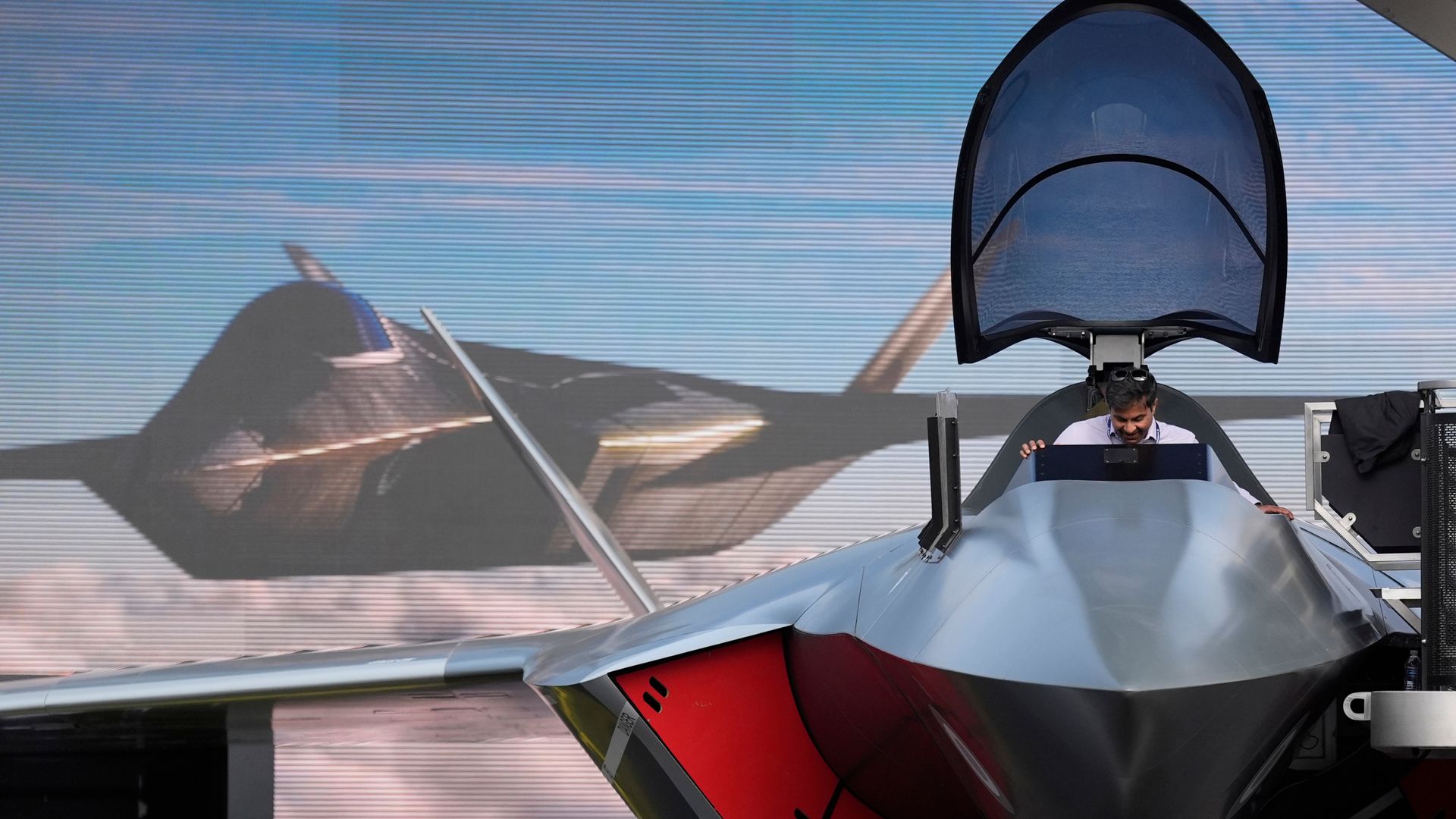
When the head of the Royal Air Force suggests that Tempest—the centerpiece of the Global Combat Air Programme (GCAP)—might be the last British fighter with a human in the cockpit, defense pundits nod along like bobbleheads. They assume the trajectory of warfare is a straight, inevitable line from manned aircraft to autonomous drone swarms.
They are wrong. Not just slightly off, but fundamentally misunderstanding the physics of modern air combat, the vulnerability of the electromagnetic spectrum, and the brutal economics of software development.
Removing the human from the tip of the spear does not make an air force smarter or cheaper. It creates a brittle, easily blinded force that collapses the exact second it meets a peer adversary who knows how to turn on a jammer.
The Myth of the Fragile Meatbag
The standard argument for ditching the pilot goes like this: human beings are heavy, expensive, and squishy. A pilot needs oxygen, pressurization, an ejection seat, and a massive cockpit canopy that ruins radar stealth. Worse, human physiology caps out at around 9 Gs before blacking out. Take the human out, the logic goes, and you can build a smaller, cheaper, hyper-maneuverable killer robot that pulls 20 Gs without breaking a sweat.
It sounds great in a PowerPoint presentation. In actual air combat, it is mostly irrelevant.
Modern air-to-air warfare is not a World War II dogfight. Nobody is winning engagements by pulling 15-G turns at 500 yards. By the time two sixth-generation fighters are close enough to see each other, somebody has already made a catastrophic mistake. Today’s kills happen Beyond Visual Range (BVR), dictated by sensor fusion, electronic warfare, low observability, and kinetic energy management at Mach 1.5 and 50,000 feet.
Even if you build an airframe capable of pulling 20 Gs, the structural weight penalty required to keep the wings from ripping off destroys your range and payload capacity. Physics charges a tax on everything. You either build a plane that can turn like a dragonfly for three minutes, or you build a plane that can fly 1,500 miles carrying heavy munitions. You cannot have both.
I have watched defense contractors burn hundreds of millions of dollars chasing "attritable" unmanned platforms, only to realize that the moment you add the sensors, range, and survivability needed to actually survive contested airspace, your "cheap" drone suddenly costs $80 million. And at $80 million a pop, you are not going to throw it away like a mortar shell. You are going to want a highly trained human brain protecting that investment.
The Electromagnetic Wall
Here is the dirty secret defense executives hate talking about when they pitch fully autonomous air forces: communications are not guaranteed.
Right now, Western militaries are drunk on the success of drones in permissive environments. Watching quadcopters drop grenades in Eastern Europe or Reapers loiter over the Middle East creates a dangerous illusion. In those theaters, the electromagnetic spectrum is contested, sure, but nobody is dealing with full-spectrum, strategic-level electronic warfare (EW) and anti-satellite capabilities deployed simultaneously.
In a high-intensity war against a peer adversary, your datalinks are dead on day one.
- Satellite communications will be jammed, spoofed, or kinetically destroyed.
- Line-of-sight RF links act like giant neon signs screaming your position to enemy direction-finding arrays.
- GPS will be completely unusable within 500 miles of the front line.
When the links go dark, a remotely piloted aircraft becomes a very expensive lawn dart.
To solve this, proponents scream "Artificial Intelligence!" They claim onboard autonomy will let the aircraft fight entirely on its own without phoning home.
Let's define our terms precisely here, because defense marketing blurs them intentionally. Automation is following a pre-programmed set of rules (if X happens, do Y). Autonomy is the ability to handle unscripted, chaotic variables in an environment the machine has never seen before, without human intervention.
We do not have true combat autonomy. We have brittle machine learning models that still get confused by edge cases on sunny suburban roads in California. Expecting an algorithm to navigate dynamic rules of engagement, distinguish a civilian airliner from a spoofing enemy bomber, and adapt to novel electronic countermeasures in total radio silence is pure fantasy.
A human pilot in the cockpit does not need a satellite link to think. Their eyes, ears, and brain operate on an internal, unjammable neural network powered by coffee and survival instinct. When the datalinks die, the pilot becomes the forward-deployed battle manager.
Manned-Unmanned Teaming Is Not Replacement
If you want to know what the actual future of air power looks like, stop listening to speeches about pilotless fighters and look at where the serious money is going: Collaborative Combat Aircraft (CCA), commonly known as Loyal Wingmen.
The United States Air Force, the RAF with its Mosquito and LANCA concepts, and the RAAF with the MQ-28 Ghost Bat are not trying to replace the pilot. They are trying to turn the pilot into a quarterback.
Think of a sixth-generation fighter like Tempest not as a lone wolf, but as a flying command post. Inside that cockpit sits a human pilot—or a two-person crew—acting as an airborne battle manager. Surrounding that jet are four to six unmanned, semi-autonomous wingmen flying miles ahead into the teeth of enemy air defenses.
The pilot does not fly the drones with a joystick. They issue high-level mission commands: "Scout that sector," "Jam that radar battery," "Engage that target."
This setup solves the exact problem that kills the pilotless fighter concept:
- Latency: Commands travel milliseconds across short-range, low-probability-of-intercept directional datalinks between the mothership and the wingmen, rather than bouncing off vulnerable satellites thousands of miles away.
- Accountability: A human remains on the loop for lethal decision-making, keeping the operation within international law and preventing algorithmic hallucinations from starting World War III.
- Mass: The drones take the high-risk forward positions, acting as missile trucks and decoys, while the manned fighter stays back in relative safety, managing the chaos.
Notice the catch here. For this architecture to work, you still need a pilot in a cockpit. You actually need a better pilot than ever before—someone with the cognitive bandwidth to manage a squadron of robots while flying a supersonic stealth jet.
Why Defense Chiefs Love the "Pilotless" Narrative
If the operational logic for keeping pilots is so overwhelming, why do top military officials keep predicting their demise? Follow the incentives.
First, pilot training is a massive bottleneck. In Western air forces, producing a single combat-ready fast-jet pilot takes years and costs upward of $10 million. Retention is terrible because commercial airlines constantly poach military aviators with better pay and a lifestyle that does not involve getting shot at. When an air chief says, "Maybe we won't need pilots in 2040," they are trying to signal to treasury officials that the crippling manpower crisis will eventually solve itself through technology. It is a convenient political deflection.
Second, software sells. Defense budgets are tight, and parliamentary committees love shiny, futuristic promises. Pitching a sixth-generation fighter that costs $150 million per tail is a brutal political sell. Pitching a "revolutionary autonomous ecosystem" sounds like Silicon Valley magic, making it much easier to pry billions of pounds out of skeptical finance ministers.
Third, procurement timelines distort reality. Programs like GCAP (Tempest) take twenty years from concept to initial operating capability. By the time the jet actually enters service in the mid-2030s or 2040s, the current generation of leadership will be retired, sitting on corporate boards, and far removed from the operational consequences of their predictions.
The Brutal Reality of Combat Software
Let's be honest about the defense industry's track record with software. We are talking about an ecosystem that took over a decade and billions of dollars in cost overruns just to stabilize the sensor-fusion code on the F-35—a jet that still relies on a human brain to interpret half of what the screens are showing.
Now, imagine handing the entire kill chain over to software written by the lowest bidder under rigid government procurement rules.
Adversaries do not fight your hardware; they fight your code. If your air force relies entirely on unmanned, autonomous platforms, you have just turned every single airframe into a cybersecurity target. An adversary does not need to build a better jet engine or a faster missile to beat you. They just need to find a zero-day exploit in your flight control firmware, spoof your optical sensors with tailored adversarial patterns, or feed garbage data into your targeting neural network.
Humans are messy, inconsistent, and expensive to train. Those exact flaws are what make us impossible to hack at scale. You cannot upload a virus into a squadron commander's brain via an X-band radar pulse. When faced with a tactic that violates every rule in the training manual, a human pilot improvises. An algorithm crashes, freezes, or executes the wrong subroutine with fatal precision.
What You Should Actually Watch For
Stop paying attention to sweeping prophecies about the death of the fighter pilot. They are noise. If you want to track who is actually winning the race for air dominance over the next twenty years, watch three concrete metrics instead:
- Cockpit Automation and Cognitive Load Reduction: Look at how Tempest and the US NGAD program design their human-machine interfaces. The goal is not removing the pilot; it is stripping away the mundane tasks of flying the jet so the human can focus entirely on tactical command. If you see investment in helmet-mounted neural interfaces and AI co-pilots, you are looking at the real future.
- Low-Probability-of-Intercept (LPI) Datalinks: Autonomous wingmen are useless if they cannot talk to the manned mothership without giving away their location. Watch for breakthroughs in laser communications and directional phased-array datalinks. Whoever solves secure, unjammable short-range networking owns the sky.
- Attritable Manufacturing Costs: Watch the price tag of unmanned wingmen. If a "loyal wingman" creeps above $30 million per unit, the entire economic model of manned-unmanned teaming breaks down, and air forces will quietly retreat back to smaller numbers of high-end manned fighters.
The human pilot is not going extinct. They are simply getting promoted from stick-and-rudder operator to airborne fleet commander.
The Royal Air Force will still be training fighter pilots in 2050, 2060, and beyond. Because when the satellites fall out of the sky, the radio spectrum turns into static, and a hypersonic missile is inbound at Mach 5, nobody is going to trust a line of code to decide how to survive.