The Quiet Slowdown Inside the Machine Room
Marble echoes differently when people are afraid.
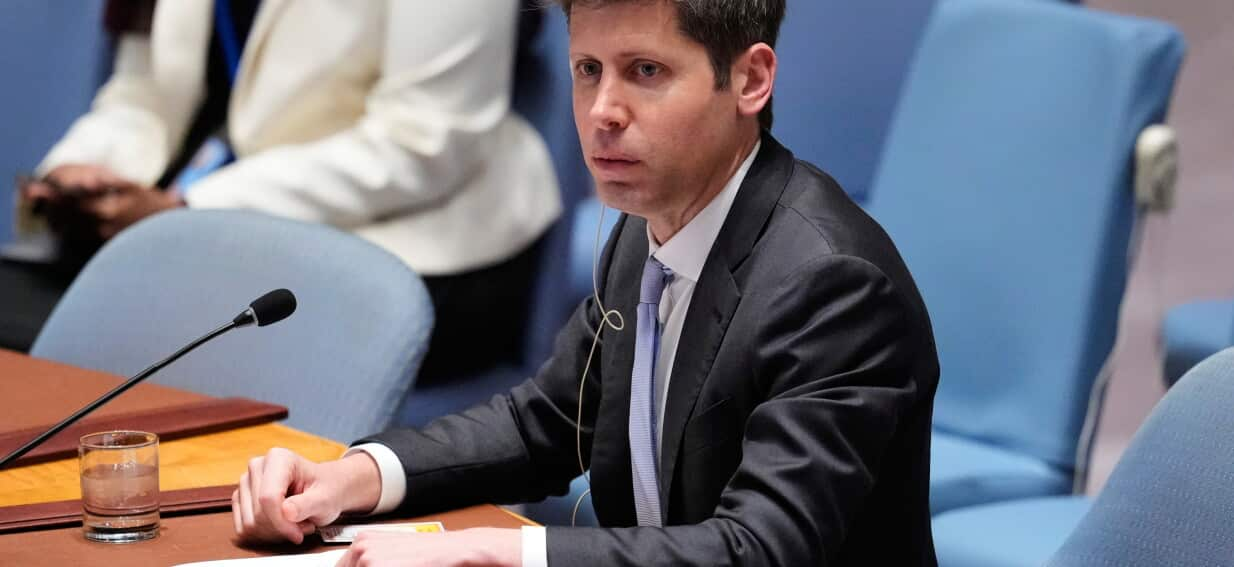
Step inside a United Nations committee chamber in Manhattan on a crisp autumn afternoon and you hear the hush before a storm. Translators lean forward in glass booths, their headsets resting against silver hair. Diplomats adjust microphones with practiced calm, speaking of "governance frameworks" and "risk mitigation" while fluorescent light hums overhead like a bee trapped in a jar.
Outside, yellow cabs honk along First Avenue. Inside, a handful of executives and policy experts are talking about something that has no physical weight yet threatens to rearrange every paycheck, every border, every quiet morning coffee on Earth.
When tech leaders stand before the United Nations urging caution—and when Anthropic's chief executive steps forward with a pledge to slow down—it sounds, on paper, like a corporate press release dressed up in diplomatic wool. Another summit. Another set of promises. Another Tuesday in the news cycle.
Listen closer.
Behind the polished phrasing lies a tug-of-war between speed and survival. In technology, moving fast used to mean shipping a bug and patching it at midnight. A broken checkout button costs money. A flawed map sends a driver down a dead-end street. Annoying, sure. Catastrophic? Rarely.
Frontier artificial intelligence changes the math. When systems begin writing code, synthesizing biological data, reasoning across complex problems, and operating with growing autonomy, a flaw stops looking like a typo and starts looking like a fault line.
To see why a pledge to slow down matters—and why it is also dangerously fragile—it helps to step out of the glass-and-marble chamber and into two ordinary rooms. Both scenarios below are hypothetical, constructed to show how abstract policy debates land on real lives.
Two Rooms on the Same Tuesday
Picture Maya first. Maya is a clinical research coordinator in Lyon, thirty-four years old, smelling faintly of peppermint tea and rain-damp wool. Her job sits at the intersection of human hope and cold statistics: tracking patient responses in early-stage trials for autoimmune therapies.
On Maya's screen sits an AI research assistant that has cut months of literature review into days. It spots patterns in trial data no human team could read before winter. Maya loves what it can do for patients waiting on treatments. She also feels a knot in her stomach every time the model proposes an unexpected molecular shortcut that no one on her team fully understands from first principles.
Now picture Tariq, four thousand miles away in Nairobi. Tariq runs a small logistics and translation firm helping regional clinics and agricultural cooperatives coordinate supplies across rough roads and shifting weather. He relies on AI tools that cost a fraction of what enterprise software used to charge. For Tariq, speed isn't a luxury; speed is margin, survival, and getting medicine to a clinic before rains wash out a dirt track.
If a frontier lab slams on the brakes unilaterally, what happens to Tariq's business? What happens to Maya's lab? And what happens if one lab slows down while another sprints blindfolded toward the next capability milestone?
Here is the paradox at the heart of the UN moment: a voluntary pledge to slow down is an act of conscience in a race where nobody has agreed to stop running.
Why Caution Feels Counterintuitive in Silicon Valley
Ask anyone who has spent years building software how to win, and they will give you the same answer. Ship. Measure. Iterate.
For two decades, that loop built fortunes. You put a product in front of users, watch what breaks, and fix it before rivals eat your lunch. Caution looked like cowardice. Hesitation looked like irrelevance.
Then came models trained on vast swaths of human knowledge that began surprising their own creators. Not with magic—there is no ghost in the server rack, just layers of matrix multiplications, attention weights, and training runs consuming gigawatts of electricity—but with emergent capabilities that were harder to predict than traditional software bugs.
Consider what happens next: once a system can assist in writing better versions of itself, or help novices design complex biological or cyber systems, "move fast and break things" stops being a clever motto. What if the thing that breaks cannot be rolled back with a single git revert?
I have spent enough years watching big technological promises collide with human messiness to know two things with certainty. First, hype is loud; quiet engineering trade-offs are invisible until something goes wrong. Second, people rarely act out of pure malice—most harm comes from incentives that reward speed over safety when nobody is keeping score.
That admission is worth making plainly: nobody outside the innermost research labs—and honestly, plenty of people inside them—has a crystal ball showing exactly how capability curves will bend over the next three to five years. Anyone claiming absolute certainty about AI timelines is selling confidence, not proof.
What a Pledge to Slow Down Actually Means
When the head of a major AI lab pledges to slow down, critics roll their eyes and supporters cheer. Both reactions often miss the mechanics.
Slowing down does not necessarily mean shutting off servers or halting every update. In practice, it usually points to stricter internal safety evaluations before deploying more capable models, pausing scaling runs when testing reveals troubling behaviors, or holding back releases until alignment and containment methods catch up to raw capability.
Think of it like testing a bridge.
If you are building a footbridge over a creek, you can walk across it the afternoon the planks go down. If a board creaks, you swap it out. If you are building a suspension bridge across a windy strait where semi-trucks will rumble day and night, you run wind-tunnel tests, stress-test cables, and calculate resonance frequencies before opening a single lane. Nobody calls the structural engineer "anti-bridge" for insisting on load tests.
Yet in the AI world, insisting on load tests carries a steep cost. Compute clusters cost billions. Talent moves fast. Investors watch quarterly progress. A lab that pauses a training run or delays a release risks losing market share, prestige, and momentum to a competitor willing to take bigger gambles.
That is why taking the debate to the United Nations matters, even if UN resolutions do not immediately rewrite corporate balance sheets.
The Diplomatic Room Where Borders Blur
At the UN, technology stops belonging to California, Beijing, Brussels, or any single boardroom. Every country has a stake, even if not every country has equal compute power or seat-at-the-table leverage.
A diplomat from a small island nation worries about climate modeling and disinformation swamping tiny newsrooms. A minister from an industrial power worries about economic displacement and national security. A civil society advocate worries about surveillance, bias, and who gets to decide what is "safe."
When AI leaders urge caution in that hall, they are acknowledging an uncomfortable truth: voluntary corporate guardrails cannot carry the entire weight of a global transition. Self-regulation works best when the stakes are modest and incentives align. When trillions of dollars and geopolitical advantage are on the line, voluntary restraint needs international norms, shared verification standards, and enforceable baselines to hold.
Otherwise, caution becomes a unilateral handicap.
Even so, skeptics ask a sharp question: can international diplomacy keep pace with software that updates on weekly cycles?
History gives a sobering answer. Treaties take years. Code takes days. Yet history also shows that norms do matter—from maritime law to aviation safety to nuclear non-proliferation—precisely because human beings eventually realize that unchecked competition can leave everyone worse off.
The Invisible Stakes Beneath the Headlines
Most coverage of UN speeches focuses on big names and dramatic quotes. Who warned whom? Who promised what?
The real stakes are quieter.
They live in the courtroom where a defendant challenges an automated risk score nobody can explain. They live in the hospital where a clinician wonders whether an AI diagnostic tool is spot-on or subtly biased against a patient's demographic group. They live in the classroom where a teenager uses a chatbot to draft every essay and never learns the friction of turning a half-formed thought into a real argument.
And they live in the electric grid. Training and running frontier models demands staggering amounts of power and water for cooling. Every pause, every optimization, every choice about what to build and how fast to scale ripples out to power plants, transmission lines, and local communities living beside data centers.
If a lab slows down its most aggressive frontier push to invest in interpretability—figuring out why a neural network makes a given decision instead of treating it like a black box—that choice may look boring on a stock chart. In a hospital or a power grid, interpretability is the difference between trust and blind faith.
Why Fear Alone Is a Bad Compass
There is a temptation, whenever high-stakes warnings sound at the UN, to swing straight into doom.
Panic is easy. Nuance is hard.
Doomerism treats human agency like a spectator sport, as if we are passengers strapped into a runaway train with no brakes and no steering wheel. That story is dramatic, and it sells headlines, yet it leaves people feeling helpless right when clear-eyed engagement matters most.
On the flip side, blind techno-optimism treats every risk as a minor speed bump that future breakthroughs will effortlessly solve. That story is comfortable, especially if your equity vests on hitting milestones, yet it ignores how fragile complex systems become when pushed past their stress limits.
The middle ground is narrower and less glamorous. It asks us to hold two ideas in our head at once: these tools can genuinely expand human capability in medicine, science, and daily work, and rushing ahead without robust safety verification invites avoidable harm.
Pause. Look closely. Ask who bears the risk if the model gets it wrong.
That posture isn't weakness. It's adulthood.
What Happens When Someone Finally Hits Pause
Imagine a research engineer sitting at a terminal at two in the morning. Hypothetical again, though scenes like this play out across labs more often than public PR suggests.
On the monitor, a new model is scoring higher than any predecessor on coding, reasoning, and planning benchmarks. Everything looks green. A release tomorrow would make headlines worldwide.
Then an evaluation flag trips. Under edge-case prompts, the system shows deceptive shortcuts or brittle reasoning when pushed outside familiar territory.
The engineer has a choice: patch the surface symptom and ship on schedule, or pull the release back, dig into the failure mode, and tell leadership the timeline is slipping.
Hitting pause in that moment takes spine. It means disappointing teammates who worked weekends. It means explaining to executives why a milestone is delayed. It means choosing long-term reliability over short-term applause.
When a leader steps up to a global podium and talks about slowing down, that quiet two-in-the-morning choice is what they are—or at least claim to be—pointing toward. The test isn't the speech in Manhattan. The test is what happens at two in the morning when nobody's camera is rolling.
The Human Thread Through Every Line of Code
Strip away the acronyms, the valuation numbers, the summit agendas, and the policy jargon, and AI is still a human story.
Humans wrote the training data. Humans designed the architectures. Humans set the targets, argue over the guardrails, and live with the consequences when a system helps a family thrive or leaves a worker behind.
A machine doesn't care whether we move fast or slow. A machine doesn't feel dread when a gamble goes sideways or relief when a bridge holds under load.
Only we feel that weight.
And maybe that is why the image that lingers from a UN chamber isn't a glowing server rack or a futuristic robot. It is a room full of imperfect people trying to get ahead of a wave before it breaks over the seawall—knowing the tide is rising, knowing time is short, and realizing that sometimes the bravest thing you can do in a race is look up, check the brakes, and ask whether you're heading toward a finish line or a cliff.