The camera light blinks red. A social media operative strikes a key. Within seconds, a video begins circulating through millions of smartphones across Israel, engineered to mock a heavy, stumbling accent.
In the clip, a man struggles with English phrases. His vowels are thick, flat, and distinctly Israeli. The video carefully splices these awkward pauses against polished footage of Benjamin Netanyahu, who commands American congressional chambers with the effortless cadence of an Ivy League graduate. The political attack seems simple. The subtext is clear: one man belongs on the global stage, while the other is a provincial outsider who cannot even handle a basic foreign interview.
But then came the counter-punch. It did not arrive via a slick public relations agency.
"Where was Netanyahu’s excellent English on October 7?"
The question was asked quietly on a podcast. It was blunt. Brutal.
"Where is his excellent English in strengthening the relationship between Israel and the United States, which is at rock bottom?"
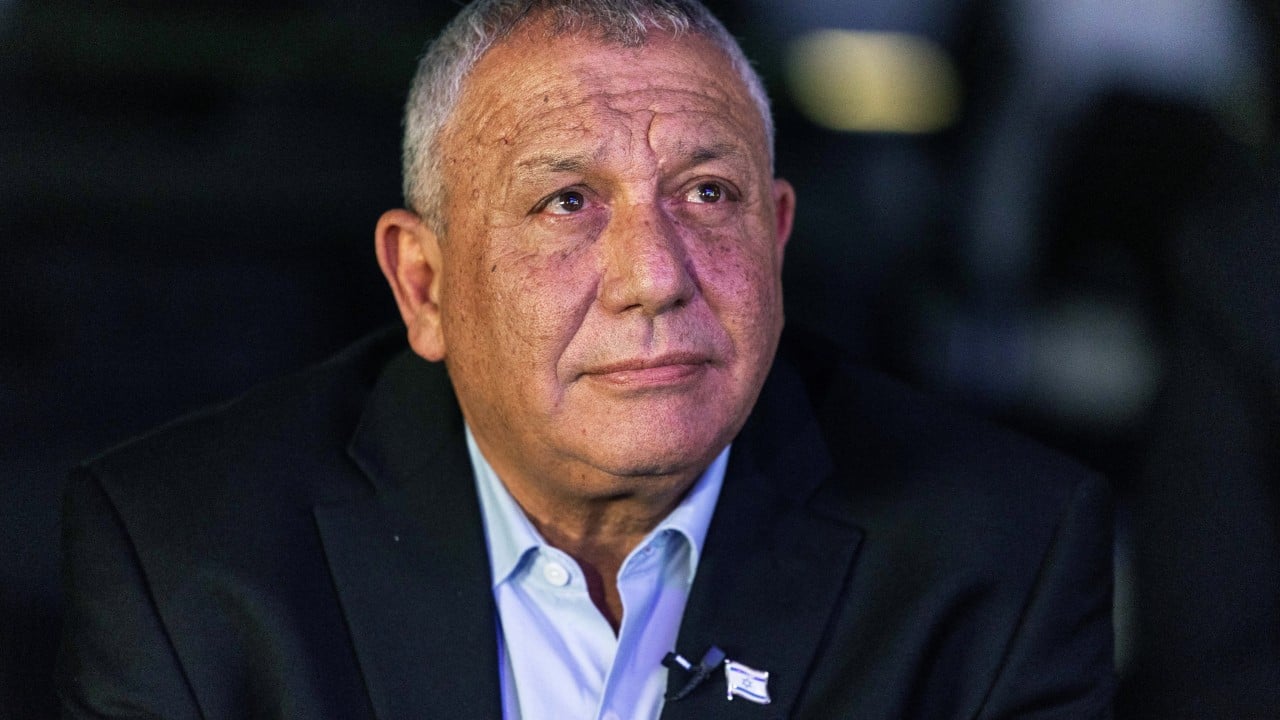
The speaker was Gadi Eisenkot. He is a sixty-six-year-old former military commander who has spent his entire existence avoiding the spotlight. He does not possess an expensive hair-stylist. He does not think in soundbites. Yet, this unassuming man from a working-class immigrant family has suddenly upended the entire political map, morphing into the most formidable threat to the longest-serving prime minister in the country's history.
To understand why a clunky accent is suddenly beating a master orator in the polls, you have to look past the political theater. You have to look at the psychological wear and tear of a country that has forgotten what normal looks like.
The Sound of the Trenches
For decades, political survival in this part of the world required a specific kind of theater. Leaders were expected to look like cinematic heroes or silver-tongued diplomats. Netanyahu mastered this art, building a twenty-year legacy on the idea that only his sophisticated, elite communication skills could keep a small, surrounded nation safe.
Eisenkot belongs to a completely different world.
He grew up in Eilat, the son of Moroccan immigrants. In a society where the defense establishment was long dominated by a secular, European-descended elite, Eisenkot had to fight for every inch of ground. He did not come from Sayeret Matkal, the legendary special forces unit that produced Netanyahu, Ehud Barak, and Naftali Bennett. Instead, he spent forty years in the Golani Brigade.
Golani is not elite. It is mud, sweat, and heavy boots. It is the infantry unit where the sons of working-class families, immigrants, and periphery towns end up. It is a place where you learn to lead not by making speeches, but by standing next to your people in a ditch.
When Eisenkot speaks, he sounds exactly like a Golani mechanic or a neighborhood shopkeeper. For years, the political establishment viewed this as a fatal flaw. They assumed a man who could not charm a Washington cocktail party could never run a country.
They were wrong.
They misunderstood a profound shift in the public mood. After years of national trauma, economic strain, and deep social polarization, a massive segment of the population has developed an allergy to polish. Slickness feels like a lie. Eloquence feels like a distraction.
Consider the momentum. Over the last several months, a newly formed political movement called Yashar—which literally translates to "Straight"—has risen steadily from a statistical footnote to the front lines of national polling. Recent data from major networks shows Eisenkot outperforming Netanyahu when citizens are asked a simple question: Who is actually suitable to lead this country?
The answers are shifting because the criteria for leadership has changed. People are no longer looking for a magician. They are looking for an anchor.
The Weight of the Ceramic Vest
Behind the polling numbers lies a deeper, darker reality that every family here understands. It is the reality of sacrifice.
In late 2023, Eisenkot was sitting in a command bunker, helping to oversee the national defense strategy. A radio transmission came through. A tunnel had been booby-trapped in northern Gaza. A soldier was dead.
That soldier was his twenty-five-year-old son, Gal.
Days later, another transmission brought news that his nephew had also fallen. Shortly after, a second nephew was killed.
Loss. Total, devastating loss.
In many democracies, a tragedy like this would cause a public figure to retreat permanently into private grief. But in a country bound together by mandatory service and shared vulnerability, Eisenkot’s personal tragedy transformed him into something else entirely. He became a living mirror of the national condition.
When he talks about the cost of conflict, he is not discussing sterile strategy or geopolitical chess. He is talking about his own dinner table. He is talking about the empty bedroom in his house.
This shared pain gives his political platform a raw authority that money cannot buy. When Eisenkot demands a policy of "service for all"—insisting that the long-standing military exemptions for ultra-Orthodox communities must end—it does not sound like a cynical partisan maneuver. It sounds like a father who has paid the ultimate price, looking at his fellow citizens and asking for fairness.
Hypothetically, imagine a mother living in a suburb outside Tel Aviv. Her eldest son is currently deployed, sleeping in armor, while her youngest is preparing for induction. When she watches the nightly news, she sees career politicians shouting at each other in parliamentary committees, trading insults for the cameras. Then she sees Eisenkot. He looks tired. His shoulders are heavy. He speaks without theatrical gestures.
She trusts him. Not because he promises an easy victory, but because he understands the exact weight of the vest her sons are wearing.
Breaking the Binary
The current political establishment operates on a simple binary code. You are either with the current leadership, or you are a traitor to the state. You are either an ultranationalist, or you want to surrender. This division has kept the country paralyzed in a cycle of endless elections and deep internal anger.
Eisenkot’s rise is terrifying to the political elite because he does not fit into their pre-written scripts.
The ruling party tried to brand him as weak on defense. It failed. You cannot call a former Chief of Staff who spent forty years in uniform naïve about security. They tried to paint him as a radical left-wing appeaser. It failed. His military record is defined by a ruthless, practical focus on deterrence.
At the same time, he has openly broken with right-wing dogmas. He has stated plainly that long-term security cannot rely solely on permanent military occupation, suggesting that future accommodations with neighbors are a mathematical necessity for survival. He defended the independence of the judiciary long before it became a popular protest movement, arguing that a strong legal system is a core component of national resilience.
This positions him in a unique, unaligned space. He is acceptable to the center-left because he respects democratic institutions and seeks pragmatic solutions. He is trusted by the moderate right because his security credentials are ironclad.
He has broken the old political monopoly. For the past year, the opposition was supposed to be led by a neat alliance of former prime ministers and media personalities. They had the funding. They had the name recognition. But their support has softened, week by week, leaking away toward the quiet general who refused to play by the established rules of political showmanship.
The Unpolished Path
The upcoming election will not be a debate over economic spreadsheets or foreign policy white papers. It will be a referendum on character.
On one side stands a political machine built on absolute loyalty, rhetorical perfection, and a deep understanding of media manipulation. It is a machine that knows how to weaponize fear, how to project strength, and how to turn every news cycle into a battle for survival.
On the other side stands a man who represents the opposite model of life. He is short, stocky, and speaks in a low monotone. He does not use teleprompters. If you watch him closely during a broadcast, you can see he would rather be anywhere else in the world than standing in front of a microphone.
This lack of ambition is precisely what makes him dangerous to his rivals.
In a political ecosystem driven by ego, a man who does not seem to want the job for his own glory becomes a magnet for the exhausted. His lack of polish is no longer a liability; it is his shield. Every time an opponent mocks his English or belittles his background, it merely reinforces the sense that the elite are completely out of touch with the reality on the ground.
The country is moving toward an uncertain crossroads. The old narratives that sustained the political landscape for two decades are cracking under the pressure of real-world crises. The polished speeches are losing their power to soothe or to distract.
A quiet man in an unbuttoned shirt stands at a podium. He looks at the audience, ignores the glare of the television lights, and begins to speak in that thick, unmistakable Golani accent. He does not promise miracles. He does not offer easy enemies. He just tells the truth, straight, and waits to see if the country is ready to listen.