Silence.
In the hills above Pacific Palisades, silence is the most expensive commodity on earth, far pricier than the imported Italian limestone or the reclaimed timber that lines the walls of Brentwood’s sprawling estates. For decades, that quiet belonged to Steven Spielberg, tucked away inside a 3.3-acre compound on Amalfi Drive that felt less like a billionaire’s trophy and more like a hidden sanctuary for a man who spent his life manufacturing dreams for everyone else. Then, in the autumn of 2024, he decided to let it go. He put the ranch on the market for $29.9 million, inviting the scrutiny of the ultra-wealthy, the whispers of Beverly Hills brokers, and the inevitable parade of curious eyes into a space that had been fiercely guarded since the 1980s.
And then, just as quietly, he took it back.
To a casual observer scrolling through real estate headlines, the news reads like a dry footnote in the ledger of Hollywood wealth: a celebrity lists a house, doesn't get his number, and pulls the listing. Routine. Predictable. A shrug of the shoulders from a man whose net worth sits comfortably above five billion dollars. Yet if you have ever stood inside a home that holds thirty-five years of your life—if you have ever watched a stranger walk across floorboards that remember the footsteps of your growing children while calculating the cost of ripping them out—you know that pulling a house off the market is rarely just a financial calculation. It is an admission that some things cannot be priced, and that the modern luxury market has forgotten how to value a soul.
The Architecture of Memory
Consider what a house actually is to someone who spends forty years building worlds out of thin air.
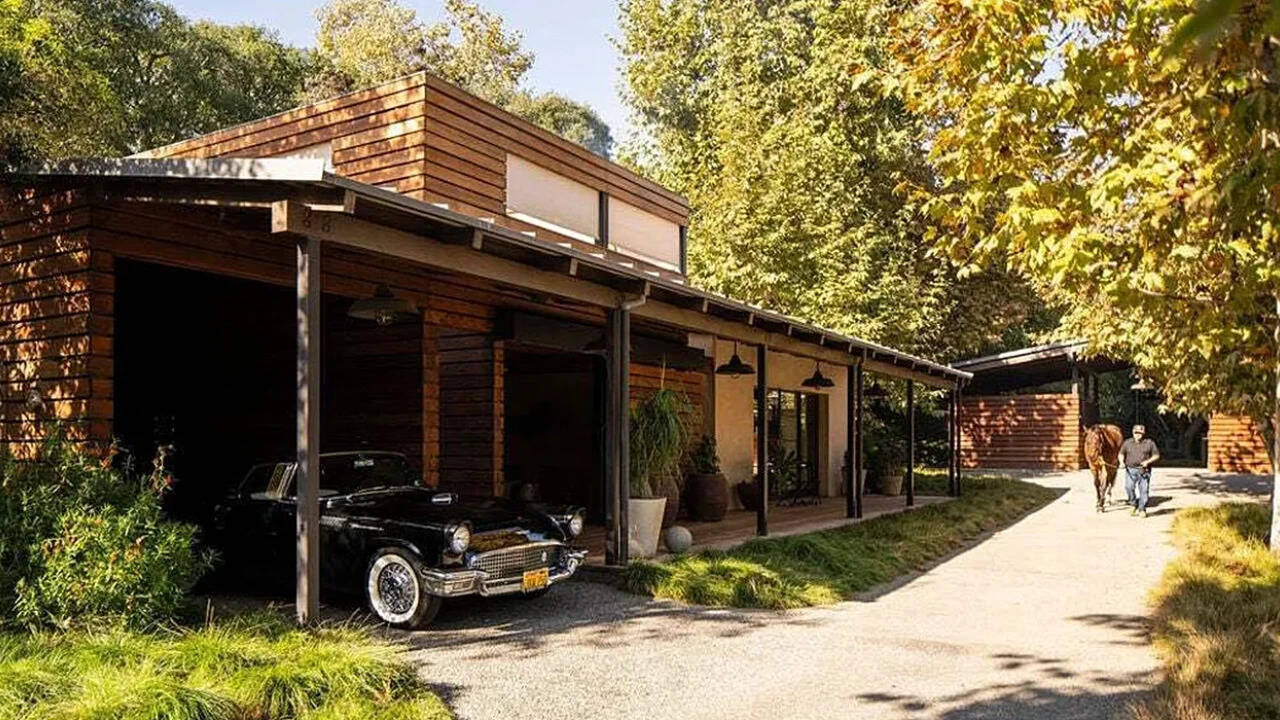
On a soundstage in Burbank or on a windswept beach in Ireland, every tree, every cobblestone, every shaft of morning light is a deliberate illusion designed to manipulate an audience’s heartbeat. When Spielberg bought the first parcel of this Pacific Palisades property in 1985—adding an adjacent lot years later to create a private, gated compound—he wasn't buying a status symbol. He was buying an antidote to the camera. Nestled in the Riviera neighborhood, shielded by mature eucalyptus trees and winding canyon roads, the main residence is a sprawling, single-story California ranch style, roughly 7,000 square feet of warm wood, sun-drenched patios, and unpretentious grace. There is a guesthouse, a swimming pool, a screening room, and a private vineyard, all arranged not to impress a magazine photographer, but to let a family breathe without a telephoto lens peering over the hedge.
Imagine, as a hypothetical scenario, a buyer walking through those gates in late 2024. Let’s call him Julian, a twenty-nine-year-old tech founder fresh off a nine-figure acquisition, accompanied by an architect who speaks exclusively in terms of square-footage maximization and glass-wall sightlines. Julian doesn't see the room where Schindler’s List was agonized over in the quiet hours before dawn, or the lawn where seven children learned to ride bicycles away from the glare of the Hollywood press. Julian sees "dated" wood paneling. He sees a single-story footprint that could be scraped down to the dirt to make room for a 15,000-square-foot modernist glass box with an infinity pool, a subterranean auto gallery, and a wellness spa.
This is the collision happening every single day in the upper tiers of Los Angeles real estate. It is a clash between two entirely different philosophies of living: the sanctuary versus the asset.
I remember the first time I walked through an old estate in the hills above Sunset Boulevard, representing a client who wanted to buy a piece of old-guard Hollywood history. The house had belonged to a screenwriter from the golden era—low ceilings, creaky oak floors, a garden overgrown with jasmine that smelled intoxicating at dusk. My client spent twenty minutes pacing the living room with a laser measure, complaining that the ceiling height wouldn't accommodate his art collection and asking how quickly we could get demolition permits. Standing there, listening to the hum of his laser bouncing off plaster that had absorbed decades of laughter and heartbreak, I felt a strange, hollow ache. We have reached a point where we no longer inhabit houses; we consume them.
The Invisible Wall in the Palisades
To understand why Spielberg’s $29.9 million listing stalled—and why pulling it off the market makes profound sense—you have to look at the mechanics of the high-end California real estate market over the last two years. It is a market caught in a vise of policy, psychology, and shifting tastes.
First, there is the cold math of Los Angeles politics. In April 2023, the city implemented Measure ULA, colloquially known among brokers and wealthy homeowners as the "mansion tax." On any property sale above $10 million, the city levies a 5.5% transfer tax on the gross sale price—not the profit, the total price. For a $29.9 million transaction, that single line item hands more than $1.64 million directly to the city before a single commission is paid or a single moving box is taped shut. Across Los Angeles, sales above the $10 million threshold plummeted by more than half in the year following the tax's enactment. Sellers suddenly found themselves trapped in a bizarre standoff: raise the asking price to absorb the tax and risk pricing yourself out of the market, or swallow a multi-million-dollar haircut just for the privilege of handing over the keys.
Yet even without the tax, the Pacific Palisades compound faced a deeper, more stubborn obstacle. Wealthy buyers in the $30 million bracket have developed a severe allergy to patience.
In the wake of the pandemic, the ultra-luxury market shifted toward turnkey perfection—homes built on spec by developers who strip away every trace of personal eccentricity in favor of neutral palettes, automated lighting systems, and monolithic slabs of book-matched marble. A buyer spending thirty million dollars today rarely wants a project, and they almost never want someone else’s taste. Spielberg’s ranch, despite its pedigree and its sprawling 3.3-acre footprint—an almost unheard-of amount of flat, usable land in the Riviera—was fundamentally a lived-in family home. It was tailored to the rhythms of Steven Spielberg and Kate Capshaw, not to the Instagram aesthetic of a twenty-something crypto heir or a hedge fund manager relocating from Greenwich.
Think of it like a bespoke suit tailored for a specific pair of shoulders. No matter how fine the wool or how legendary the tailor, if you put it on the rack at a luxury department store, most shoppers will walk right past it because it doesn't hang right on their frame. To make it fit, they would have to tear out the seams and recut the fabric—and nobody wants to pay top dollar for a suit they immediately have to destroy.
Why Pull the Plug?
When a listing lingers on the market for months without a bite, the real estate playbook usually dictates a price cut. Drop it to $26.5 million. Test the water at $24.9 million. Signal to the sharks circling the cove that the seller is motivated, flexible, willing to deal.
Spielberg didn't flinch. Instead of discounting the ranch, he removed it entirely.
That decision reveals something crucial about the psychology of real wealth—and the trap that catches lesser sellers. When you own a home outright, free of debt, and your financial security doesn't hinge on liquidating an asset by the end of the quarter, an unsold listing isn't a failure. It is data. The market spoke, and what it said was clear: We don't want to pay $30 million for a memory; we want to pay $20 million for the dirt.
And if you are Steven Spielberg, why on earth would you sell someone the dirt so they can bulldoze the place where your children grew up?
There is a vulnerability in putting a beloved home on the market that outsiders rarely appreciate. Every showing is an audit of your life. Strangers open your closets, critique your kitchen layout, peer into your screening room, and reduce decades of quiet domesticity to a spreadsheet of comparable sales per square foot. At first, the prospect of downsizing—simplifying a sprawling real estate portfolio that also includes a massive estate in Malibu and properties on the East Coast—feels rational, even liberating. You tell yourself it’s time to move on, to let another family fill the rooms with noise.
Then the reality sets in. You watch months pass without an offer that respects the place. You hear the whispers from brokers suggesting that a buyer would likely tear down the main house to build something bigger, flashier, louder. Suddenly, the idea of keeping the keys doesn't feel like stubbornness; it feels like preservation.
The Myth of the Forever Transaction
We tend to treat real estate in America like a stock ticker—a relentless climb toward liquidity, where every home is merely a stepping stone to the next bracket, and holding onto an asset that isn't actively appreciating at maximum velocity is viewed as a strategic error. We obsess over exit strategies before we have even unpacked the dishes.
I used to believe that mindset completely. Early in my career, I advised a couple in their late sixties to sell their hillside home because the market had hit a peak and the maintenance costs were climbing. On paper, my math was airtight. They walked away with a magnificent check, moved into a sleek, low-maintenance condominium near the beach, and within eighteen months, the husband had fallen into a quiet, unmistakable grief he couldn't quite name. He missed the uneven flagstones on the back patio that he had laid himself in 1988. He missed the way the afternoon wind rattled the specific eucalyptus tree outside his study. He had traded a sanctuary for liquidity, and no amount of return on investment could buy back the texture of his own life.
Spielberg’s retreat from the market is a rare, public reminder that the ultimate luxury isn't the ability to sell anything at any price—it is the power to walk away from the table when the deal feels wrong.
In the end, the Pacific Palisades ranch remains what it has been for nearly four decades: a quiet pocket of green tucked behind high hedges on Amalfi Drive, untouched by the wrecking ball, immune to the speculative fever of Los Angeles real estate. Somewhere behind those gates, the late afternoon sun still slants through the eucalyptus trees onto the lawn, casting long, familiar shadows across ground that refuses to be turned into someone else’s blank slate.