The espresso cup clatters against the porcelain saucer at seven in the morning, a sharp ceramic bell ringing out inside a pastelaria in Arroios. Outside, the yellow tram groans up the hill, its steel wheels screeching against the tracks like a waking beast. Inside, the air smells of toasted bread, burnt sugar, and damp wool.
This is the Lisbon of postcards. It is warm, golden, and effortlessly charming. Yet if you sit quietly at the corner table, nursing a galão while the morning light hits the azulejo tiles, you will hear a different sound beneath the hiss of the steam wand. You will hear the rustle of folded lease agreements. You will hear the low, anxious murmur of people doing mental math on paper napkins.
Across the city, at the Palácio de São Bento, lawmakers in dark suits are debating the national budget. They speak in the clean, bloodless dialect of fiscal policy, public expenditure, and macroeconomic stability. Meanwhile, just down the hill, thousands of teachers, nurses, students, and retirees are marching through the streets with cardboard signs and keys held high above their heads.
They are not protesting a recession. Portugal’s economy has boasted some of the strongest growth rates in the Eurozone in recent years, fueled by tourism, foreign investment, and a thriving tech sector. They are protesting a paradox. They are protesting the terrifying reality of living in a booming country where the people who bake the bread, teach the children, and clean the hospital wards can no longer afford to sleep under a roof.
The Arithmetic of Slow Displacement
To understand why the streets of Lisbon, Porto, and Braga are swelling with anger, you have to step away from the parliamentary floor and look at a kitchen table.
Consider a hypothetical scenario, built from the exact averages reported by Portugal’s National Statistics Institute and housing watchdogs. Meet Sofia. She is thirty-two years old, holds a master’s degree in nursing, and works full-time at a public hospital in Lisbon. Her take-home pay is roughly 1,150 euros a month. By local standards, she has a stable, respectable career.
Five years ago, Sofia rented a modest one-bedroom apartment in a working-class neighborhood for 650 euros. It was tight, leaving little room for savings, but it was hers. She knew the grocer by name. She watered geraniums on a tiny iron balcony.
Then her building was sold to an international investment fund.
When her lease came up for renewal, the new management company offered her a choice. She could sign a new contract at 1,350 euros a month, or she could vacate the premises in ninety days. The math is brutal and immediate. Her rent did not just rise; it surpassed her entire monthly income by two hundred euros. Even if Sofia stopped eating, stopped paying for electricity, and walked six miles to the hospital in the rain, she could not keep her front door key.
Sofia is a composite character, a literary stand-in, yet her predicament is the daily reality for an entire generation. According to European housing data, Lisbon has repeatedly ranked among the least affordable cities in the world relative to local wages—often outpacing London, Paris, and New York when adjusted for what residents actually earn. While average rents in the capital have surged by more than ninety percent over the past decade, median wages have crept upward at a glacial pace, hovering near the bottom of Western Europe.
Think of the Portuguese housing market like a high-stakes auction where two completely different currencies are being used at the exact same time. On one side of the room stand local workers, bidding with Portuguese salaries earned in a service-heavy economy. On the other side stand digital nomads, wealthy retirees, and institutional real estate funds, bidding with Californian tech salaries, Northern European pensions, and global capital. When both groups bid on the exact same finite supply of stone and mortar, the outcome is mathematically predetermined. The local bidder loses every single time.
A History Written in Stone and Scarcity
I remember walking through the Alfama district a few winters ago, long after the summer cruise ships had vanished and the souvenir shops had pulled down their metal shutters. The laundry still hung across the narrow alleys like bright flags, fluttering in the Atlantic wind. An elderly woman sat on a wooden stool outside her doorway, shelling peas into an aluminum bowl. When we spoke, she pointed to the buildings around her—half of them gleaming with fresh white paint and smart-lock keypads on the doors, the other half crumbling with broken windows and padlocked gates. "The ghosts moved in," she told me simply. "They only visit on weekends."
That image stays with you because it captures a structural failure decades in the making. The current crisis did not materialize overnight, nor is it solely the fault of a single policy. It is the collision of historical neglect with aggressive modern deregulation.
For much of the twentieth century, strict rent-control laws kept housing cheap in Portugal, which protected tenants during decades of dictatorship and early democracy, yet simultaneously starved landlords of the capital needed to maintain aging buildings. By the early 2000s, the historic centers of Lisbon and Porto were hollowed out, filled with magnificent nineteenth-century facades slowly rotting from the inside out.
Then came the 2008 financial crisis and the sovereign debt bailout. Desperate for foreign capital to rescue a battered economy, the Portuguese government threw open the doors. In 2009, it introduced the Non-Habitual Resident tax regime, offering steep tax breaks to wealthy foreigners relocating to Portugal. In 2012, it launched the Golden Visa program, granting European residency permits to non-EU citizens who purchased real estate worth at least 500,000 euros. Simultaneously, urban lease laws were liberalized, making it dramatically easier to terminate long-term contracts and convert residential apartments into short-term tourist rentals.
At the time, the strategy looked like a lifeline. Cranes filled the skyline. Blighted neighborhoods were restored. Tourism exploded, pulling the country out of economic stagnation and creating tens of thousands of jobs.
What policymakers failed to build alongside this boom was a safety net. While countries like Austria, the Netherlands, and Denmark maintain public social housing stocks ranging from fifteen to nearly thirty percent of their total housing supply, Portugal’s public housing stock sits at a staggering two percent. There was no buffer. There was no reserve of affordable homes to absorb the shock when global capital flooded a small, low-wage market.
The Invisible Stakes Inside Parliament
This brings us back to the stone halls of the Palácio de São Bento, where the annual budget debate has become a referendum on the soul of the country.
When politicians stand at the podium to argue over spending plans, the public hears numbers—billions allocated to infrastructure, tax cuts for the middle class, subsidies for young homebuyers, or incentives for construction companies. It is easy to get lost in the partisan theater. Opposition parties accuse the government of offering band-aids to a hemorrhage; the ruling coalition insists that fiscal discipline is the only way to prevent another debt crisis while gradually expanding supply.
I will admit something that rarely makes it into tidy political commentary: watching these debates leaves me deeply conflicted, and more than a little uncertain. Economics does not offer painless levers. If the government caps rents aggressively, private developers may freeze construction, shrinking the very supply of homes the country desperately needs. If the government relies entirely on the free market to build its way out of the crisis, luxury apartments will continue to rise while working families are pushed thirty miles outside the city limits into sprawling, car-dependent suburbs.
The real danger lies in treating housing solely as a financial asset rather than a foundational piece of social infrastructure.
Consider what happens next when a city prices out its essential workforce. It starts quietly, in ways that do not immediately show up on a GDP chart. Schools in central Lisbon struggle to fill teaching vacancies because no educator can afford the commute or the rent. Hospital wards face chronic staffing shortages. Fire stations, police precincts, and municipal transit lines begin to fray at the edges.
Then the cultural fabric begins to unravel. A neighborhood is not made alive by freshly painted walls or artisanal sourdough bakeries; it is kept alive by the multigenerational friction of daily life—the butcher who knows your mother, the bookshop owner who argues about football, the elderly neighbor watching the street from her window. When you replace permanent residents with transient tourists and absentee investors, you turn a living city into a museum of itself.
Beyond the Protests
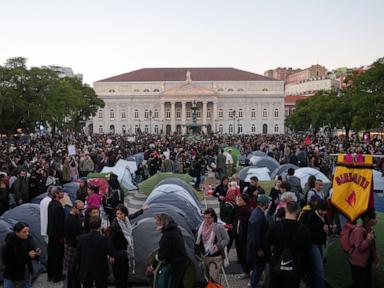
On a Saturday afternoon, the Avenida da Liberdade transforms into a river of voices. Grandmothers walk beside university students. Parents push strollers draped in banners reading Casas para viver, não para investir—Homes to live in, not to invest in. The energy in the crowd is different from the cynical apathy that often defines modern politics. It is urgent, personal, and remarkably united across ideological lines.
Over the past year, that public pressure has forced tangible shifts. The government has moved to wind down the real estate pathway of the Golden Visa program, phase out the Non-Habitual Resident tax breaks, tighten restrictions on new short-term rental licenses in saturated urban zones, and pledge billions in European recovery funds toward rehabilitating public housing units.
Yet on the ground, change moves at the speed of concrete pouring, while eviction notices move at the speed of email.
Solving a crisis of this scale requires more than tweaking tax codes or offering state-backed mortgage guarantees to young buyers—policies that, while politically popular, risk pouring gasoline on the fire by inflating demand without adding a single brick to the supply. Meaningful relief demands a massive, sustained expansion of public and cooperative housing that sits permanently outside the speculative market. It requires fast-tracking permits for affordable builds, taxing vacant properties left rotting by speculators, and incentivizing landlords to return empty apartments to long-term residential leases at regulated, predictable rates.
Most of all, it requires a shift in political courage—a willingness to state clearly that a country’s prosperity cannot be measured solely by the wealth it attracts from abroad, but by the dignity it affords the people who already call it home.
Late in the evening, after the protest banners have been rolled up and the parliamentary cameras have switched off for the night, a commuter train pulls out of Rossio station. It is packed shoulder to shoulder. Inside the fluorescent-lit carriages, exhausted workers lean against the glass, watching the illuminated monuments of Lisbon slide backward into the dark as the train carries them forty minutes north toward the concrete apartment blocks of the outer ring. They have spent their day serving the city, cleaning its rooms, and keeping its lights on. Now, in the quiet hum of the rails, they are going home—until the next rent review arrives.