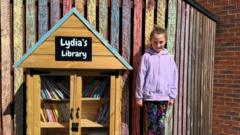
While the average seven-year-old is currently being hypnotized by algorithmic short-form video, a young girl in a small corner of the world has done something radical. She built a library. This is not just a feel-good story for the local evening news. It is a stark indictment of a public infrastructure that has largely abandoned the physical book in favor of digital convenience. When a child decides that the most valuable thing they can own is a room full of paper and ink, they are reacting to a void left by schools, local governments, and a tech-saturated culture that has forgotten how to value deep focus.
The Infrastructure of Distraction
The narrative surrounding children’s literacy often focuses on test scores and classroom funding. We argue about budgets, but we ignore the physical environment. Most children today live in a "book desert." These are neighborhoods where a child has no access to a library within walking distance and where the only reading material in the home is purely functional.
The success of a child-led library project highlights a massive failure in urban planning and social service delivery. We have traded communal reading spaces for high-speed internet, assuming that a tablet is a suitable replacement for a shelf. It isn't. Research consistently shows that physical books provide tactile feedback and spatial memory markers that digital screens cannot replicate. A child who physically turns a page is building a different cognitive map than one who swipes a glass pane.
The Psychology of Ownership
Why does a seven-year-old want to own a library rather than just visit one? The answer lies in the psychological concept of agency. In a world where every piece of media is rented or streamed, the concept of a "collection" is becoming foreign to the youth.
Building a private collection teaches a child curation. They must decide what stays and what goes. They must organize. They must care for the physical condition of the objects. This is early-stage management and stewardship. When we see a child obsessing over the arrangement of spines on a shelf, we are seeing the development of an analytical mind. They are categorizing the world.
The Economic Barrier to Reading
Let’s be blunt. Books are expensive. A new hardcover often costs more than a monthly subscription to a streaming service. For a family living paycheck to paycheck, a library is a luxury. This is why the rise of "micro-libraries" or personal collections shared with neighbors is a form of grassroots rebellion against the commodification of knowledge.
If a child has to build their own library to ensure they have something to read, our "knowledge economy" is broken. We see a massive disparity between "information-rich" households and "information-poor" ones. The seven-year-old founder of a local library isn't just a cute story; she is an entrepreneur filling a market gap created by the slow erosion of public funding for municipal branches.
The Cognitive Cost of Shifting Screens
We have spent the last decade convincing ourselves that any reading is good reading. We told parents that if their kid was reading a caption on a video or a text message, it counted. We were wrong.
The type of "deep reading" required for a novel or a history book builds a specific kind of mental stamina. This stamina is under attack. The constant interruptions of notifications have decimated the attention spans of adults, and the effect on children is even more pronounced. A physical library acts as a sanctuary from the pings and buzzes of the digital world. It is a physical commitment to a single task.
The Role of the Community Guardian
A child-led library often starts with a single box or a small shelf on a porch. It grows through the "gift economy." Neighbors see the effort and contribute. This creates a feedback loop of social validation that is far more powerful than any "streak" on a reading app.
The child becomes a curator, a librarian, and a community leader before they can even ride a bike on the road. They are learning that value is something you build, not something you merely consume. This shift from consumer to creator is the most important psychological development a human can undergo.
Breaking the Digital Default
The "digital-first" approach in education was sold to us as an equalizer. We were told that giving every child a laptop would level the playing field. Instead, it has created a new hierarchy. The children of the tech elite are often restricted from screens and encouraged to play with wooden blocks and read physical books. Meanwhile, underfunded public schools lean harder into digital platforms because they are cheaper than maintaining a physical collection of books.
The real "luxury" in the coming years will not be the latest gadget. It will be the ability to focus on a single, physical object for an hour. It will be the possession of a private collection of knowledge that cannot be deleted by a server or hidden behind a paywall.
Logistics of the Modern Personal Library
For those looking to replicate this child's success, the path is not through a shopping spree at a major retailer. It is through the slow, methodical hunt.
- Estate sales and thrift stores: These are the primary veins of the book world.
- Library sales: Most municipal libraries sell off their overstock for pennies on the dollar.
- Book swaps: Creating a local network where books are traded rather than bought.
The goal is not to have a museum. The goal is to have a working toolset. A library should be messy. It should have dog-eared pages. It should show signs of life. If the books look perfect, they aren't being used.
The Survival of the Printed Word
There is a persistent myth that the physical book is a dying medium. The data suggests otherwise. Printed book sales have remained resilient, even as e-books plateaued years ago. There is a primal human need to hold the weight of a story in our hands.
When a seven-year-old insists on a library, they are tapping into an ancestral drive. They want a physical record of their thoughts and the thoughts of others. They want a wall of ideas that protects them from the ephemeral, fleeting nature of the internet.
Redefining the "Wish"
We often treat a child's wish as something magical or whimsical. "She wished for a library, and it came true." This framing is lazy. Wishes don't build libraries. Labor builds libraries. Organization builds libraries. Persistent advocacy builds libraries.
This child didn't just close her eyes and hope; she likely badgered her parents, sorted her toys to make room, and convinced her community to invest in her vision. We do a disservice to young achievers when we attribute their success to "wishes" rather than work.
The Neighborhood Effect
A library is a signal. When you walk into a home or a neighborhood and see books, you are seeing a commitment to the future. It is a sign that the people living there believe there is something worth learning and something worth passing down.
In many ways, a seven-year-old starting a library is a survivalist. She is stockpiling the only resource that actually matters when the power goes out or the internet goes down: the collective intelligence of the human race. She is building a fortress.
Stop waiting for the school board to fix the literacy crisis. Stop waiting for a grant to fund a new wing of the local library. The solution is sitting in the garage, in the thrift store, and in the hands of children who still understand that a book is the most powerful technology ever invented.