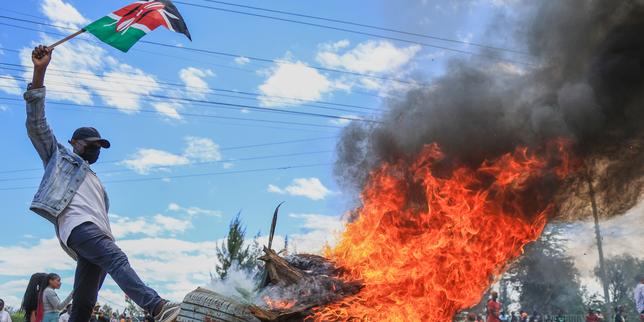
The dust in Oloitokitok does not settle; it just hangs in the air, coating the throat with a metallic taste that stays with you long after the sun goes down. For three weeks, this dust has been kicked up by the tires of heavy military trucks and the scuffling boots of protesters.
They stand outside the chain-link fence, faces obscured by colorful shuka cloths wrapped tight against the grit. On the other side of the wire sits a freshly painted complex of white modular units. The paint is so new it still smells of synthetic chemicals, cutting through the dry scent of the Kenyan savannah. This is the new isolation facility, built with breathless speed.
It was supposed to be a triumph of international health cooperation. Instead, it has become a pressure cooker of rage.
The anger here is not born of ignorance. It is born of a profound, bone-deep weariness. The headlines across the globe speak of statistics, infection rates, and containment strategies. They track the spread of Ebola with cold, color-coded maps. But on the ground, a few hours' drive from Nairobi, the crisis has a human face, a local name, and a burning sense of injustice.
The spark that lit this fire was a simple, jarring realization: the beds inside this high-tech isolation ward were not built for Kenyans. They were built for Americans.
The Weight of the Cargo
To understand why a community would risk tear gas and rubber bullets to protest a medical facility, you have to look at how fear travels.
When the latest Ebola outbreak flared up, the international response followed a familiar, well-rehearsed script. Western aid organizations deployed personnel, medical supplies arrived at Jomo Kenyatta International Airport, and press releases praised the global solidarity against a deadly pathogen. But then came the pivot.
A quiet agreement between international agencies and local authorities led to the establishment of this specialized quarantine hub. The purpose? To serve as a primary evacuation and treatment staging ground for Western aid workers, diplomats, and contractors who might contract the virus while operating across the region.
Consider the mechanics of that decision. A highly contagious, lethal virus is systematically gathered from various points across the continent and flown into a country that was, until that moment, largely managing its own risk.
Step into the shoes of a mother living less than a mile from that fence. Let us call her Amina. She runs a small vegetable stall near the main road. For years, Amina has watched international convoys roll past her shop. Usually, they bring food, water filters, or textbooks. Now, she watches ambulances with tinted windows speed past, escorted by security detail.
She knows exactly what Ebola does to a human body. She has seen the news reports from past outbreaks in West Africa and the Democratic Republic of Congo. She understands the bleeding, the organ failure, the terrifying speed of the disease.
Now, she is told that the world’s most dangerous virus is being intentionally brought to her doorstep, packaged inside the bodies of foreign nationals, because her homeland has been deemed a convenient "buffer zone."
The risk feels entirely one-sided. If a seal breaks, if a protective suit tears, if a single syringe is improperly discarded, the fallout will not land in Washington or Geneva. It will wash over Oloitokitok. It will sweep through Nairobi’s crowded informal settlements, where social distancing is a mathematical impossibility and running water is a luxury bought by the jerrycan.
An Asymmetry of Care
The protest line moves with a rhythmic, chanting energy. Signs written in English and Swahili demand the immediate closure of the center. "Our lives are not a shield," reads one, scrawled in black marker on a piece of flattened cardboard.
The protestors are pointing at a hypocritical divide that modern global health policy tries very hard to obscure.
Inside the white gates, the facility boasts state-of-the-art negative pressure rooms. It has dedicated water purification systems that sterilize every drop of waste before it hits the local water table. It has an uninterrupted supply of experimental antiviral therapeutics and monoclonal antibodies. The doctors inside are backed by the finest medical infrastructure the Global North can finance.
Just two kilometers down the dirt road sits the local public health clinic.
Go inside that clinic on any Tuesday morning. The line stretches out the door into the heat. The shelves in the pharmacy are frequently bare. Antibiotics are rationed. The sole doctor on duty routinely works thirty-hour shifts, sometimes running out of basic latex gloves.
This contrast is where the clinical data fails and the human reality takes over. The local population is being asked to host a bio-hazard of global proportions while their own children die of preventable waterborne diseases because the local clinic lacks basic rehydration salts.
It is an agonizing calculation. The international community leverages Kenya's relatively stable logistical network, its airports, and its medical staff to create a safety net for its own people. Yet, that same safety net is built on top of a community that feels entirely unprotected.
When global health officials try to explain the necessity of the center, their arguments sound like cold mathematics. They talk about "regional containment vectors" and "mitigating operational liability for frontline responders."
But Amina does not think in vectors. She thinks in terms of her children playing in the dirt near the drainage ditches. She knows that when the American patients recover, they will be flown back to their comfortable homes across the Atlantic. If the virus escapes into the local population, the borders will slam shut, flights will be canceled, and Kenya will be left to bury its dead alone.
The Memory in the Soil
Trust is a fragile thing, easily broken and notoriously difficult to rebuild. In this part of the world, suspicion of foreign medical intervention is not a sudden, irrational conspiracy theory. It is a historical hangover.
For decades, the relationship between international medical research and African populations has been fraught. Memories of experimental drug trials conducted without fully informed consent, of colonial-era public health mandates enforced at the point of a bayonet, and of resource extraction masquerading as philanthropy still linger in the collective consciousness.
When a massive, opaque facility appears overnight with minimal community consultation, those old ghosts wake up.
The government in Nairobi urges calm, issuing statements about strict protocols and international standards. They emphasize that the center is fully contained, that the risk to the public is statistically negligible.
But statistics are cold comfort when you can see the exhaust vents of an isolation ward from your front porch. The lack of transparency in the initial stages of the project created a vacuum, and in politics, a vacuum is always filled by anger. The community feels bypassed, viewed not as partners in a global health effort, but as geographical coordinates on a crisis manager's map.
The standoff at the gates shows no signs of dissolving. Every morning, the crowd gathers again. The police arrive with shields and tear gas canisters, a grim wall of state power protecting a sanctuary of foreign illness.
The real tragedy is that this conflict undermines the very thing it seeks to protect. Global health security cannot be achieved through isolation walls and armed guards. True security relies on solidarity, on the mutual understanding that a life in Oloitokitok is worth exactly the same as a life in Washington. Until that balance is corrected, the white units of the quarantine center will remain an island of privilege surrounded by a sea of resentment.
As the afternoon sun dips below the horizon, painting the sky in bruised shades of purple and orange, a silence finally falls over the road. The protestors begin their long walk home, their shoes kicking up small plumes of dust that glow in the fading light. Behind the chain-link fence, the floodlights click on with a sharp, electric hum, illuminating the empty courtyard of the facility. A lone guard paces the perimeter, his silhouette sharp against the brilliant white walls, watching the darkness swallow the hills.



:max_bytes(150000):strip_icc():focal(665x0:667x2)/gettyimages-50733149-2000-8b129a2475974982a915418ce92a73d8.jpg)