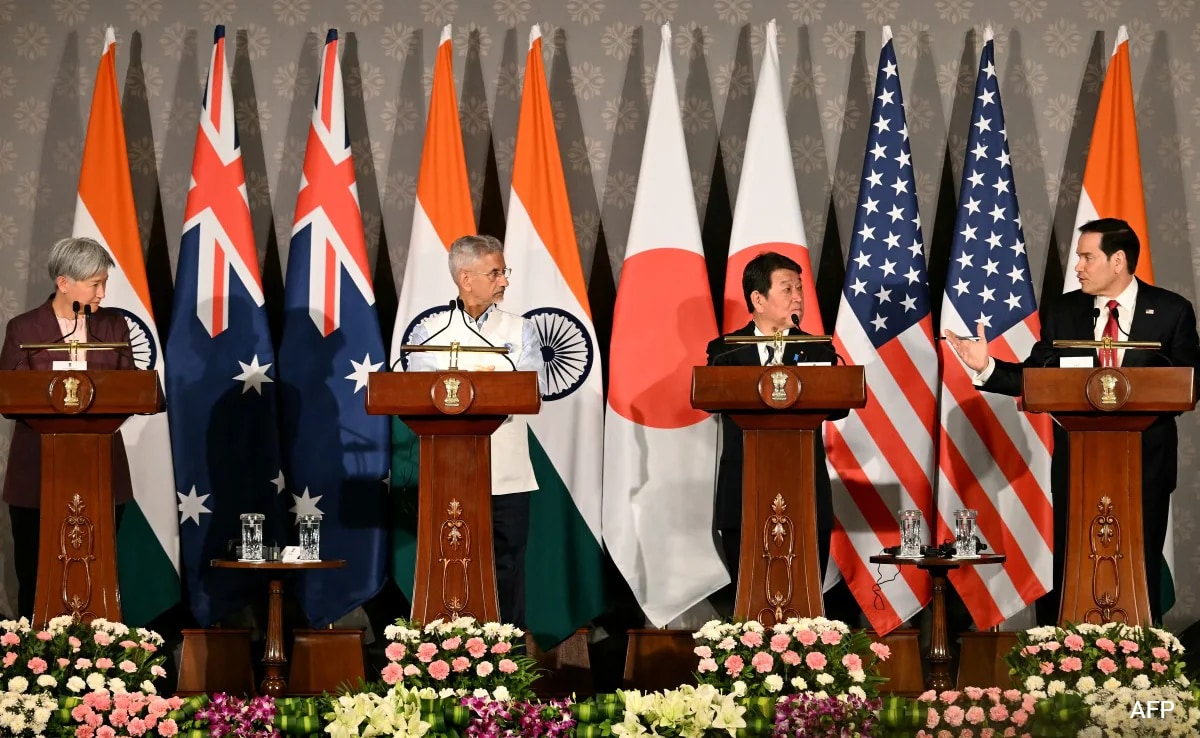
The Quad is building a paper dam to contain an ocean of oil and gas.
When the United States, Japan, India, and Australia announced the creation of a Fuel Security Forum to protect energy flows in the Indo-Pacific, the foreign policy establishment nodded in unison. The consensus was immediate, lazy, and predictably naive. The narrative tells us that by coordinating supply chains, building strategic reserves, and mapping out maritime vulnerabilities, these four nations will secure the lifeblood of global commerce.
It is a comforting bedtime story for bureaucrats. It is also completely decoupled from the reality of global energy markets.
The proposed forum ignores a fundamental truth of commodity trading: supply chains are governed by price signals and physical infrastructure, not diplomatic communiqués. By attempting to construct a closed-loop energy security architecture, the Quad is not mitigating risk. It is injecting systemic fragility into the exact region it claims to protect.
The Fatal Flaw of Diplomatic Supply Chains
Diplomats view energy security through the lens of alliances. Traders view it through the lens of arbitrage. This disconnect is where the Quad’s strategy unravels.
The Indo-Pacific relies on a vast, interconnected network of sea lines of communication (SLOCs). The Malacca Strait, the Lombok Strait, and the South China Sea are not just lines on a map; they are high-efficiency corridors dictated by geography and economic necessity.
When a multi-lateral body attempts to "protect" or reroute these flows based on political alignment rather than market efficiency, it creates artificial distortions. Consider the mechanics of a localized supply disruption. In a free market, a sudden shortage in Japan triggers a price spike, which immediately attracts spot cargoes from West Africa, the Middle East, or the US Gulf Coast. The market self-corrects because price mechanisms route the physical commodity to the highest bidder.
If the Quad operationalizes a framework that prioritizes member-state supply sharing during a crisis, it interferes with this automated rebalancing act.
- Artificial Scarcity: Non-Quad nations in Southeast Asia (like Indonesia, Vietnam, or the Philippines) will find themselves priced out or structurally locked out of redirected supply.
- Geopolitical Alignment as Risk: Forcing regional states to choose between a Quad-backed energy framework and existing commercial realities creates a binary friction point that did not previously exist.
- The Bureaucratic Lag: Governments cannot match the velocity of spot-market optimization. By the time a Quad committee authorizes a coordinated reserve release or supply diversion, the market has already moved, leaving participating nations holding overpriced contracts.
I have spent decades analyzing how state intervention warps physical commodity markets. Every single time a political coalition tries to build a walled garden around a fungible global commodity, the walls crumble at the first sign of real scarcity.
The Illusion of Strategic Petroleum Reserves
A cornerstone of the Quad’s proposed forum is the harmonization of Strategic Petroleum Reserves (SPRs). The thesis is simple: if we align our emergency stockpiles, we can cushion the blow of a blockade or a sudden maritime shutdown.
This assumes the problem is volume. It isn't. The problem is location and refining configuration.
Let us look at the actual math of the region's energy infrastructure. Japan and South Korea possess massive, sophisticated refining capacities designed to process heavy, sour crudes from the Middle East. Australia, conversely, has systematically dismantled its domestic refining sector over the last two decades, leaving it almost entirely dependent on imported refined products like diesel and jet fuel. India boasts massive refining hubs like Jamnagar, but its domestic consumption is growing so fast that it must prioritize its own internal market over regional altruism during a crunch.
+-----------------------------------------------------------------------+
|                       REGIONAL STRUCTURAL MISMATCH                    |
+-----------------------------------------------------------------------+
| Country   | Refining Status             | Strategic Vulnerability     |
+-----------+-----------------------------+-----------------------------|
| Australia | Near-zero domestic refining | Entirely reliant on imported|
|           | capacity                    | clean products              |
+-----------+-----------------------------+-----------------------------|
| Japan     | High capacity, optimized for| Total dependence on Middle  |
|           | crude processing            | Eastern sour crude grades   |
+-----------+-----------------------------+-----------------------------|
| India     | massive export refiner      | Domestic political pressure |
|           |                             | forces export bans in crises|
+-----------+-----------------------------+-----------------------------|
| USA       | Massive producer, wrong     | Logistics of trans-Pacific  |
|           | geography                   | transit take weeks          |
+-----------------------------------------------------------------------+
Imagine a scenario where a conflict disrupts shipping lanes in the South China Sea. If Australia runs out of diesel in 20 days, Japan cannot simply pump crude from its SPR into a tanker and send it down south. Australia cannot refine it.
Even if the US commits to exporting more light tight oil from the Permian Basin to plug the gap, that oil must travel across the Pacific, navigating congested ports and exposed sea lanes. The logistical lead time alone renders the response useless in an acute crisis.
The concept of a unified Quad SPR framework treats oil as a homogenous block of Lego. It completely ignores that crude quality (API gravity and sulfur content) must precisely match the metallurgy and configuration of the destination refinery. The Quad’s forum is trying to solve a highly technical, chemical engineering problem with a geopolitical press release.
Dismantling the Consensus on Chokepoint Security
Go to any maritime security conference, and you will hear the same panic-stricken question: How do we secure the Malacca Strait against a hostile blockade?
The Quad Fuel Security Forum purports to offer a collective defense mechanism for this exact vulnerability. But the premise of the question is fatally flawed.
You cannot blockade a global chokepoint without shutting down the global economy, including your own. The interdependencies are too dense. China relies on the Malacca Strait for its energy imports, but it also relies on those same waters to export the manufactured goods that sustain its economy.
Furthermore, the physical act of intercepting commercial shipping is a tactical nightmare that no navy—including the combined forces of the Quad—is equipped to handle indefinitely without triggering catastrophic collateral damage.
The Real Threat: Dark Fleets and Shadow Infrastructure
While the Quad prepares for a legacy World War II-style naval blockade, the real disruption is already happening right under their noses through the weaponization of commercial infrastructure.
The proliferation of the "dark fleet"—uninsured, obsolete tankers operating with obfuscated ownership and disabled transponders—has created a parallel energy economy. This shadow network moves millions of barrels of oil daily from sanctioned states to buyers across the Indo-Pacific.
[Sanctioned Producer] ---> [Shadow Tanker / Disabled AIS] ---> [STS Transfer] ---> [Opaque Destination]
                                                                        |
                                                     (The Quad's Blind Spot)
This is where the Quad's forum fails completely. It is designed to regulate and protect the transparent, compliant, rules-based energy market. But that market is shrinking in market share relative to the gray and black markets.
By enforcing stricter security protocols, tracking mechanisms, and compliance mandates within the Quad framework, the forum will merely increase the compliance cost for legitimate operators. This drives marginal barrels further into the shadow economy, reducing total transparency in the region and making real tracking impossible.
The Hard Truth of Indian Strategic Autonomy
The biggest logical fault line within the Quad’s energy strategy is New Delhi.
Washington, Canberra, and Tokyo view energy security through a lens of containment and democratic solidarity. India views energy security through the cold, hard lens of poverty alleviation and industrial survival.
We saw this play out clearly following the escalation of European sanctions on Russian crude. While the US and its allies attempted to starve Moscow of oil revenue, India aggressively ramped up its purchases of discounted Urals crude, transforming itself into a primary laundering hub for Russian molecules, which were then refined and exported to Europe and the West.
New Delhi acted in its absolute self-interest. It had to.
If the Quad Fuel Security Forum demands that members curtail purchases from geopolitical adversaries during a future dispute, India will ignore the directive. The moment a Quad energy mandate clashes with India's need for cheap, accessible BTUs, the forum's solidarity evaporates.
Any framework that assumes India will sacrifice its economic growth for the collective security goals of the Western Pacific is a fantasy.
Stop Securing Routes; Start De-Risking the Asset Class
If the Quad wants to protect the Indo-Pacific from energy shocks, it must stop trying to play naval escort to oil tankers and start addressing the structural vulnerabilities of regional capital markets.
Instead of a Fuel Security Forum that acts as an ad-hoc coordination committee, regional powers should focus on decoupling local energy pricing from international benchmarks that are easily manipulated by external shocks.
The true vulnerability of the Indo-Pacific is not that a tanker will be sunk by a missile; it is that a sudden escalation in tension anywhere in the world will cause regional insurance premiums to skyrocket, making the transport of standard energy cargoes economically unviable for smaller developing nations.
- Underwrite Maritime Insurance: Rather than coordinating physical oil drops, the Quad should create a multilateral sovereign insurance pool to backstop commercial shipping lines operating in the Indo-Pacific during periods of heightened geopolitical risk. This keeps the market liquid when private insurers pull out.
- Standardize Port Logistics: Focus entirely on technical interoperability at the port level. If the region can rapidly unload, blend, and distribute varying grades of crude and refined products regardless of the vessel type, the market will naturally solve supply disruptions faster than any government task force.
- Acknowledge the Downside: This approach requires accepting a brutal truth: you cannot control where the molecules go. It means allowing your adversaries to benefit from a stable, liquid market because a stable market is the only thing that guarantees your own supply.
The current Quad proposal is a relic of 20th-century strategic thinking. It treats energy as a physical trophy to be guarded by warships and allocated by committees.
The global energy market is too fluid, too chaotic, and too deeply decentralized to submit to the desires of a four-nation club. The Fuel Security Forum will generate plenty of white papers, a few high-profile photo opportunities, and absolutely zero security.
When the next real energy crisis hits the Indo-Pacific, the nations that survive will not be those that relied on a bureaucratic forum to save them. They will be the ones that built the most ruthless, flexible, market-driven infrastructure to bid for whatever oil is left on the water.