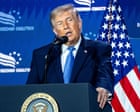
The air inside the arena always smells the same. It is a mix of stale popcorn, synthetic floor wax, and the collective heat of ten thousand people waiting for a spark.
If you stand near the press riser at the back, the noise does not just hit your ears; it vibrates through the soles of your shoes. For months, political analysts have been staring at spreadsheets, trying to decode the upcoming midterm elections with polling data, demographic shifts, and fundraising metrics. They treat politics like finance. They track the numbers. They calculate the margins.
But they miss the theater. They miss the soul of it.
When Donald Trump walks onto a stage in America’s heartland, the spreadsheet dissolves. He does not speak in policy positions or legislative compromises. He speaks in the oldest dialect known to humanity: the language of good versus evil, of total victory or complete destruction. When he looked out at a roaring crowd and branded his political opponents as "godless communists," it was not a slip of the tongue. It was a calculated, high-stakes experiment in political alchemy.
To understand why this works, you have to leave the cable news studios behind and look at the people sitting in the bleachers.
The Geography of Belonging
Consider a voter named Sarah. She is not a political operative. She runs a small daycare center in a Midwestern suburb, worries about the price of diesel fuel, and spends her Sunday mornings in a brick church that smells of coffee and old hymnals. For Sarah, faith is not a voting guide; it is the scaffolding of her life. It is how she makes sense of a world that feels increasingly volatile, loud, and unfamiliar.
When a political figure suggests that the other side of the aisle wants to tear down that scaffolding, something shifts inside Sarah. It is no longer an argument about marginal tax rates or infrastructure bills. It is an existential threat.
The strategy is simple yet devastatingly effective. By framing the Democratic platform not just as a different set of priorities, but as a hostile ideology—"godless communism"—the campaign stops being about governance. It becomes a crusade.
Politicians have always used labels to diminish their rivals. But this specific vocabulary taps into a deep-seated American trauma. For half a century, the word "communist" represented the ultimate shadow, the foreign adversary that threatened the very fabric of American freedom. By superimposing that historical ghost onto modern domestic political opponents, the rhetoric transforms ordinary neighbors who vote differently into agents of a foreign threat.
It simplifies a complex world. The messy, frustrating reality of bipartisan governance is replaced by a stark, binary choice. Light or darkness. Patriot or radical.
The Power of the High Voltage Wire
This kind of language operates like a high-voltage wire. It generates immense energy, but it burns whatever it touches.
For the campaign, the immediate benefit is obvious. Rage is a powerful motivator. It fills stadium seats, drives small-dollar donations, and ensures that voters will show up on a rainy Tuesday in November. When people believe they are fighting to save their way of life from a godless regime, they do not stay home. They vote.
But look closer at the friction this creates.
When the rally ends, the stadium lights go out, and the caravan moves to the next town, the words remain. They settle into communities like heavy smoke. They change how people talk across backyard fences. They alter the dynamics at Thanksgiving dinner tables. If the person across the street is merely a neighbor with bad ideas about tax policy, you can still invite them over for a barbecue. If they are part of a movement to dismantle your faith and freedom, the barbecue is over.
The challenge for the opposing party is that responding to this strategy is notoriously difficult.
If Democrats ignore the accusation, the silence is often interpreted by the base as an admission of guilt, or at least a lack of fight. If they respond with policy white papers, economic charts, and defensive explanations of their personal faith, they are bringing a knife to a laser fight. They are trying to answer an emotional, mythic narrative with a technocratic argument. It rarely lands.
The political arena has always been brutal, but the introduction of theological warfare changes the rules of engagement. When political disagreements are elevated to spiritual battles, compromise becomes a sin.
The stadium is empty now. The discarded signs lie on the concrete floor, damp with spilled soda. The echoes of the chanting have faded into the rafters, but the machinery of the midterm strategy is already locked into place. The language chosen for this test run will ripple through every television ad, every mailer, and every stump speech for the foreseeable future. It is a formula designed for maximum impact, built on the understanding that in modern politics, the loudest voice often dictates the perimeter of the fight. The country watches, waits, and prepares for the collision.