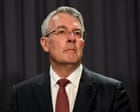
Australia is on the verge of redrawing the boundaries of public dissent. Former Attorney-General Mark Dreyfus dropped a political anvil onto the Royal Commission on Antisemitism and Social Cohesion by suggesting that protests should be legally banned outside synagogues and Jewish schools. His mechanism of choice? The High Court precedent that established "bubble zones" around abortion clinics.
This is not a theoretical argument about hurt feelings. It is a fundamental friction point between the right to assemble and the right to exist in public space without fear. Counsel assisting the commission, Richard Lancaster SC, laid out the stakes clearly, noting a "substantial and ongoing threat" that has resulted in a literal "shrinking of Jewish communal life" across the country.
The debate moves the goalposts of how modern democracies govern their sidewalks. It poses an uncomfortable question: when does a political assembly outside a house of worship stop being free speech and start becoming targeted intimidation?
The Abortion Clinic Analogy
By invoking the 2019 High Court decision that upheld 150-metre safe access zones around reproductive health facilities in Victoria and Tasmania, Dreyfus is attempting to borrow established legal architecture. The 2019 ruling succeeded because the court recognized that targeted protests outside medical facilities directly impeded a citizen's right to access healthcare safely and privately.
Applying that same logic to a synagogue or a primary school is a major legal leap. A clinic provides a discrete medical service. A place of worship is an anchor of civic, cultural, and spiritual life.
If the state seals off the perimeter of a synagogue, it must decide what constitutes a protest. Does a silent vigil with a placard trigger an arrest? What about a solitary figure holding a flag? The moment the law begins defining acceptable behavior based on the specific address of a building, it steps into a legal minefield.
The Shifting Burden of Private Security
While politicians debate the fine print of constitutional law, the everyday reality on the ground is governed by private budgets. The Royal Commission has pulled back the curtain on the immense financial strain currently borne by Jewish community groups. Volunteer-led operations, such as the Jewish Community Security Groups (CSGs), are effectively operating as secondary, localized intelligence and policing networks.
They monitor threats, secure drop-off zones at schools, and stand guard during Saturday morning services. This is a massive privatization of public safety.
+-----------------------------------------------------------------+
|              The Cost of Community Protection                   |
+-----------------------------------------------------------------+
| * Heavy reliance on volunteer-led CSG infrastructure            |
| * Spiraling financial costs for professional guard hire         |
| * Complex, real-time coordination with state police forces     |
| * Psychological toll on parents and community volunteers        |
+-----------------------------------------------------------------+
When a community must self-fund its own basic physical security just to send children to school or attend a funeral, the social contract has broken down. State police forces are reactive; they deploy when an incident occurs or when a large march is registered. They do not sit outside every neighborhood institution every single day. The proposed bubble zones are an attempt to use the statutory law to create a permanent, passive deterrent that police can enforce instantly without waiting for a situation to escalate.
The Practical Failure of Localized Bans
We have seen variations of this playbook before. New South Wales previously rushed through laws to restrict protests blocking places of worship, only to see parts of that legal framework challenged and struck down. The state government had to reintroduce reworked legislation just to keep pace with shifting judicial standards.
The problem with creating micro-zones of exclusion is that protest is fluid. If a group is banned from standing 150 meters from a school gate, they move to the 151-meter mark. They occupy the transit hubs the students use. They target the nearby shopping strips.
Targeted harassment does not disappear because of a geographical boundary; it merely mutates. A ban might clear the immediate footpath outside a sanctuary, but it does nothing to address the radicalization happening online or the broader social fragmentation that drives people to picket a house of worship in the first place.
The Threat to Broad Expression
Civil liberties advocates are watching this development with cold fury. The concern is obvious: if the government can ban protests outside religious institutions to protect social cohesion, what stops it from extending those zones to corporate headquarters, government offices, or university campuses?
Australia lacks a formal, federally entrenched bill of rights. Freedom of political communication is an implied right, carved out meticulously by the High Court over decades of jurisprudence. It is a fragile right that relies heavily on judicial interpretation.
If the state determines that the psychological comfort and safety of a specific group overrides the right to public assembly in a public street, a new precedent is set. Every controversial industry, every embattled politician, and every religious organization will have a blueprint for legal immunity from public scrutiny at their front door.
The state cannot easily distinguish between a protest targeting the state of Israel and a protest targeting the Jewish community itself when that protest is staged directly outside a local Australian synagogue. By pulling the conflict into the immediate physical space of suburban neighborhoods, the distinction between foreign policy dissent and domestic bigotry disappears entirely. Dreyfus knows this. His testimony was a warning that the current legal toolkit is failing to maintain that vital distinction, leaving communities to pay the price in anxiety and concrete barricades.