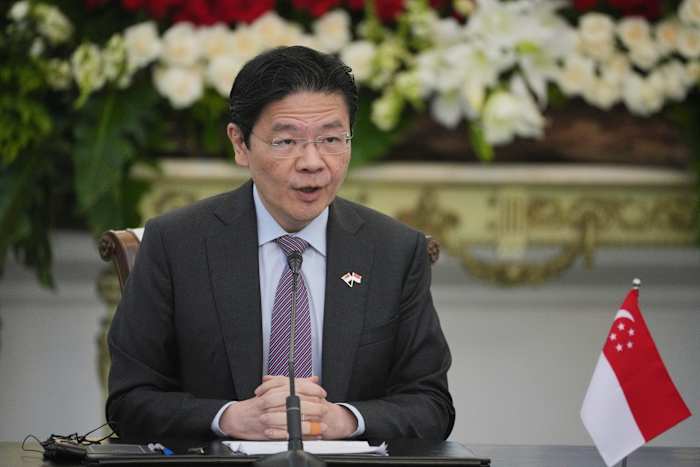
Singapore has broken a fifteen-year pay freeze for its political leadership, vaulting Prime Minister Lawrence Wong’s benchmark annual salary to S$3.6 million (approximately $2.85 million USD) and widening an already staggering chasm between public servants and ordinary taxpayers. Under a newly revised framework announced in Parliament, entry-level ministerial benchmarks are climbing from S$1.1 million to S$1.8 million, cementing the city-state's position as home to the highest-paid government officials on earth. Yet, beneath the headline-grabbing figures lies a carefully managed rollout: officials will not immediately pocket the full benchmark amounts. Instead, an initial one-off adjustment of up to 9 percent takes effect on October 15, leaving Wong to pledge his personal pay increase to charity for the next five years while the broader apparatus of governance grapples with an uncomfortable truth about meritocracy, public trust, and the market value of authority.
To understand why a government feels compelled to pay its leader nearly seven times the salary of the President of the United States, one must look past the sticker shock and examine the foundational doctrine of modern Singaporean statecraft. The People's Action Party has long operated on a pragmatic, corporate-modeled philosophy: to prevent systemic corruption and secure top-tier executive talent away from lucrative multinational boardrooms and elite law firms, public office must match private sector affluence.
The numbers are striking against domestic realities. While top ministers eye multi-million dollar packages, the median monthly wage for a resident worker hovers around S$5,775. That stark contrast fuels quiet resentment in coffee shops across the island, even in a nation accustomed to pragmatic governance.
Wong addressed the emotional friction head-on during his parliamentary address. He acknowledged that the sums dwarf what the average citizen brings home, admitting that political pay remains an emotive and difficult topic.
"Good government did not come naturally to Singapore," Wong told Parliament. "It was built deliberately over many years. And there is nothing automatic about sustaining this."
The architecture of this compensation model relies on an explicit indexing formula. Salaries are benchmarked against the median earnings of the top 1,000 citizen earners in Singapore, applying a 40 percent discount to account for the intrinsic public service ethos. Proponents argue this keeps compensation tethered to national economic growth. Critics, however, contend that tying political wealth to the hyper-rich upper crust creates an insular administrative class increasingly detached from the economic anxieties of the working class.
History shows that this system is uniquely vulnerable to political backlash. The last major overhaul occurred in 2012, when widespread public fury over ministerial compensation forced a bruising 36 percent pay cut. Subsequent reviews—including one recommended in 2017—were shelved or deferred as administrations balked at the political cost of raising their own wages. By freezing rates for a decade and a half, the government allowed a massive divergence to open up between bureaucratic pay and private sector trajectories, setting the stage for the current structural reset.
A common defense from state supporters points to the rarity of high-level graft. Singapore routinely scores near the absolute top of international transparency and anti-corruption indices. The argument posits that well-compensated officials possess zero financial incentive to accept bribes, turning honesty into a state-secured asset.
Yet, recent history complicates that tidy narrative. The 2024 corruption and obstruction of justice conviction of former Transport Minister S. Iswaran shattered the illusion that astronomical salaries act as an absolute shield against human greed or ethical lapses. It served as a stark reminder that institutional safeguards require constant vigilance, regardless of pay scales.
Furthermore, the mechanics of the current adjustment diverge from a simple rubber-stamp payout. Officials will not instantly scale the heights of the newly minted S$1.8 million floor for junior ministers. The initial 9 percent adjustment acts as a baseline, with future movements tied strictly to individual performance evaluations and portfolio responsibilities. Wong projects that most entry-level ministers will cluster around S$1.35 million by the conclusion of the current legislative term, turning the higher benchmarks into ceilings rather than guarantees.
This performance-oriented structuring attempts to appease a skeptical electorate, yet the core philosophical divide remains untouched. Can integrity and public dedication be purchased at market rate, or does an elite corps priced out of reach of ordinary life fundamentally alter the social contract between the governed and those who rule? As the new framework takes root with mandatory five-year structural reviews, Singapore tests the limits of whether technocracy can indefinitely outweigh populism in the ledger of state survival.