The metal chair in the center of the room is bolted to the concrete floor. It does not move. Neither does the young man sitting in it, his spine curved like a question mark, his skin a roadmap of blue-black ink. Outside the high, slit windows of the courtroom, the tropical sun beats down on San Salvador, heavy and suffocating. Inside, the air is cold, smelling of bleach and fear.
A judge sits behind a raised dais. She does not look at the man in the chair. Instead, her eyes are glued to a glowing monitor, scrolling through a digital spreadsheet that contains three hundred names.
Three hundred lives, reduced to rows on an Excel document.
The defense lawyer has exactly three minutes to speak. Not three minutes per person. Three minutes for the entire batch. He reads from a script, his voice a flat, exhausted drone. When his time expires, a digital chime sounds. The judge clicks a mouse. The spreadsheet updates.
Justice in El Salvador is no longer measured in weights and balances. It is measured in megabytes per second.
The Arithmetic of the Iron Fist
For decades, El Salvador was a nation defined by terror. To understand the present, we must remember the suffocating weight of the past.
Imagine a neighborhood where stepping across an invisible line on the asphalt meant an automatic death sentence. That was not a hypothetical scenario; it was daily life under the tyranny of MS-13 and the Barrio 18 gangs. Shopkeepers paid "rent" just to keep their doors open. Parents kept their daughters indoors, praying they wouldn't catch the eye of a local palabrero. The state had retreated, leaving a vacuum filled by violence.
Then came Nayib Bukele.
The young, baseball-cap-wearing president promised to crush the gangs. He kept his word. Under the régimen de excepción—a state of exception enacted in 2022 and renewed month after month—the government has arrested more than 80,000 people.
To house them, Bukele built the CECOT, a mega-prison of terrifying proportions. It is a monument to concrete and steel, designed to hold 40,000 souls in a state of perpetual sensory deprivation. No sheets. No mattresses. No family visits. Only white light and the rhythmic clinking of chains.
On the surface, the transformation is miraculous. The homicide rate plummeted to near zero. Streets that were once ghost towns after dark are now alive with night markets and children playing soccer. The fear that haunted the country for a generation has lifted.
But look closer at the machinery that built this peace.
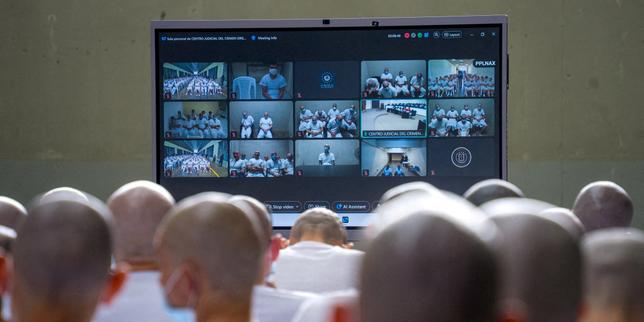
To process eighty thousand detainees, the traditional legal system had to be dismantled. It was simply too slow. The solution was the introduction of mass trials—collective hearings where up to nine hundred defendants are tried simultaneously via video conference.
The Ghost in the Algorithm
Consider the story of a hypothetical young man named Mateo. He is twenty-two, a construction worker from Soyapango. He has no criminal record. But he has a cousin who was in a gang, and he lives in a neighborhood controlled by that gang. One evening, walking home from work, he is stopped by a police officer.
Under the emergency decree, the police do not need a warrant. They do not need proof of a specific crime. Belonging to a gang is enough, and "belonging" is defined by the state’s digital databases.
Mateo is photographed. His data is uploaded into a centralized system managed by the Ministry of Justice.
This is where the human element vanishes, replaced by automated triage. The software cross-references Mateo’s address, his family ties, and anonymous tips received through a government hotline. The algorithm flags him as a high probability gang associate.
When his day in court arrives, Mateo does not see a courtroom. He sits in a crowded room inside a prison, staring at a television screen split into dozens of tiny boxes. In one box is a judge he will never meet. In another is a public defender who has never spoken to him.
The prosecutor presents the evidence: a digital folder containing a police report stating Mateo was found in a "gang-dominated area" and an anonymous tip. There are no witnesses to cross-examine. There is no discovery process.
The judge listens to forty similar cases in the span of an hour. The verdict is delivered en masse. Guilty. The sentence is parsed out automatically, appended to the digital file. Mateo is swallowed by the system, his identity erased by a keystroke.
Human rights organizations estimate that thousands of innocent people have been caught in this digital dragnet. They are the collateral damage in a war of statistics.
The Seduction of Efficiency
It is easy to condemn this from afar. From the comfort of a safe, stable democracy, the erosion of due process looks like a dystopian nightmare.
But talk to the mother who can finally walk her children to school without paying a toll to a teenager with a machete. Talk to the bus driver who no longer has to worry about being executed because his company couldn't afford the extortion fee. For them, the abstraction of "human rights" pale in comparison to the tangible reality of physical safety.
Bukele’s genius was recognizing that a traumatized population will gladly trade liberty for security. He weaponized efficiency. In the modern world, we expect everything to be instantaneous—our food, our entertainment, our communication. Why not our justice?
This is the hidden cost of the Salvadoran experiment. It creates a precedent that efficiency is the ultimate virtue of a state. It suggests that the slow, messy, frustrating work of individual justice is a luxury we can no longer afford.
The danger of an automated, assembly-line legal system is that it possesses no mechanism for correction. When a computer program miscalculates, it repeats the error flawlessly, thousands of times over, until someone forces a hard reset. In El Salvador, there is no one left to press the button.
The courtroom screen flickers. The next batch of three hundred names loads into the spreadsheet.
Outside, a mother waits near the prison gates, holding a manila envelope filled with utility bills and character references—worthless paper tokens meant to prove her son is a worker, not a killer. She has been standing there for three days. No one will take the envelope. No one will look at it. The system does not accept physical inputs.
The sun begins to set, casting long, dark shadows across the volcanic rock of San Salvador. The chime sounds again in the courtroom. Another click. Another row of lives turns from blue to red, locked away in the digital archives of a nation that decided peace was worth the price of its soul.