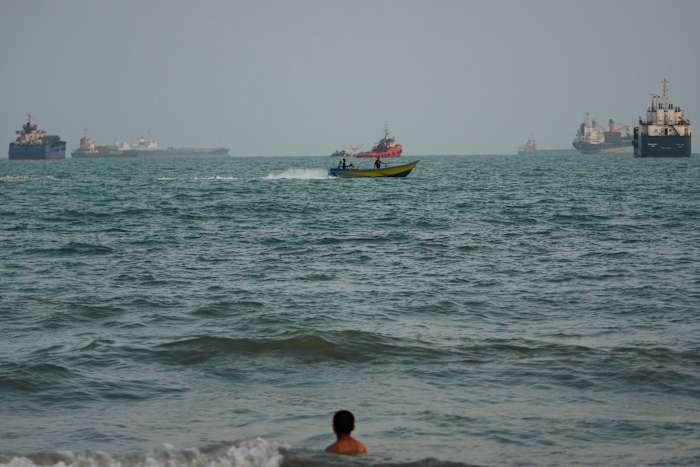
The sea does not care about borders, but it keeps strict accounts. In the humid stillness off Kharg Island, salt air clings to the skin like a second shirt, and the horizon blurs into a flat, blinding glare. Down below, deep in the engine control room of a patrolling American destroyer, the air smells of hot copper, ozone, and coffee that has been reheated one too many times.
Then the Klaxon screams.
For a few heart-stopping seconds, abstract geopolitics transform into raw physics. Ballistic missiles, screaming down from the upper atmosphere with the terrifying velocity of falling stars, target regional waters. They are aimed straight at an American aircraft carrier and its accompanying guided-missile destroyer. Modern warfare is largely invisible—fought through silent streams of telemetry, invisible radar beams, and split-second digital decisions made by young operators staring at glowing green scopes. But when steel meets evasion, the abstract becomes brutally immediate.
The ships move. Countermeasures flare. Algorithms calculate trajectories in milliseconds while human sailors hold their breath, gripping consoles until their knuckles whiten. The missiles miss. They churn into the dark swells, leaving behind churning white foam and ringing ears. No American blood is spilled today.
Yet, every action in this narrow, volatile corridor demands an equal and opposite reaction. The ledger must balance.
Half a world away from the carpeted briefing rooms of Washington, down in the Central Command nerve center, the response is swift, cold, and calculated not in territory, but in economic blood. The logic laid down by military commanders is mercilessly straightforward: if you shoot at two of our ships, we will take out three of yours.
The targets are not missile batteries hidden in the rugged mountain folds of the mainland. They are floating mountains of steel—crude oil carriers belonging to a multibillion-dollar shadow network that funnels lifeblood directly to Iran’s Islamic Revolutionary Guard Corps and its regional proxies. To understand this conflict, you have to look past the political speeches and watch the tankers. They are the financial arteries of a regime at war, moving the crude that pays for rockets, drones, and proxy militias. Cut the arteries, and the pulse weakens.
Consider what happens next in the Gulf of Oman and near the jagged coastlines of Jask and Kharg Island.
American air and naval power, flexing an undisputed reach, converges on three specific vessels: the M/T Downy, the M/T Stark 1, and the M/T Kylo—also known in shipping registries as the Noxen. These ships have no effective navy or air force to shield them; they are massive, lumbering, and utterly exposed in open water.
Imagine standing on the deck of the M/T Kylo as the warning order crackles through the radio, commanding the crew to drop tools, abandon ship, and flee into the safety of orange lifeboats. The engines whine down into a heavy, dying silence. The crew scrambles, hearts hammering against their ribs, looking back at the colossal hull they call home.
Moments later, precision strikes tear through critical locations on the unladen vessel. Secondary explosions bloom against the morning sky, rolling across the water in deep, concussive thuds that rattle windows miles away on the Iranian shore. The M/T Kylo is completely destroyed, its twisted skeleton settling slowly into the Gulf. Nearby, the Downy and the Stark 1 take direct hits that permanently disable their machinery, turning multimillion-dollar floating assets into burning, immovable hulks.
Thick plumes of black smoke billow into the stratosphere, visible for miles, writing a stark message across the Middle Eastern sky.
When the smoke clears, the strategic math of the region shifts once more. The surface skirmishes continue to flicker between periods of tense, fragile calm and sudden, violent spikes, treated by distant capitals as intermittent friction. But for the sailors staring out across the darkening water, and for the crews drifting away from their burning ships in lifeboats, the cost is real, heavy, and permanent. The ledger has been updated, written in fire and steel upon the restless waves.