The auctioneer’s gavel is a small piece of wood, but when it strikes a table, it makes the sound of a closing door.
A few years ago, in a plush London auction room filled with quiet men in tailored suits, that door slammed shut on a piece of football history. A circular hunk of gold and blue enamel, no bigger than a wristwatch face, changed hands. The final bid was £156,000. By the time the premium taxes and fees were tacked on, the anonymous buyer shelled out £316,800.
To the tax man, it was a luxury asset. To the statisticians, it was George Best’s 1968 European Cup winner's medal, minted to commemorate Manchester United’s historic 4-1 victory over Benfica at Wembley.
But to anyone who understands the beautiful game, that little disc of metal wasn't just memorabilia. It was the physical manifestation of a man's soul, sold off to pay for the wreckage of a life lived too fast.
The Weight of Gold
Look closely at the old photographs from May 29, 1968.
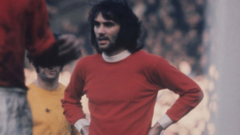
There is George. He is only twenty-two years old. His hair is a thick, dark mop that catches the stadium floodlights. His sideburns are sharp. He looks less like an athlete and more like the fifth Beatle, a pop icon trapped in a red football jersey.
That night, he bypassed Benfica’s goalkeeper with a feint so fluid it looked like modern dance. He rolled the ball into the empty net. The crowd roared—a deafening, tribal wave of sound that validated everything he was. When the final whistle blew, United became the first English club to lift the European Cup. The medal they pressed into Best’s palm was supposed to be the beginning of an empire.
Instead, it was the peak. The view from the top of the mountain before the long, agonizing slide into the fog.
We tend to look at sports memorabilia as investments. We track values on graphs. We treat the market like a playground for the wealthy, a place where people hedge against inflation by buying the boots of dead strikers.
That is a sterile way to look at the world.
Consider a hypothetical boy sitting in the Stretford End in 1968. Let's call him Tom. Tom spent his pocket money on a ticket just to watch Best play. To Tom, Best wasn't a collection of statistics. He was freedom. He was proof that a working-class kid from Belfast could conquer Europe with nothing but a leather ball and pure defiance. When that medal sold decades later, it wasn't just a transaction. It was the commercialization of Tom's youth. It was a price tag placed on a memory that should have been priceless.
The Auction of a Life
George Best did not sell this medal on his deathbed. The story of how it reached the auction block at Bonhams is more complicated, tangled in the messy reality of a family trying to cope with a legacy that was both a blessing and a curse.
Best passed away in 2005. His liver failed. His body simply quit after decades of severe alcoholism. He left behind a fractured estate, a mountain of memories, and a handful of physical tokens from his glory days. The European Cup medal ended up in the hands of his sister, Barbara McNarry, through the George Best Foundation.
When the decision was made to sell it, along with a collection of his other trophies and awards, the family faced fierce criticism. Fans cried foul. Traditionalists argued the medal belonged in a museum, preserved for the public, kept safe from the private vaults of billionaires.
But public outrage rarely pays the bills or funds charitable foundations.
The auction itself was a study in tension. The air in the room felt thick. Bidders on the phone spoke in hushed whispers to representatives who raised plastic paddles with practiced indifference. The opening bid was high, but the price climbed with a terrifying momentum. Fifty thousand. One hundred thousand. One hundred and fifty.
With every tick upward, the medal drifted further away from the ordinary people who had cheered for the man who won it.
It is easy to judge the family. It is easy to sit in an armchair and declare that history should never be sold. But legacy is expensive. It carries an emotional tax that outsiders never see. The estate needed funds to keep Best's memory alive in constructive ways, to support charities that fight the very demons that destroyed him. To save the memory of the man, they had to sacrifice the metal.
The Illusion of Ownership
What does the anonymous collector actually own today?
They own a piece of history, certainly. They have a certified document proving that this specific piece of metal was once touched by the hands of Matt Busby and Bobby Charlton. They can lock it in a climate-controlled safe. They can display it under a spotlight behind bulletproof glass in a private study, pouring a glass of expensive scotch and staring at it while the rain beats against the window.
But they do not own the moment.
They do not own the feeling of sixty thousand people gasping as Best dropped his shoulder. They do not own the sweat that soaked into the Wembley turf. They do not own the sheer, unadulterated joy of a young man from Belfast who had the entire world at his feet before he turned twenty-three.
That is the great irony of the sports memorabilia boom. The wealthier the buyers become, the more detached they are from the source of the value. You can buy the artifact, but you can never buy the genius.
The market for these items has exploded because we live in an era that craves authenticity. Everything around us is digital, fleeting, and easily replicated. A tweet vanishes in seconds. A video clip is viewed a million times and forgotten by Tuesday. But a medal is heavy. It has edges. It has scratches on the back from where it knocked against other medals in a drawer. It represents a physical reality that can't be deleted.
The Ghost in the Machine
The tragedy of George Best is that he was always selling pieces of himself.
Long before his medal went under the hammer, he sold his privacy to the tabloids. He sold his energy to the nightclubs. He sold his immense, god-given talent to the bottle, pint by pint, until there was nothing left but a frail man in a hospital bed warning the world not to die like him.
The sale of the 1968 medal was just the final chapter in that long liquidation.
When the gavel fell, the room emptied quickly. The suits walked out into the London afternoon, checking their watches, calculating commissions, hailing black cabs. The medal was packed into a velvet-lined box, shielded from the light, and carried away into the shadows of private wealth.
The record books will always show the number: £316,800.
But if you walk past Old Trafford on a winter evening, when the fog rolls in off the canal and the bronze statues of the United Trinity look like they are about to step off their plinth, you realize the auctioneer's hammer didn't really settle anything. The money is gone, spent and distributed. The medal is locked away unseen.
Yet the ghost of George Best remains exactly where it belongs, free of charge, drifting past an phantom defender on a pitch that never grows old.