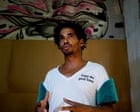
The Weight of the Suitcase
The cell at Guanajay maximum-security prison does not change based on the weather outside. It remains a gray, oppressive cube of concrete, smelling of damp stone, sweat, and the faint, chemical tang of cheap disinfectant. For years, this was the entire world for Luis Manuel Otero Alcántara. Outside those walls, the world moved on. Trends spiked and faded on TikTok. Wars broke out. Modern art galleries in New York and Paris held champagne receptions. Inside, there was only the rhythm of the guards' boots, the clink of metal, and the heavy silence of a man buried alive for the crime of holding a flag.
Then came the offer.
It did not arrive with a fanfare. It arrived with the quiet rustle of official paperwork. The Cuban government, which had spent years branding the performance artist as a dangerous threat to society, suddenly decided he was free to leave. Not free to walk the streets of Havana. Not free to return to his crumbling studio in the San Isidro neighborhood. Free to go to the United States.
To the outside world, this looks like a victory. Headlines across the globe flashed the news: the dissident artist had been cleared for travel. Human rights organizations breathed a sigh of relief. On paper, it is a triumph of international pressure and diplomatic maneuvering. But if you sit in the quiet realization of what that offer actually means, the victory begins to taste like ash.
Exile is not a gift. It is a weapon.
Consider a hypothetical young artist sitting in Havana today, watching this unfold. Let us call him Yosvani. Yosvani paints on scraps of cardboard because canvas is too expensive. He watches his friends board makeshift rafts or sell everything they own for a flight to Nicaragua. Yosvani wants to stay. He believes his art can change his neighborhood. But when he looks at the news of Otero Alcántara, the message from the state is crystal clear: We can break you, or we can erase you. Choose.
The Art of the Provocation
To understand why a government with an army and a nuclear-capable ally would fear a man with some paint and an internet connection, you have to understand Havana. The city is a living contradiction. It is heartbreakingly beautiful, decaying under the salt air, trapped in a time capsule of revolutionary slogans that few still believe.
Otero Alcántara understood that the greatest threat to an authoritarian regime is not violence. It is ridicule. It is joy.
He did not march with weapons. He wore the Cuban flag like a second skin. He lay in bed with it. He walked the streets with it. In a country where the state claims ownership over every national symbol, treating the flag like a personal, intimate object was an act of pure heresy. The authorities reacted with predictable fury. They arrested him dozens of times. They confiscated his work. They turned his home into a fortress under siege.
Every arrest only magnified his canvas. The street became his gallery. The police officers became unwilling performers in his grand piece about control and resistance. When the San Isidro Movement coalesced around him, it became a lightning rod for an entire generation of Cubans who were tired of whispering in their own kitchens.
Then came July 11, 2021.
Thousands of people poured into the streets across Cuba. They were hungry. They were tired of the blackouts. They wanted freedom. Otero Alcántara posted a video announcing he was joining the march. He never made it to the main protest. He was picked up before he could reach the crowds.
The trial that followed was a formality. The sentence was five years. The destination was Guanajay.
The Strategy of the Open Door
Governments like Cuba’s have a long history of using the exit visa as a safety valve. When internal pressure builds to a boiling point, you do not tighten the lid; you open a valve and let the steam escape. They did it during the Mariel boatlift in 1980. They did it during the rafter crisis of 1994.
By allowing prominent dissidents to leave for Miami or Madrid, the state achieves two things at once. First, it pacifies international critics. It allows diplomats to point to the release as a sign of progress. Second, and far more importantly, it decapitates the domestic resistance. A leader in exile is a leader who can no longer look his neighbors in the eye. He becomes a voice on a screen, easily dismissed by state media as a well-paid tool of foreign interests.
The state knows that nostalgia softens the edge of rebellion. Once you are trying to pay rent in Florida, navigating car insurance, and learning a new language, the raw, immediate anger that fuels street protests begins to blur. The survival of the daily grind replaces the survival of the political struggle.
This is the psychological trap of the current arrangement. The Cuban government did not suddenly develop a respect for artistic expression. They simply calculated that Otero Alcántara is less dangerous to them in an American gallery than he is in a Cuban prison cell.
Imagine the conversation in those sterile offices where these decisions are made. It is a cold mathematical equation. Five years in prison makes him a martyr. An infinite stay in Miami makes him just another expatriate.
The View From the Diaspora
For those who have already made that journey, the news brings a complicated mix of emotions. There is immense relief that a human being will no longer be subjected to the horrific conditions of a maximum-security prison. There is joy that he will eat real food, see the sun without bars, and be able to create without a guard watching over his shoulder.
But there is also a profound sadness.
Every Cuban who leaves carries a invisible brick of guilt. You leave behind the grandparents who cannot travel. You leave behind the streets that formed your vocabulary. You leave behind the very air that inspired your work. For an artist whose entire creative identity is rooted in the specific, gritty reality of Havana, exile can feel like an amputation.
How do you paint the sunlight of Cuba when you are looking at the neon signs of Miami? How do you speak for the hungry when your own refrigerator is full? These are the questions that haunt every exiled creator. They are the questions that Otero Alcántara will now have to answer for himself.
The international community often views these stories as simple morality plays. Good versus evil. Freedom versus tyranny. But the reality on the ground is muddy, painful, and deeply uncertain. The clearance to travel is not a happy ending. It is merely the beginning of a different kind of exile.
The suitcase is packed. The papers are signed. The plane will land on American soil, and the cameras will flash. A man will step out into the bright light of a free country, carrying nothing but his memories and the heavy, lingering scent of a cell he left behind.