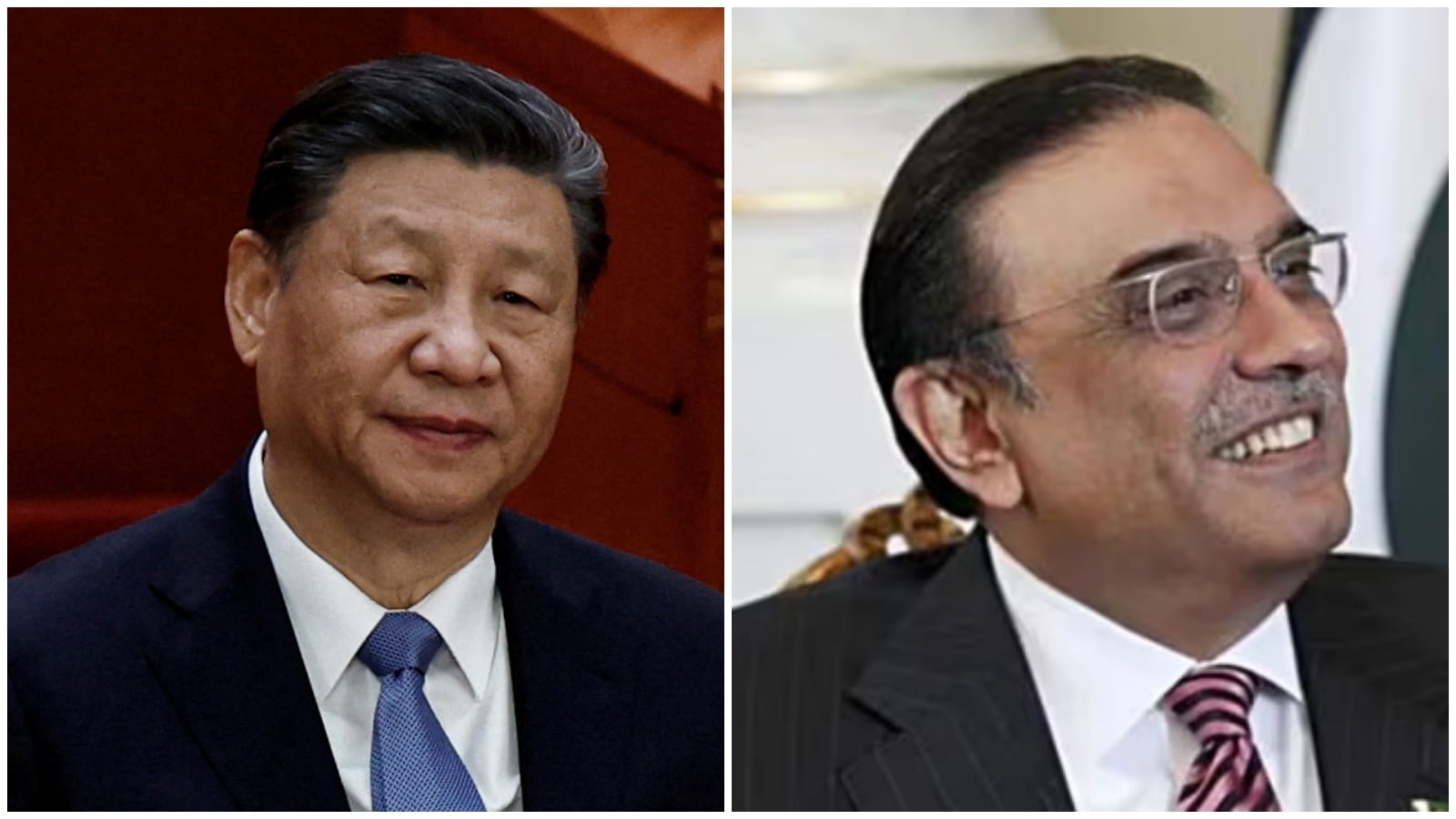
President Asif Ali Zardari landed in China this Saturday for a week-long mission that officially celebrates 75 years of diplomatic ties, but the reality on the ground is far grittier than the ceremonial red carpets suggest. While the official itinerary highlights visits to the industrial hubs of Changsha and the coastal breeze of Sanya, the true agenda is a desperate bid to breathe life into the stalled second phase of the China-Pakistan Economic Corridor (CPEC). Pakistan is currently trapped between a crushing debt cycle and a volatile security landscape that has made Beijing increasingly hesitant to write the blank checks of the past.
The visit comes at a moment of extreme fiscal fragility for Islamabad. Despite a recent $1 billion injection from Saudi Arabia, the State Bank of Pakistan remains in a defensive crouch, bracing for a $3.5 billion repayment to the UAE that has yet to be rolled over. For Zardari, this trip is less about historical nostalgia and more about ensuring that the "All-Weather Strategic Cooperative Partnership" translates into immediate industrial investment and debt relief.
The CPEC Phase 2 Pivot
For years, the corridor was defined by massive coal plants and gleaming asphalt. That era of heavy infrastructure is largely over. Beijing has shifted its focus toward "industrial embeddedness," a strategy that seeks to move Chinese manufacturing supply chains directly into Pakistani soil. The number of approved Special Economic Zones (SEZs) has ballooned from 7 to 44, yet most remain skeletal, awaiting the "anchor firms" necessary to trigger actual exports.
Zardari’s stops in Hunan and Hainan are deliberate. Hunan is a powerhouse for heavy machinery and agricultural technology, while Hainan represents China’s ambitious free-trade port model. Pakistan wants to replicate these successes, but the hurdles are systemic. Chinese investors are no longer satisfied with government guarantees that often fall victim to the Pakistani rupee’s chronic depreciation. They want operational stability, a commodity that has been in short supply.
The shift to Phase 2 is also a survival tactic. Pakistan’s export-to-GDP ratio is abysmal, hovering around 10% in a region where competitors are surging. By integrating into China-linked production networks, Islamabad hopes to finally fix its structural trade imbalance. However, this integration brings a new kind of dependence. It tethers Pakistan’s manufacturing base to Chinese technical standards, curricula, and equipment, creating a long-term technological ecosystem that will be difficult to decouple from in the future.
The Security Shadow
You cannot talk about Chinese money in Pakistan without talking about the cost of keeping it safe. The security environment has darkened significantly in 2026. The "open war" along the Afghan border and the resurgence of militant strikes against CPEC targets have forced Islamabad to allocate a massive portion of its dwindling budget to protecting Chinese personnel.
Beijing’s patience is wearing thin. Each attack on a Chinese engineer is a direct hit to the credibility of the corridor. During his meetings with provincial leaders, Zardari will likely be pressed for concrete updates on the "Uraan Pakistan" framework, specifically the security guarantees for the thousands of Chinese supervisors now required for the expanded SEZs. The irony is sharp. To attract the investment needed to save the economy, Pakistan must spend money it doesn't have on a security apparatus that has yet to prove it can fully insulate Chinese projects from regional blowback.
A Trilateral Balancing Act
The backdrop of this visit is further complicated by Pakistan’s emerging role as a mediator between the United States and Iran. While Zardari is in China, high-stakes diplomatic movements are occurring back in Islamabad involving Iranian and American delegations. China views this mediation with cautious interest. A stable Middle East and a pacified Iran-Pakistan border are essential for the long-term viability of the Gwadar Port, the crown jewel of CPEC that has struggled to meet its lofty expectations.
If Zardari can convince Beijing that Pakistan remains the indispensable bridge between the East and the West—and between conflicting regional powers—he may secure the favorable financing terms needed to avoid a total economic meltdown. But the "Iron Brotherhood" is increasingly transactional.
The Debt Trap Dilemma
Pakistan’s external debt now sits at a staggering $131 billion. Servicing this debt consumes nearly two-thirds of government spending, a math problem that has no easy solution. The International Monetary Fund (IMF) is watching this China trip with a hawk's eye. The IMF demands transparency and has warned against opaque, off-budget commitments to Chinese projects.
Zardari is walking a tightrope. He needs Chinese capital to spark growth, but he cannot afford to alienate the IMF, which provides the baseline credibility for Pakistan’s remaining international credit. The talk of "B2B cooperation" is a way to bypass government-to-government debt, but even private Chinese firms are wary of a country where the central bank struggles to cover three months of imports.
The outcome of this week in China will define the trajectory of the Zardari presidency. If he returns with only symbolic MOUs and no hard commitments for industrial relocation or debt restructuring, the "Iron Brotherhood" will look more like a polite distance between a patron and a client in crisis.
The era of easy money is dead. Pakistan must now prove it can be a productive partner rather than just a strategic geography.