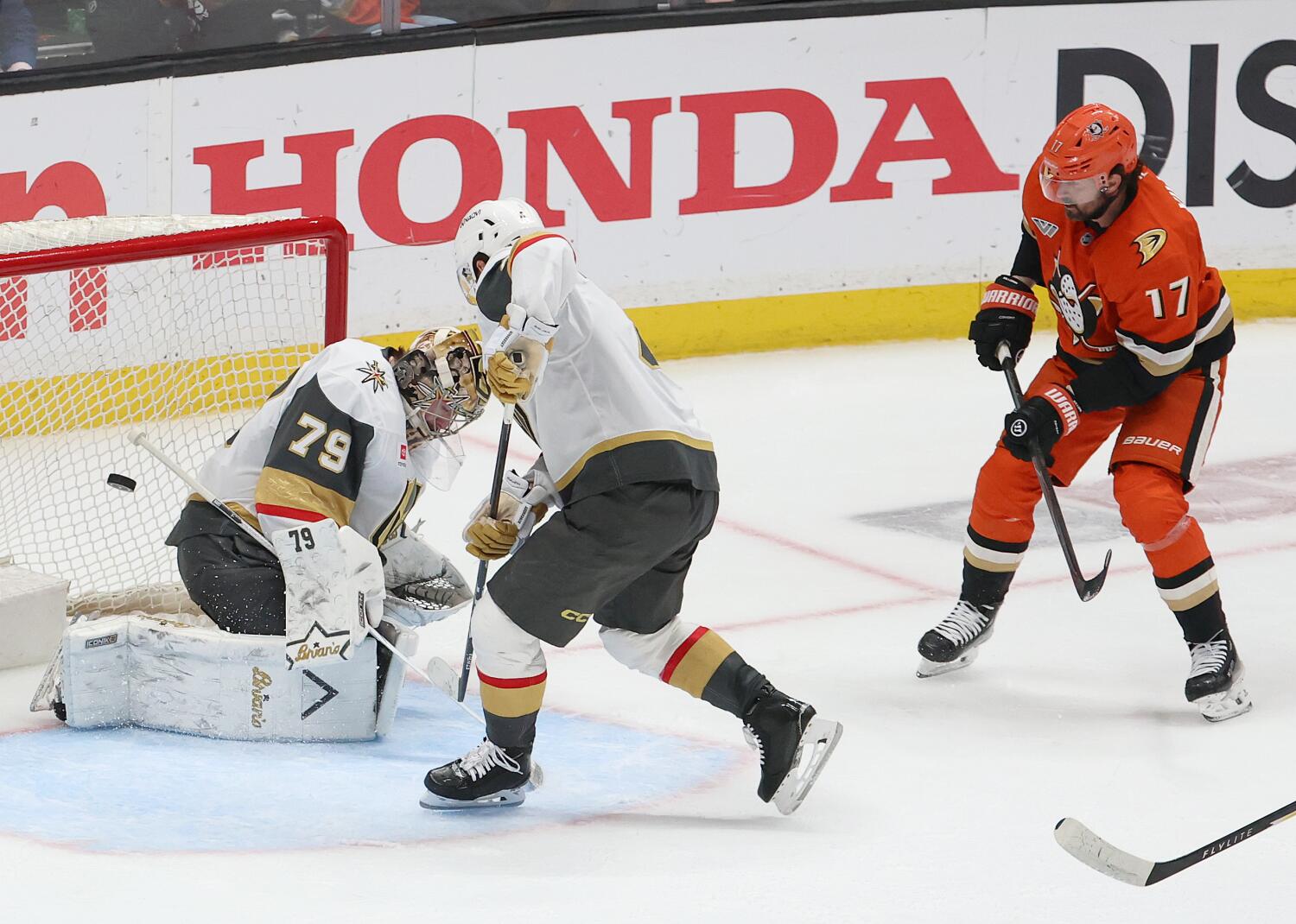
The hockey world is currently obsessed with a mirage.
After the Anaheim Ducks dismantled the Vegas Golden Knights to even their playoff series, the headlines practically wrote themselves. "Special Teams Surge," they screamed. "Ducks Find Scoring Touch." It is the kind of lazy, results-oriented analysis that keeps mediocre coaches employed and ruins betting accounts.
If you think a 3-for-5 night on the man advantage is a sign of a "resurgent" offense, you aren't watching the game. You are watching a spreadsheet.
The Ducks didn't win because their power play "found its touch." They won because Vegas played a high-variance, undisciplined defensive structure that won’t happen again. Betting on a power-play-led victory in the postseason is like trying to fund a retirement account with lottery tickets. It works until the math catches up to you.
The Myth of the Power Play Pivot
Conventional wisdom suggests that special teams win championships. It is a comforting thought because it implies that games can be decided in controlled, 5-on-4 environments where coaches can draw up plays on a whiteboard.
The reality is far more clinical.
Playoff hockey is defined by 5-on-5 suppression. Over the last decade of NHL postseasons, the teams that rely on the power play for more than 25% of their total scoring output almost never reach the Conference Finals. Why? Because referees swallow their whistles in May. The "scoring touch" the Ducks supposedly found is a temporary gift from the officiating crew, not a sustainable tactical shift.
When you look at the goals Anaheim scored, you see a defense in Vegas that was uncharacteristically stagnant. They weren't being picked apart by superior puck movement; they were caught in "no-man's-land" coverage, failing to clear the front of the net. That isn't an offensive breakthrough. That is a defensive collapse.
Regression is Coming for Anaheim
Let’s talk about Shooting Percentage ($Sh%$).
In a standard NHL game, a league-average power play operates at roughly $20%$. In their victory over Vegas, the Ducks operated at a clip that suggests they are the 1980s Oilers. It is a statistical anomaly.
- The Trap: Thinking that "momentum" carries over to the next game.
- The Reality: Power play success is highly volatile.
- The Danger: Anaheim’s even-strength play was actually outclassed.
While the broadcast was busy praising the Ducks' man-advantage execution, they ignored the fact that Vegas controlled over $60%$ of the Expected Goals ($xG$) at 5-on-5. If you are getting caved in at full strength, you aren't winning a seven-game series. You are surviving a single night on luck and a hot whistle.
I’ve watched teams ride a hot power play for three games only to get swept out of the building the moment the opponent stops taking "lazy" hooking penalties. If the Ducks believe their own press, they are walking straight into a buzzsaw in Game 3.
Why Vegas Still Holds the Edge
Vegas lost this game in the box, not on the ice.
The Golden Knights are built for heavy, grinding, even-strength dominance. Their defensive rotation is designed to clog the neutral zone and force dump-ins. In this specific loss, they lacked the discipline to stay out of the box, which neutralized their greatest asset: their depth.
When you are short-handed, your stars are sitting on the bench or burning their lungs on the PK. Your fourth-line energy guys—the ones who actually wear down an opponent over a long series—become spectators.
Vegas doesn't need to "fix" their defense. They just need to stop hitting people in the face.
The False Narrative of the "Power Play Specialist"
We need to kill the idea that certain players "specialize" in the power play as if it's a separate sport. If a player can’t produce at 5-on-5, they are a liability.
The Ducks are currently leaning on players who are scoring "garbage time" points on the man advantage while being defensive sieves when the numbers are even. This is the classic "empty calorie" stat line. It looks great in the box score, but it doesn't move the needle toward a Stanley Cup.
The Counter-Intuitive Path to Winning Game 3
If I’m the Ducks' coaching staff, I’m not celebrating this win. I’m terrified.
I would be showing the team tape of the 40 minutes where they were pinned in their own zone. I would be highlighting the missed assignments and the lost board battles.
Success in the playoffs is about sustainability.
- Stop chasing the perfect pass: The Ducks' power play succeeded because they threw pucks at the net blindly. It worked once. It won’t work when Vegas starts blocking those lanes.
- Shorten the shifts: They look tired. Relying on the power play is a sign of a team that can't dictate the pace of the game.
- Accept the ugly goal: If you can't score at 5-on-5 by crashing the crease, you aren't going to win.
The Industry Secret Nobody Wants to Admit
NHL analysts love the "Special Teams" narrative because it’s easy to explain to a casual audience. It’s "The Power Play vs. The Penalty Kill." It’s a mini-game.
The secret? Most professional scouts view a blowout power-play win as a "fake" win. It doesn't tell you who the better team is. It tells you who had a better 120 seconds of luck.
Vegas remains the superior roster. They have the better expected goal differential. They have the better goaltending floor. Anaheim’s "power-play touch" isn't a weapon; it’s a distraction from the fact that they are being outplayed in every meaningful metric that actually predicts a series winner.
Stop looking at the scoreboard and start looking at the shot heatmaps. The Ducks are standing on a crumbling ledge, and they think they’re flying because the wind caught their coat for a second.
Don't buy the hype. The "momentum" isn't with Anaheim. It’s with the team that knows they can dominate the other 50 minutes of the game.
Burn the game tape and get back to the dirty work at center ice, or prepare for an early summer.