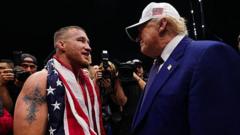
The staging of UFC Freedom 250 on the South Lawn of the White House establishes a precedent where federal infrastructure directly serves commercial enterprise and concentrated executive branding. Ostensibly organized to celebrate the United States' semiquincentennial and the incumbent executive's 80th birthday, the event structurally functioned as a high-yield monetization vehicle and a case study in athletic asymmetry. By analyzing the structural mechanics of the promotion, the economic pipeline of the distribution model, and the technical tactical variables of the main event, we can decode the strategic playbook that transformed federal property into an exclusive corporate engine.
The Revenue Mechanics of Federal Venue Arbitrage
The execution of professional sports within a restricted government perimeter bypasses traditional stadium cost functions while imposing significant capital barriers to entry for participants. The physical transformation of the space required erecting a 92-foot canopy—archaeologically dubbed "The Claw"—directly atop the executive lawn. Typically, a sports promotion incurs heavy local municipal taxes, venue rental fees, and permitting overhead. UFC parent company TKO Group Holdings absorbed an estimated $60 million in operational execution costs, but the return on investment was driven by two high-margin revenue structures:
- Sponsorship Hyper-Inflation: Corporate sponsorship packages escalated up to $1.5 million per unit, utilizing the historical exclusivity of the executive mansion to command premium valuations that standard arena installations cannot replicate.
- Monopsonistic Ticket Distribution: With capacity restricted to approximately 4,000 seats, standard public ticketing mechanisms were replaced. Seating inventory was bifurcated entirely between military personnel utilized for ideological staging and ultra-high-net-worth donors or corporate sponsors.
The distribution model relied on structural vertical integration to maximize executive-adjacent financial interests. Pay-per-view access was routed exclusively through Paramount+, a platform controlled by corporate leadership present at the event. Auxiliary monetization channels directly leveraged the captive audience; closed-captioning feeds for the broadcast were sponsored by private commercial entities owned by the executive's family, such as Trump Coin. This represents a closed economic loop where federal authority reduces promotional friction, corporate allies manage the distribution infrastructure, and private family enterprises capture residual cash flows.
Tactical Decay and Biomechanical Asymmetry in Gaethje vs. Topuria
The main event, which saw 37-year-old American Justin Gaethje defeat 29-year-old Georgian-Spanish favorite Ilia Topuria for the undisputed lightweight championship, serves as a masterclass in exploiting overextended aggression. Prior to the bout, Topuria possessed a pristine 17-0 record, characterized by technical boxing and an elite pound-for-pound rating. The sports books positioned Gaethje as a heavy 6-to-1 betting underdog, largely due to age-related regression curves typical in the 155-pound division.
The kinetic reality of the fight, however, exposed a failure in Topuria’s tactical pacing framework. The mechanical trajectory of the bout can be broken down into three distinct phases:
[Phase 1: Linear Aggression] -> Topuria forces high-volume exchanges, targeting head positioning.
[Phase 2: Positional Interruption] -> Gaethje lands a counter-punch in Round 2, altering Topuria's velocity.
[Phase 3: Attrition Domination] -> Gaethje applies attritional pressure, leading to a Round 4 corner stoppage.
Topuria relied on linear aggression, assuming his youthful volume would overwhelm Gaethje’s high-guard defensive shell. Gaethje systematically disrupted this velocity. In the second round, Gaethje landed a heavy counter-punch that altered Topuria's forward momentum and caused significant structural damage to Topuria’s facial profile.
This created a mechanical bottleneck for the champion. Topuria’s game plan lacked a secondary defensive pivot; as his spatial awareness degraded due to blood accumulation and accumulating head strikes, his punch accuracy dropped from an expected 60% baseline down to sporadic, telegraphed exchanges. Gaethje used this structural breakdown to dictate the distance. By targeting the midsection with a damaging knee strike in the fourth round and maintaining a constant output of heavy punches, Gaethje forced Topuria’s corner to initiate a technical stoppage late in the fourth round.
The outcome highlights the limitation of standard performance metrics. While youth and statistical volume favor the younger athlete on paper, high-variance striking environments favor fighters who can withstand early output and impose attritional damage.
The Historic Variance of the Undercard
The performance metrics of the UFC Freedom 250 undercard deviated entirely from historical baselines, recording an unprecedented 100% finishing rate across the first six bouts of the main card before the final stoppage. In the 33-year history of the promotion, zero main cards had achieved a clean sweep of knockouts or technical knockouts (TKOs). This statistical anomaly was driven by a distinct psychological variable: the immediate presence of the chief executive at cageside.
The physical architecture of the event required winning athletes to exit the Octagon immediately upon the referee's stoppage to engage in a direct greeting with the president. This structural loop altered the fighters' risk-reward calculus:
- Elevated Finishes: Athletes prioritized high-risk, maximum-damage striking combinations over safe, control-oriented grappling strategies to secure a definitive, highlight-reel finish.
- The Incentive Curve: A decision victory yields standard promotional payouts, but an emphatic knockout in front of a sitting president under a national spotlight drastically increases an athlete's political and social capital.
This incentive structure explains the performance of Josh Hokit, a former American football player who entered as a prospect against veteran heavyweight Derrick Lewis. Lewis was personally placed on the card via executive request. Despite Lewis's historical knockout power, Hokit bypassed cautious distance management, trading in close quarters to floor Lewis with a precise combination in the second round.
Similarly, middleweight Bo Nickal secured an immediate first-round TKO over Kyle Daukaus, immediately scaling the cage to convert athletic dominance into immediate political access. Bantamweight Sean O'Malley mirrored this operational behavior, executing a walk-off knockout against Aiemann Zahabi before immediately using his post-fight interview to build his personal brand within the venue's unique power structure.
Structural Geopolitical Risk and Capital Allocation
The integration of professional bloodsport with state infrastructure exposes significant systemic risks that corporations and sports promotions must quantify before attempting replication. The primary vulnerability lies in regulatory and legal exposure. Utilizing federal property for a commercial event operated by a private entity whose leadership maintains personal ties to the executive branch invites immediate administrative and legal challenges regarding the anti-competitive deployment of public funds and assets.
Furthermore, the operational security footprint required to isolate the White House South Lawn from the surrounding urban environment creates a hostile logistical perimeter. The forced removal of high-profile athletes like middleweight Sean Strickland from the Ellipse by the US Park Police highlights the friction generated when partisan politics intersect with independent contractor rosters. Promotions risk alienating key talent assets when the corporate stance becomes inextricably bound to a singular political apparatus.
For corporate entities looking to replicate this high-impact branding strategy, the capital allocation must be treated as a high-risk, depreciating asset. The immense short-term lift in brand visibility and premium sponsorship capture is offset by long-term reputational volatility. Promotions must build strict insulation layers between their core athletic ranking systems and external political influences.
The optimal strategic play moving forward is to treat federal venue activation as a non-repeatable marketing anomaly. Future event planning should return to neutral, high-capacity jurisdictions where municipal tax incentives can be codified contractually, rather than relying on executive fiat that remains vulnerable to shifting legislative majorities.


GR_SOL_TOP__FCO_X_200_ML.jpg)