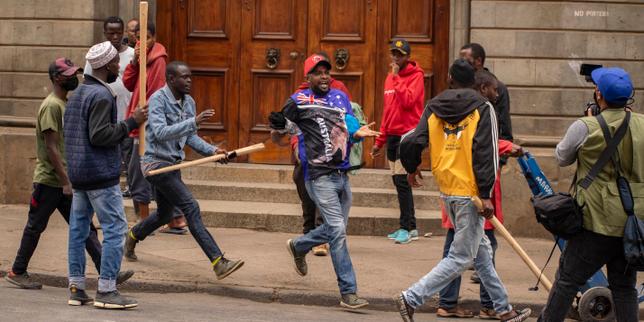
Political stability in Kenya is currently mediated by an informal, high-velocity market for violence. The emergence of organized "goonism"—the strategic deployment of non-state actors to disrupt rallies and suppress dissent—is not a spontaneous phenomenon of urban volatility. It is a calculated exercise in cost-shifting by political principals who seek to achieve strategic objectives while maintaining plausible deniability.
The Mechanics of Informal Repression
The infrastructure of political violence in Kenya functions as a tiered labor market. At the top of the hierarchy are political financiers, ranging from local aspirants to senior national officials. These principals do not directly engage in physical coercion. Instead, they interact with intermediaries—fixers who manage localized recruitment networks within low-income settlements such as Kibera, Kayole, and Kawangware.
The recruitment process exploits the intersection of extreme economic scarcity and youth unemployment. Investigative reports indicate a transactional "rate card," where individual operatives can be retained for as little as $4 per day. This low barrier to entry ensures a constant supply of human capital available for rent. By outsourcing violence to these informal syndicates, political principals accomplish three specific goals:
- Strategic Disruption: Preventing opposition mobilization by introducing uncertainty and physical danger into public spaces.
- Operational Decoupling: Creating a buffer between the state’s official security apparatus and acts of repression, which prevents direct legal and reputational accountability for the political leadership.
- Framing and Attribution: Using the chaos generated by these actors to frame peaceful protesters as "destructive elements" or criminals, providing a pretext for state intervention and the suppression of legitimate dissent.
The Three Pillars of Coercive Influence
The persistence of these groups rests on three institutional failures that characterize the contemporary Kenyan political environment.
1. The Arbitrage of Impunity
The most potent incentive for the use of informal gangs is the expectation of non-prosecution. When police forces "turn a blind eye" to the activities of these groups, the risk-reward calculation for the politician favors the use of violence. This creates an environment where the cost of suppression is lower than the cost of legitimate political engagement or policy competition.
2. Spatial and Social Fragmentation
These networks are deeply rooted in the structural vulnerabilities of informal urban settlements. Because these areas suffer from limited state service delivery and economic exclusion, the gangs often function as shadow providers of security or influence. This makes them difficult to dismantle without addressing the root causes of their local authority, as they are not merely "thugs" but stakeholders in the social fabric of their neighborhoods.
3. The Escalation Trap
The current trajectory points to a dangerous feedback loop. As political competition intensifies in the lead-up to the 2027 general elections, the demand for coercive services increases. This triggers a competitive cycle where rival political factions must match or exceed the violent capacity of their opponents to maintain operational parity. Consequently, what begins as a tactical tool for electioneering risks evolving into a self-sustaining security crisis that can easily escape the control of the original financiers.
Limitations of the Current Response
Current critiques often conflate "goonism" with simple criminality, which misinterprets the strategic intent. Treating these acts merely as a matter for local police stations fails to account for the top-down nature of the funding. Without targeting the financial pipelines and the political beneficiaries, security interventions are restricted to the symptoms—the street-level operatives—while the source of the violence remains untouched. The reliance on this model demonstrates a decay in democratic norms, where the physical occupation of public space is increasingly viewed as a legitimate component of the electoral process rather than an illegal disruption of civil rights.
Strategic Outlook
The market for informal violence in Kenya will likely reach a threshold of instability if the cost of recruitment continues to decrease while the political stakes remain high. To disrupt this equilibrium, interventions must shift from reactive policing to investigative focus on the political financing of these networks. Future stability hinges on the ability of civil society to map the financial links between donors and criminal syndicates, thereby increasing the reputational and legal costs for politicians who rely on coercion. The objective is to make the political cost of hiring a "goon" exceed the perceived benefit of their disruptive capability.
Kenya: Les "goons", ces petites mains de la violence politique, inquiètent les ONG
This video provides a concise overview of the rise of organized political violence in Kenya and the growing concerns regarding its impact on the 2027 electoral landscape.