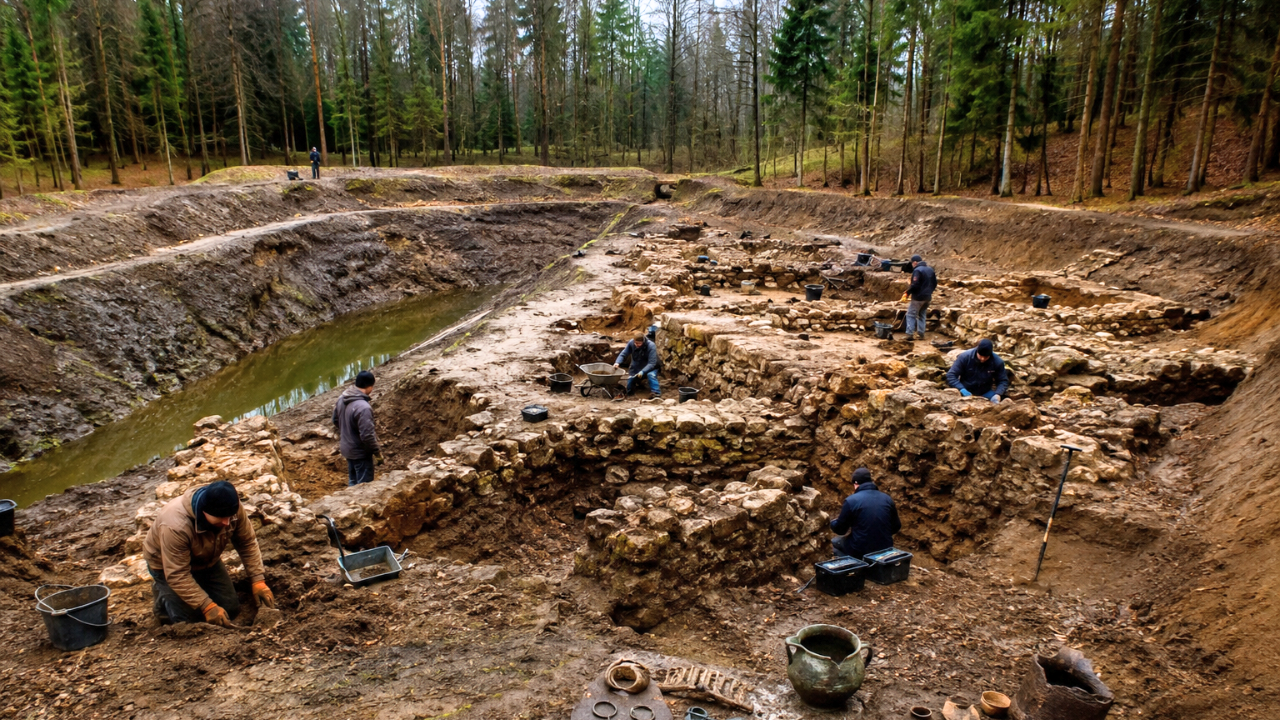
Archeologists in Poland have finally pinpointed the exact location of a lost medieval settlement that vanished from historical records six centuries ago. Deep within the Tuchel Forest (Bory Tucholskie), a team led by Dr. Mateusz Sosnowski used high-resolution LiDAR technology to strip away the dense canopy—virtually, at least—and reveal a perfectly preserved urban layout that has sat undisturbed since the 1400s. This isn't just a collection of old rocks. It is a complete, fossilized town plan that offers a rare, unfiltered look at how Central European life functioned before war and plague wiped the slate clean.
For decades, historians knew something was missing. Local legends and fragmented tax records whispered about a community in this region that simply ceased to exist. But searching for a needle in a haystack is easy compared to searching for a village under a primeval forest. The ground is uneven, the brush is thick, and the passage of time usually grinds timber and thatch into nothingness.
The Laser That Saw Through Time
The breakthrough didn't come from a shovel. It came from the air. Light Detection and Ranging (LiDAR) has fundamentally changed the economics and the physics of archeology. By firing millions of laser pulses from a plane and measuring how long they take to bounce back, researchers can create a three-dimensional map of the ground surface.
When Sosnowski’s team processed the data from the Tuchel Forest, the results were startling. The forest floor, which looks like a chaotic mess of roots and dirt to the naked eye, suddenly resolved into sharp, geometric patterns. They saw streets. They saw building foundations. They saw clear boundaries between private plots and public spaces.
This is the "Pompeii of the North," but without the volcanic ash. Instead of being buried by fire, the town was swallowed by silence. The forest grew over it, protecting the earthworks from the greatest enemy of archeology: the modern plow. Most medieval sites in Europe have been farmed over for five hundred years, which erases the subtle ridges and depressions of old homes. Here, the trees acted as a giant sarcophagus.
Why a Town Simply Dies
A settlement of this size doesn't just evaporate because of a bad harvest. To understand the death of this nameless town, you have to look at the brutal geopolitical realities of the 15th century. Poland was a meat grinder of competing interests, primarily involving the Teutonic Knights and the Kingdom of Poland.
The collapse likely boiled down to three factors:
- The Thirteen Years' War: Constant raiding and "scorched earth" tactics meant that even if a town wasn't burned down, its supply lines and trade routes were severed.
- Economic Shifting: The medieval economy was surprisingly fragile. If a nearby river changed course or a primary trade road moved five miles to the east, a town could lose its entire reason for being within a generation.
- The Black Death Resurgence: While the mid-14th century is the famous era of the plague, outbreaks continued to ripple through Eastern Europe for a hundred years afterward, often hollowing out rural communities that lacked the resources of major hubs like Kraków or Gdańsk.
The lack of large-scale stone ruins suggests the inhabitants lived in timber-frame houses. When the people left, the wood rotted, the roofs fell in, and the moss took over. Within fifty years, it would have looked like a series of strange mounds. Within a hundred, it was just "the woods."
The Layout of a Lost Society
What makes this specific find superior to previous discoveries is the spatial integrity of the site. The LiDAR data shows a centralized square, the clear predecessor to the market squares we see in modern European cities.
Researchers identified what appear to be individual farmsteads surrounding the core. Each plot had a specific long, narrow shape, indicating a highly organized system of land distribution. This wasn't a haphazard collection of huts. It was a planned community.
"We are looking at a snapshot of medieval urban planning that has remained static since the moment the last resident walked away," says the research notes.
The team also found evidence of man-made water management. Dikes and ditches suggest the inhabitants were sophisticated enough to direct water for both livestock and defense. This level of infrastructure requires a local government, a tax base, and a shared vision. Finding it all intact under a canopy of pine and oak is the archeological equivalent of winning the lottery.
The Difficulty of the Dig
Mapping a site is one thing; digging it up is another beast entirely. The Polish authorities face a massive logistical challenge. You cannot simply bring in a backhoe. Excavating in a protected forest means navigating a bureaucratic and environmental minefield.
Furthermore, there is the question of preservation versus exploration. As soon as you dig up a site that has been protected by the forest floor, you expose it to oxygen and bacteria. Timber fragments that have survived in an anaerobic state for centuries can crumble into dust in a matter of days once uncovered.
The current strategy relies on "non-invasive" archeology. Beyond LiDAR, the team uses magnetometry and ground-penetrating radar. These tools allow them to see metal deposits—nails, coins, tools—and stone hearths without moving a single inch of dirt. It is a slow, methodical process that prioritizes data over trophies.
What Lies Beneath the Floorboards
Initial probes have already hinted at the wealth of information buried just a few centimeters down. Pottery shards found in the topsoil date the site firmly to the late medieval period. These aren't just pieces of plates; they are fingerprints of trade. The chemical composition of the clay can tell us if the town was trading with the Baltic coast or looking south toward the interior of the continent.
There is also the grim possibility of finding human remains. If the town was abandoned during a conflict, the "lost" citizens might still be there, buried in shallow graves or left in the ruins of their homes. Their bones would hold the secrets of their diet, their hard labor, and ultimately, their cause of death.
The Modern Threat to Ancient History
The discovery has sparked a race against time that has nothing to do with the weather. Looting is a persistent shadow over Polish archeology. As soon as coordinates for sites like this become public, "treasure hunters" with high-end metal detectors often descend on the area.
They aren't looking for history; they are looking for silver groschen and Teutonic artifacts to sell on the black market. Every time a looter pulls a coin from the ground, they destroy the stratigraphy—the layer of soil that provides the context for when and how that coin got there. Without context, an artifact is just a trinket.
The Polish State Forests and local police have increased patrols in the area, but the Tuchel Forest is vast. It is nearly 300,000 acres of dense woodland. Hiding a town was easy for 600 years; protecting it now that it's found might be impossible.
Reframing the Medieval Narrative
We often think of the Middle Ages as a time of static, permanent settlements. We assume that if a town was built, it stayed there unless it grew into a city. The Tuchel Forest discovery proves the opposite. The medieval map was fluid. Towns were experiments. Some succeeded and became the Berlins and Warsaws of the world. Others failed and were erased by the map-makers.
This site forces a realization that there are likely hundreds of these "ghost towns" scattered across the European plains. Each one represents a failed economic gamble or a community that blinked in the face of a changing climate or a predatory neighbor.
The work in Poland is just beginning. As the team moves from aerial mapping to targeted test pits, the "Forest Secrets" will stop being myths and start being data points. We are about to get a very loud answer to the question of what happens when a society simply runs out of time.
The next time you walk through an ancient forest, look at the shape of the ground. Those strange humps and regular ridges aren't always the work of nature. You might be standing on someone's living room.
Go to the archives, check the old tax rolls, and look for the names that no longer appear on the maps. That is where the next ghost town is waiting.