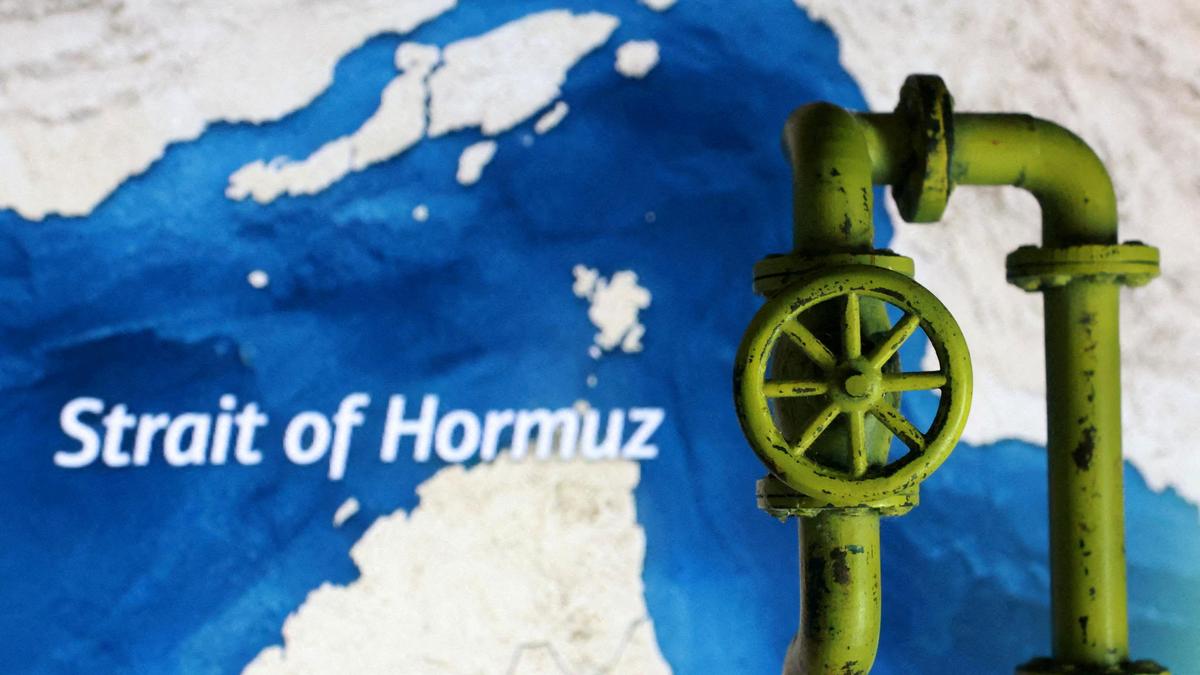
The map of the world is often drawn in ink, but it is governed by pressure. For decades, the global economy has held its collective breath every time a tanker maneuvers through the Strait of Hormuz. It is a narrow, jagged throat of water, barely twenty-one miles wide at its tightest squeeze. Through this passage flows one-fifth of the world’s liquid energy. It is a choke point in the most literal sense. If that throat closes, the world suffocates.
But 230 miles away, buried under the shifting orange sands of the Rub' al Khali, a different reality is being welded into place.
Consider a man named Omar. He isn't a CEO or a minister. He is a welder, a shadow in a heavy jumpsuit working in the brutal heat of the Fujairah coastline. His goggles reflect the blue spark of a join that will eventually help carry millions of barrels of crude oil from the giant fields of Abu Dhabi directly to the Gulf of Oman. He is working on a bypass. In the grand theater of geopolitics, Omar’s weld is a small stitch, but it is part of a 224-mile steel artery that effectively moves the United Arab Emirates' coastline.
The UAE is currently in the midst of a massive industrial pivot. By next year, the nation intends to double its export capacity through the Habshan-Fujairah pipeline. This isn't merely an infrastructure project. It is an insurance policy against geography itself.
The Tyranny of the Choke Point
To understand why a pipe in the desert matters to a commuter in London or a factory owner in Tokyo, you have to look at the water. The Strait of Hormuz is a psychological trigger. Every time a regional conflict flares or a naval exercise is announced, the price of oil spikes. Why? Because the markets hate a single point of failure.
Imagine a massive skyscraper with only one revolving door. If that door jams, the thousands of people inside are trapped, and the thousands outside are left in the cold. For the UAE, the "revolving door" has always been Hormuz. By expanding the Fujairah terminal, they are building a massive, high-speed back exit that opens directly into the deep, blue waters of the Indian Ocean.
The math is staggering. The current pipeline can move roughly 1.5 million barrels a day. The push to double this capacity means that soon, the UAE could potentially move the vast majority of its daily production without a single drop passing through the Strait. This shifts the power dynamic of the entire Middle East. It turns a vulnerability into a footnote.
The Sound of Silence in the Desert
There is a specific silence in the deep desert where the pipeline runs. It is the sound of immense, invisible power. If you were to stand above the buried line, you wouldn't hear the rush of the crude. You would only feel a faint, rhythmic pulse beneath your boots—the heartbeat of a global engine.
This project represents a triumph of engineering over environment. The heat in the Empty Quarter can liquefy standard plastics and push human endurance to the breaking point. Yet, the steel holds. The pumps, massive turbines that roar with the intensity of jet engines, push the "black gold" over the rugged Jebel Hajar mountains.
The climb is the hardest part. The oil has to be forced upward, defying gravity to reach the coastal plains of Fujairah. It is a brute-force solution to a diplomatic problem. If the sea is too dangerous or too crowded, you go over the mountains. You go through the rock.
The Fujairah Transformation
Thirty years ago, Fujairah was a quiet outpost known for its fort and its fishing. Today, it looks like a scene from a hard-science fiction novel. Rows of gargantuan white storage tanks sit like giant mushrooms against the backdrop of jagged, dark mountains. These tanks are the world’s waiting room.
The expansion of the export capacity here changes the very nature of how oil is traded. When a supertanker docks at the deep-water berths in Fujairah, it isn't just loading fuel. It is participating in a grand redirection of energy. These ships no longer have to navigate the crowded, tense shipping lanes of the inner Gulf. They pull up to the coast, fill their bellies, and turn east toward the hungry markets of India, China, and South Korea.
This creates a buffer. In the event of a maritime blockade or a regional skirmish, the UAE’s economy remains decoupled from the chaos. While other nations might see their exports frozen, the flow from Fujairah would remain steady, a constant stream of revenue and energy that ignores the headlines.
The Invisible Stakes
We often talk about "energy security" as if it’s a dry, academic concept. It isn't. It is the difference between a grocery store being able to chill its produce and a city going dark. It is the cost of a plane ticket to see a dying relative. It is the stability of a nation's currency.
The UAE’s decision to double down on this bypass is a confession of sorts. It is an admission that the world remains a volatile place and that relying on a single narrow strip of water is a gamble they are no longer willing to take.
There is a certain irony in the timing. As the West talks of energy transitions and the end of the oil age, the steel in the ground tells a different story. It tells a story of a world that still runs on high-pressure liquid carbon. It tells a story of a region that is bracing for a century where the ability to deliver that carbon—safely, reliably, and outside of the reach of rivals—is the ultimate form of sovereignty.
A New Map
The project is nearing its crescendo. The final stretches of pipe are being tested. The storage capacities are being calibrated. For the people living in the shadow of the Hajar mountains, the change is visceral. The skyline is no longer defined just by the peaks, but by the cranes and the masts of the world’s largest vessels.
By next year, the project will be fully operational. The UAE will have successfully moved its "economic mouth" to a safer place. They will have bypassed the most dangerous water on earth by simply ignoring it.
The weld that Omar made in the heat of the day is now cool. It is buried under several feet of sand, invisible to the satellites and the passing travelers. But as the first surges of increased volume begin to pulse through that steel, the geometry of global trade shifts. The throat is no longer so tight. The pressure has found a new way out.
The desert has always been a place of mirages, but there is nothing illusory about the millions of barrels now diverted through the rock. The map has changed. The sand has swallowed the sea's monopoly, and the world's most important detour is finally open.