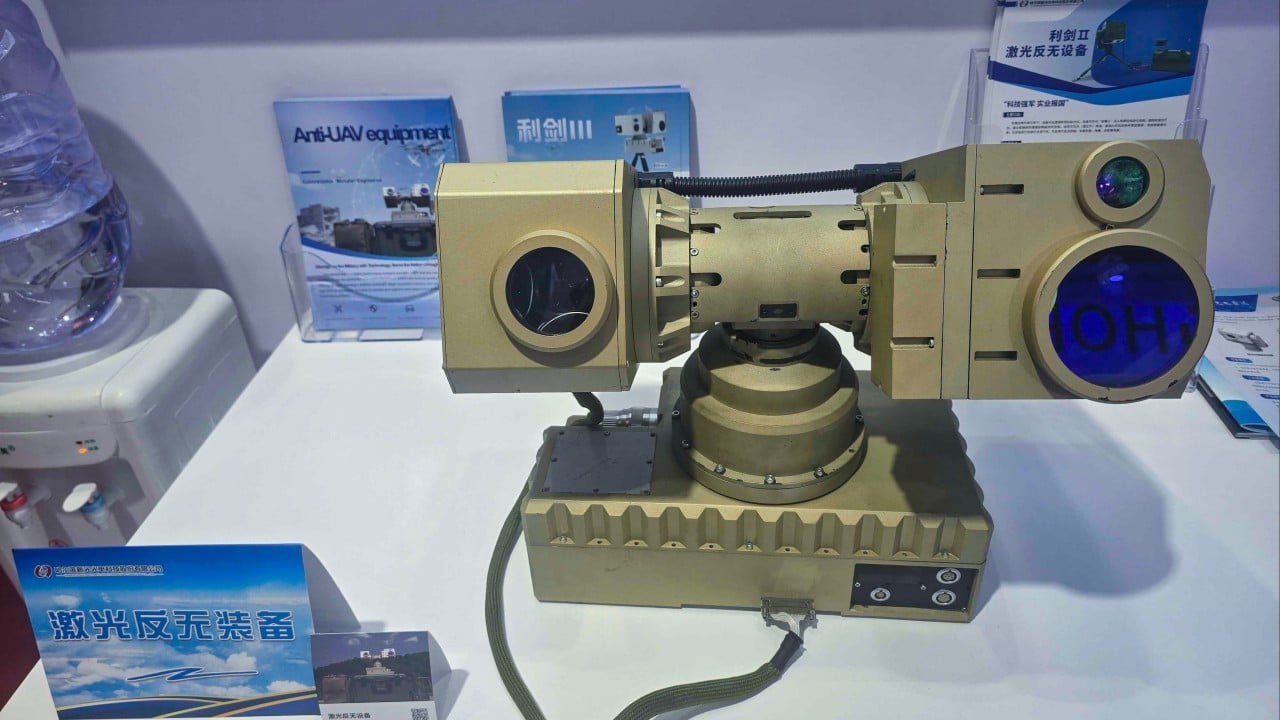
The democratization of low-altitude, slow-flying unmanned aerial systems (UAS) has exposed a structural vulnerability in modern air defense architectures. Conventional kinetic solutions suffer from a fatal asymmetry: utilizing a $100,000 surface-to-air missile to neutralize a $500 commercial off-the-shelf drone creates a negative economic feedback loop that guarantees defensive attrition. State-sponsored media releases regarding Chinese portable and vehicle-mounted tactical laser systems—specifically the "Guangjian-21A" hard-kill and "Guangjian-11E" soft-kill configurations—attempt to position directed energy weapons (DEWs) as the definitive resolution to this imbalance.
Evaluating the operational viability of these systems requires stripping away the speculative enthusiasm surrounding "portable" laser weapons. A rigorous analysis of directed energy physics, thermodynamic material destruction, and power density constraints reveals that while vehicle-integrated platforms are altering tactical doctrine, the concept of a true "single-soldier" individual laser weapon faces rigid physical bottlenecks.
The Micro-Layer Dilemma: Hard-Kill vs. Soft-Kill Disruption
To evaluate Chinese directed energy deployments, the mechanism of target defeat must be split into two distinct physical domains: thermal-structural degradation (hard-kill) and electro-optical saturation (soft-kill).
The hard-kill mechanism, utilized by platforms like the vehicle-mounted Guangjian-21A, relies on continuous-wave (CW) laser energy to induce rapid thermal loading on the target's skin. The physics of this interaction are governed by the material's absorption coefficient at the specific wavelength of the laser—typically around 1,064 nanometers for solid-state fiber lasers. The energy transfer function required to penetrate a drone housing is expressed through the relationship between thermal conductivity, heat capacity, and the spot size of the focused beam.
Energy Required = Mass × Specific Heat Capacity × (Melting Point - Ambient Temperature) + Latent Heat of Fusion
For a laser to achieve a hard-kill within a militarily viable window (under 5 seconds), it must deliver sufficient irradiance (watts per square centimeter) to outpace the thermal dissipation of the target material. On a carbon-fiber or aluminum UAS chassis, this means heating the substrate past its structural degradation point, causing aerodynamic failure or exploding the onboard lithium-polymer battery cells.
Conversely, the soft-kill approach, embodied by the Guangjian-11E, operates on a lower energy threshold. Instead of melting structural components, it focuses pulsed laser energy directly onto the optical tracking systems or camera sensors of the incoming UAS. This causes "dazzling"—temporary sensor blindness—or permanent structural damage to the sensor's focal plane array via thermal overloading of the charge-coupled device (CCD) or complementary metal-oxide-semiconductor (CMOS) element. Soft-kill systems require orders of magnitude less power and can operate effectively over longer slant ranges, as they do not need to melt metal or composites to achieve mission denial.
The Power-to-Weight Bottleneck of Infantry Portability
The primary constraint of any laser weapon is the inverse relationship between power output and system mobility. While state media demonstrations highlight individual soldiers operating modular units, true tactical efficacy is bound by the energy density of modern battery technology.
To burn through a commercial drone's rotor arm or fuselage at a distance of 500 meters requires a sustained beam delivery of at least 1 to 5 kilowatts (kW) for several seconds. When evaluating a hypothetical infantry-portable configuration, the total weight of the system decomposes into three sub-assemblies:
- The Beam Director and Optics: The lenses and gimbals required to focus and stabilize a high-energy beam on a moving target.
- The Lasing Medium: Fiber-optic modules or solid-state crystals that generate the coherent light.
- The Power Storage and Thermal Management System (TMS): The batteries needed to supply the electrical current, and the cooling loops required to prevent the lasing medium from destroying itself.
Solid-state lasers operate at an average efficiency of 30% to 40%. This means that for a 2-kW laser beam generated, approximately 4-kW of waste heat must be dissipated simultaneously. An infantryman cannot carry a liquid-cooling radiator assembly capable of managing that thermal spike without rendering the weapon completely static.
Furthermore, drawing 6-kW of electrical power from a man-portable lithium-ion battery pack limits the weapon to a minimal engagement window before depletion. Consequently, true "single-soldier" laser weapons are functionally restricted to low-power soft-kill roles—such as optical disruption rifles—rather than the hard-kill, drone-shredding capabilities frequently implied. Hard-kill operations remain tethered to vehicular platforms capable of supporting dedicated alternators and ruggedized liquid-cooling loops.
Atmospheric Attenuation and the Targeting Error Budget
Unlike kinetic projectiles, which maintain their mass and structural integrity through air currents, a laser beam is highly susceptible to atmospheric disruption. The path of a high-energy laser beam through the troposphere suffers from three distinct degradations:
Linear Absorption and Scattering
Molecules in the air (such as water vapor and carbon dioxide) absorb specific wavelengths of light, while aerosols and dust scatter the photons. This reduces the total power density that reaches the target surface, scaling exponentially with distance.
Thermal Blooming
As the laser propagates, the air along the beam path absorbs a fraction of the energy, heats up, and expands. This heated air acts as a diverging lens, causing the laser beam to defocus and spread its energy over a larger surface area at the target zone. This reduces the irradiance below the threshold required for material melting.
Jitter and Tracking Drift
To melt a drone component at a range of 1,500 meters, the beam must stay focused on an identical, sub-centimeter spot for a continuous duration of 2 to 4 seconds. At low altitudes (50 to 80 meters), atmospheric turbulence creates microscopic variations in the air's refractive index. This causes the beam to dance across the target.
Without highly sophisticated adaptive optics—systems that rapidly deform internal mirrors to compensate for atmospheric shimmer—and high-frequency closed-loop tracking sensors, the energy delivered is smeared across the drone's hull, resulting in surface charring rather than structural penetration.
The Unit Economics of Directed Energy Defense
The architectural integration of platforms like the vehicle-mounted Guangjian-21A into broader tactical networks highlights the clear economic advantage of directed energy over traditional options. When deployed from multi-mode terminal jamming systems alongside phased-array radars and infrared tracking, lasers offer a marginal cost per shot that conventional ballistics cannot match.
| Operational Metric | Kinetic Air Defense (e.g., HQ-17 / Pantsir) | High-Energy Laser System (e.g., Guangjian-21A) |
|---|---|---|
| Cost Per Engagement | $20,000 to $100,000+ per missile | Less than $5.00 (Cost of diesel/electricity) |
| Magazine Depth | Finite (Typically 4 to 12 rounds per vehicle) | Virtually unlimited (Tethered to fuel/power source) |
| Engagement Time | Flight time of missile (Seconds to minutes) | Speed of light (Instantaneous time-of-flight) |
| Collateral Risk | High (Shrapnel, unexploded ordnance fall) | Extremely Low (Line-of-sight energy termination) |
| Environmental Sensitivity | Low (All-weather operational capacity) | High (Severely degraded by heavy rain, fog, dense smoke) |
The strategic value proposition is not that lasers replace missiles, but rather that they serve as a cost-imposing tier within a layered defense system. By routing low-cost, slow-moving threats (Group 1 and Group 2 UAS) to directed energy platforms, command networks preserve high-end kinetic interceptors for complex, high-velocity threats like cruise missiles or loitering munitions.
The Countermeasure Escalation Cycle
Deploying these systems at scale immediately forces an evolutionary shift in UAS design. The primary limitation of tactical laser deployment is that the weapon's effectiveness is tied directly to the vulnerabilities of the target's outer layer. Adversaries can bypass laser hard-kills through cheap, passive structural modifications.
Applying highly reflective coatings, such as polished aluminum or gold-leaf laminates, can drop a target's laser absorption rate at 1,064 nm from 80% down to under 10%. If the drone reflects 90% of the incoming photons, the time-on-target required to melt the skin increases tenfold, breaking the weapon system's engagement timeline.
Additionally, manufacturing drone fuselages out of ablative materials—substances that peel away and carry the thermal energy with them as they vaporize—shields internal circuitry and propulsion elements from thermal transfer. Finally, programming incoming drone swarms to execute continuous, high-rate-of-turn maneuvers introduces tracking errors, forcing the laser's beam director to constantly shift its focal point and preventing the concentrated thermal buildup required for structural failure.
Strategic Deployment Reality
The integration of vehicle-mounted systems capable of firing on the move indicates a maturing capability in point defense. These units will likely find an immediate home protecting mobile command posts, logistics nodes, and localized air-defense radars from tactical scouting drones.
However, defense planners must discount the narrative of laser-wielding infantrymen single-handedly denying airspace. Until energy storage achieves a generational jump in megajoules per kilogram, man-portable laser systems will remain niche, short-range tools for sensor blinding and optical disruption, while the heavy lifting of drone destruction stays firmly bolted to a heavy vehicle chassis.
This video offers a practical look at how these mobile laser platforms operate in real-world conditions, providing visual context to the power and range requirements discussed above: China mobile laser weapon system showcase.