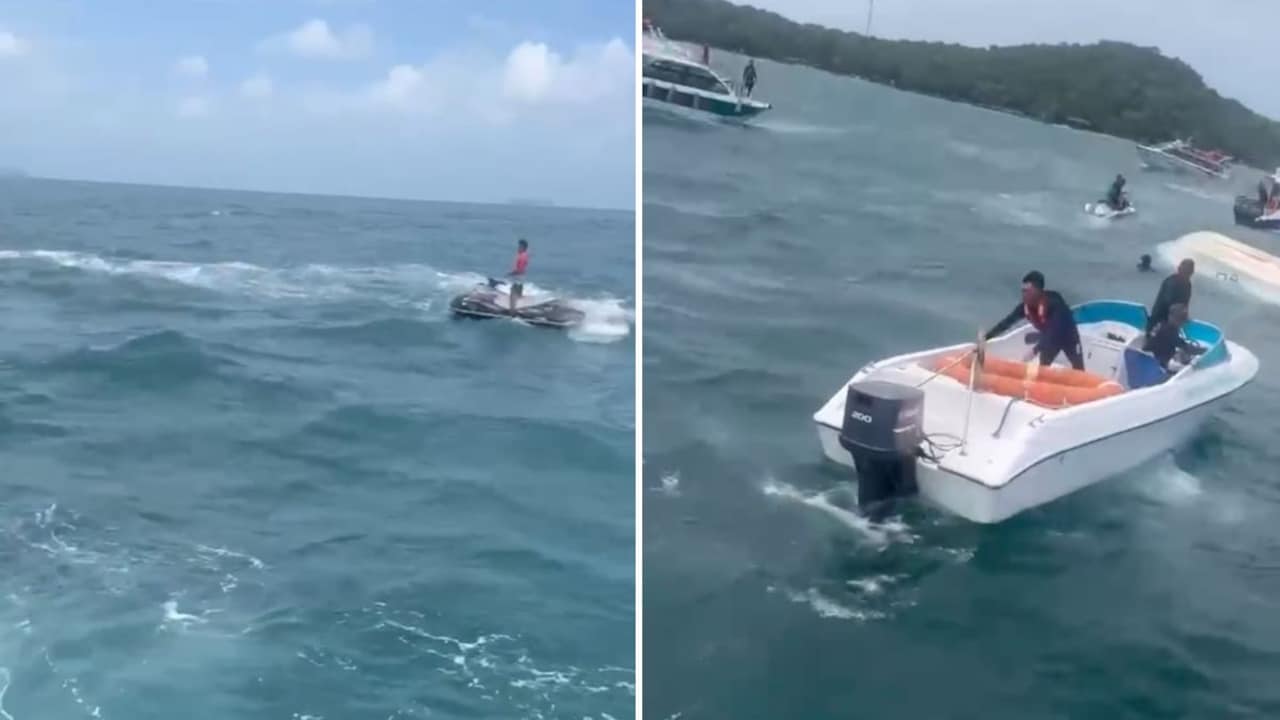
The capsize of a commercial speedboat 400 meters off Hon May Rut Ngoai island near Phu Quoc, resulting in 15 fatalities among Indian nationals, represents a predictable breakdown in operational risk mitigation rather than a simple consequence of adverse weather. While initial state declarations classified the event as an unavoidable climate anomaly, the subsequent arrest of the 57-year-old vessel captain, Nguyen Hong Hai, for inland waterway transport safety violations shifts the analytical focus. The incident demands an examination of three critical failure points: localized maritime dynamics, physical structural entrapment, and compliance psychology.
The Micro-Climate Risk Function
The geographic vector of the transit—originating at Hon May Rut Ngoai and heading toward An Thoi Port—features high vulnerability to localized, rapid-onset sea state deterioration. At 1:00 PM on the day of the incident, the micro-climate manifested three-meter waves despite a total absence of precipitation. Don't miss our previous coverage on this related article.
This decoupling of severe wave action from visual meteorological indicators (like storm clouds or heavy rainfall) creates a dangerous information asymmetry for vessel operators.
The primary physical mechanism driving the capsize was a combination of lateral wave force and asymmetric load distribution. A standard commercial speedboat designed for 30–40 passengers possesses a narrow beam width to optimize velocity. When three-meter waves strike such a hull perpendicular to its longitudinal axis, the vessel experiences a severe roll moment. If you want more about the context of this, NPR provides an in-depth breakdown.
If passengers shift simultaneously toward the leeward side to avoid spray or due to panic, the center of gravity moves outside the meta-centric height of the hull, causing instantaneous inversion.
The Entrapment and Flotation Disconnect
The critical determinant of the 41.6% mortality rate (15 deaths out of 36 total occupants) was not the submersion itself, but the immediate structural environment post-inversion. Operational data gathered from the rescue site reveals a dual-failure mechanism regarding flotation and egress.
The Structural Egress Bottleneck
First-responding vessels noted that a significant proportion of the deceased were trapped within the inverted hull framework. Speedboats configured for high-capacity tourism often feature rigid fiberglass or canvas canopies designed for sun protection.
When the vessel turtles, these structures act as a physical containment cell, reversing the intended escape route and creating an overhead barrier to the surface. For individuals lacking aquatic egress training, navigating an inverted, darkened compartment under severe hydrostatic pressure presents an insurmountable cognitive and physical bottleneck.
The Flotation Compliance Paradox
The second mechanism is rooted in human behavior and enforcement failure. Survivors and rescuers verified that while passengers received pre-departure instructions to utilize life jackets, a substantial portion carried the vests instead of wearing them. This creates a critical delay during a sudden capsize event.
An unfastened life jacket is stripped from a passenger's grasp by the hydrodynamic drag of an overturning boat. Without the immediate upward buoyancy vector of a secured vest, victims are subjected to immediate downward currents generated by the sinking or rolling mass of the vessel.
Strategic Operational Vulnerabilities in High-Growth Tourism
The broader context of this incident is the rapid scaling of Phu Quoc's international tourism sector, which recorded over 1.3 million foreign arrivals in the first half of 2026 alone. The influx of high-volume corporate travel groups—such as this 32-member delegation from the Indian smartphone manufacturer Lava International—places immense throughput stress on localized transit infrastructure.
[Rapid Volume Scaling (1.3M+ Arrivals)]
                 │
                 ▼
[High-Throughput Demand on Small Transit Operations]
                 │
                 ▼
[Incentive to Maximize Daily Fleet Rotations]
                 │
                 ▼
[Compressed Safety Check Windows & Safety Decoupling]
This structural stress incentives rapid fleet rotations, which decouples safety oversight from operational speed. The primary limitation of the current regulatory framework in these emerging hubs is its reliance on passive compliance. The captain or operator satisfies the letter of maritime law by having flotation devices physically present on the vessel.
However, they frequently fail to enforce active compliance—ensuring every passenger has a closed, buckled vest before the propulsion system engages. When regulatory bodies measure safety via an inventory check rather than behavioral audit logs, fatal operational vulnerabilities remain unaddressed.
The immediate suspension of regional speedboat operations by local firms represents a short-term, defensive reaction to legal liability rather than a systemic solution. Long-term stabilization of transit safety in emerging coastal corridors requires shifting from discretionary captain-level decision-making to centralized, automated dispatch protocols.
Implementing real-time wave-buoy telemetry linked to mandatory port lockouts during wave-height thresholds is the only mechanism capable of neutralizing the risks of localized micro-climates. Until operators face immediate digital license revocation for moving a vessel with unbuckled passengers, the behavioral failures that drove this tragedy will persist across parallel tourist corridors globally.