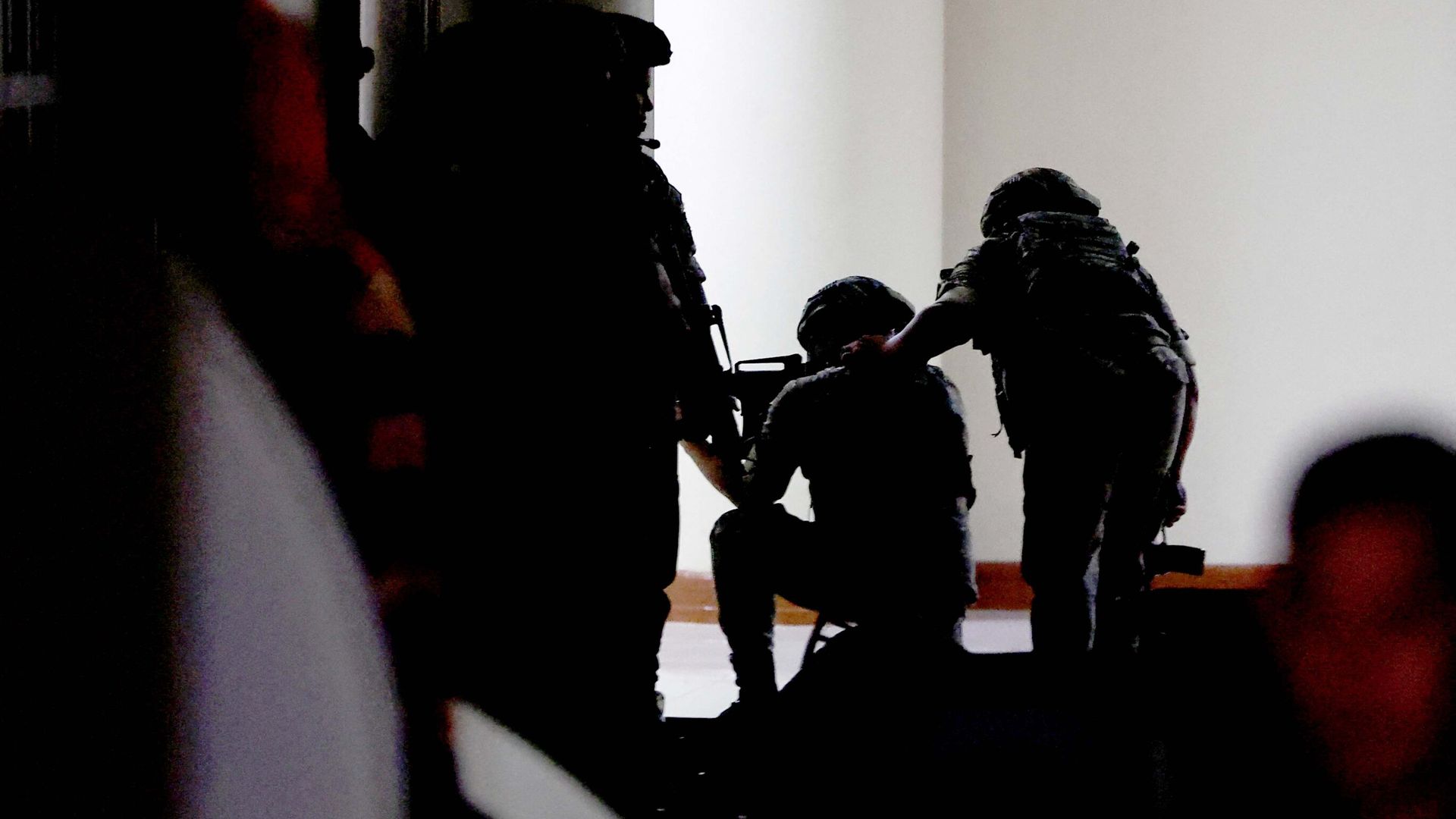
The sound of gunfire within the hallowed, supposedly secure halls of the Philippine Senate is not merely a security breach. It is a visceral signal that the country’s political institutions are buckling under the weight of an unprecedented internal war. When shots rang out in the vicinity of where a sitting senator—already under the shadow of international accusations for crimes against humanity—was seeking refuge, the thin veneer of democratic stability finally gave way. This was not a random act of violence. It was the physical manifestation of a legal and moral crisis that has been brewing since the first extrajudicial killings were recorded years ago.
The senator in question, whose name has become synonymous with the brutal enforcement of a controversial drug war, had been using the legislative building as a makeshift fortress. This strategy relies on the long-standing tradition of parliamentary immunity and the physical sanctity of the Senate, a tactic used by embattled Filipino politicians for decades. However, the recent violence suggests that the unwritten rules of political sanctuary are being rewritten in real-time, often with lead and gunpowder.
The Mechanics of an Institutional Siege
To understand why the Senate became a target, one must look at the legal wall the senator built. By refusing to surrender to authorities and instead holing up in a legislative office, the accused created a jurisdictional nightmare. The police cannot easily enter the Senate without violating the separation of powers, yet the Senate cannot harbor a fugitive from justice indefinitely without destroying its own credibility.
This standoff has paralyzed the legislative process. Instead of debating economic policy or infrastructure, the nation's leaders are arguing over room service for a suspect and the placement of tactical units in the hallways. The presence of armed supporters and the counter-deployment of special forces created a pressure cooker. It was only a matter of time before someone's finger slipped on a trigger.
Why the International Criminal Court Looms Large
The underlying trigger for this chaos is not just domestic law, but the heavy hand of international justice. The accusations of crimes against humanity are tied to a systemic pattern of state-sanctioned violence that allegedly claimed thousands of lives. For years, the Philippine government maintained that its judicial system was "working and able," a defense meant to keep the International Criminal Court (ICC) at bay.
The violence at the Senate shatters that argument. When a state cannot peacefully arrest one of its own high-ranking officials because that official has turned a branch of government into a bunker, the "functioning justice system" claim becomes a punchline. This spectacle provides the ICC with the exact evidence it needs: proof that the domestic legal apparatus is either unwilling or unable to handle the gravity of the crimes alleged.
The Myth of the Strongman Security
There is a bitter irony in the fact that a political figure who rose to power on a platform of "law and order" is now the primary source of national disorder. For the average citizen, the "iron fist" was promised as a tool to clean up the streets. Instead, that same fist is now pounding on the doors of the Senate, while the people who were promised safety are watching their capital turn into a combat zone.
The power vacuum created by this standoff is being filled by fragmented loyalties within the police and military. We are seeing a split in the ranks. Some officers remain loyal to the former administration and the senator, viewing him as a hero of the drug war. Others are moving toward the current administration’s mandate to restore the rule of law. This fracture is the most dangerous element of the current crisis. If the men with the guns cannot agree on who the criminal is, the law ceases to exist.
A History of Legislative Bunkers
This is not the first time a Philippine senator has hidden behind the red carpet. In the early 2000s, Antonio Trillanes IV and his "Magdalo" group took over hotels and utilized the Senate's protection during various mutiny attempts. The difference now is the scale of the accusations. We are no longer talking about a coup attempt or corruption charges. We are talking about the systematic elimination of citizens.
History shows us that these standoffs rarely end with a quiet surrender. They end with a middle-of-the-night raid, a negotiated exit that involves significant political concessions, or, in the worst-case scenario, more blood on the Senate floor. The current administration is walking a tightrope. Move too fast, and they create a martyr for the "Dutertista" base. Move too slow, and they look weak, proving to the world that some people truly are above the law in Manila.
The Collapse of the Gentlemen's Agreement
The Philippine political class has long operated on a "Gentlemen's Agreement"—a set of unspoken rules that protected the elite from the harshest consequences of their actions. You might lose an election, you might even be investigated, but you were rarely hunted. That agreement is dead.
The current escalation shows that the stakes have shifted from political survival to physical survival. When the threat is a cell in The Hague, the accused has no incentive to play by the old rules. They will burn the institution down around them if it means staying free for one more day. The shots fired in the Senate were the sound of the old guard realizing that their immunity has expired.
Tactical Failures and the Security Perimeter
The fact that an armed individual—or a group of individuals—could get close enough to discharge a firearm in the Senate's vicinity speaks to a catastrophic failure of the Senate Sergeant-at-Arms and the Philippine National Police. Investigative reports suggest that the security perimeter had been compromised by a mix of private security details and unauthorized "volunteers" loyal to the senator.
In any other democracy, a security breach of this magnitude would result in the immediate resignation of the entire security leadership. In the Philippines, it resulted in finger-pointing and conspiracy theories. Was the shooting a "false flag" designed to justify a more aggressive crackdown? Or was it an assassination attempt by those silenced by the senator's former policies? The lack of clear answers only deepens the public's distrust.
The Economic Cost of Political Theater
Beyond the immediate danger, the standoff is hemorrhaging the country’s economic prospects. Foreign investors loathe instability. They particularly loathe the kind of instability where the legislative body is under siege. As the standoff drags into its second week, the Philippine peso has shown signs of volatility, and talks of foreign direct investment have cooled.
Money follows stability. When the news cycle is dominated by footage of SWAT teams in the Senate cafeteria, the narrative of the Philippines as a rising tiger in Southeast Asia takes a backseat. The "Bagong Pilipinas" (New Philippines) branding of the current administration is being choked out by the ghost of the old one.
The Role of Social Media in Real Time Escalation
While the physical standoff happens in Pasay City, a digital war is being fought on TikTok and Facebook. Each side is using heavily edited clips of the Senate chaos to radicalize their base. The senator’s supporters frame him as a victim of "political persecution" and "foreign interference," while his detractors use the gunfire as proof that he is a warlord who must be neutralized.
This digital echo chamber makes a peaceful resolution nearly impossible. Any move by the government is immediately dissected and distorted by thousands of paid trolls and sincere fanatics. The reality of the situation—a legal process for alleged crimes—is lost in a sea of viral outrage. The gunfire provided the perfect "content" for these machines, turning a national tragedy into a spectacle for clicks.
The Broken Shield of Immunity
Section 11, Article VI of the Philippine Constitution provides that "A Senator or Member of the House of Representatives shall, in all offenses punishable by not more than six years imprisonment, be privileged from arrest while the Congress is in session." The crimes the senator is accused of carry penalties far exceeding six years. Therefore, the "immunity" being claimed is a legal fiction. It is a psychological shield, not a constitutional one.
The government’s hesitation to act is not about the law; it is about the optics. They are terrified of the "EDSA" effect—the mass mobilization of people that has toppled presidents in the past. But by waiting, they are allowing the senator to dictate the terms of his own capture. They are teaching the public that the law is negotiable if you are loud enough and have enough loyalists in the hallway.
Weaponizing the Senate Floor
During the standoff, the senator has continued to release statements and even participate in committee hearings via video link, effectively weaponizing his office. This allows him to maintain a veneer of legitimacy while evading the police. It is a mockery of the legislative process. The Senate floor, intended for the creation of laws, is being used as a platform to evade them.
This creates a dangerous precedent for future officials. If this tactic works, every politician facing a warrant will simply move into their office and claim "parliamentary sanctity." The Senate will no longer be a place of debate; it will be a high-end fugitive recovery center.
The End of the Standoff
The resolution of this crisis will likely not come from a courtroom, but from a backroom deal or a tactical breach. Neither option is good for the health of the republic. A deal suggests that justice is a commodity to be traded. A breach risks a bloodbath that could trigger wider civil unrest.
The shots fired in the Senate were a warning that the time for "delicate handling" has passed. When the institution tasked with making the laws becomes the primary obstacle to enforcing them, the state has failed its most basic duty. The senator may be hiding in an office, but the entire country is now trapped in the fallout of his defiance. Every hour the standoff continues, the authority of the Philippine state erodes a little more, leaving behind a vacuum that only more violence can fill. The government must decide if it values the tradition of the Senate more than the integrity of the law itself.
Stop treating the Senate as a sanctuary and start treating it as a crime scene. If the Philippine government wants to prove its judicial system is functional, it must end the theater and execute the warrants. Anything less is an admission that the Republic is still a collection of fiefdoms, and the law is only for those who can't afford a private army and a Senate seat.