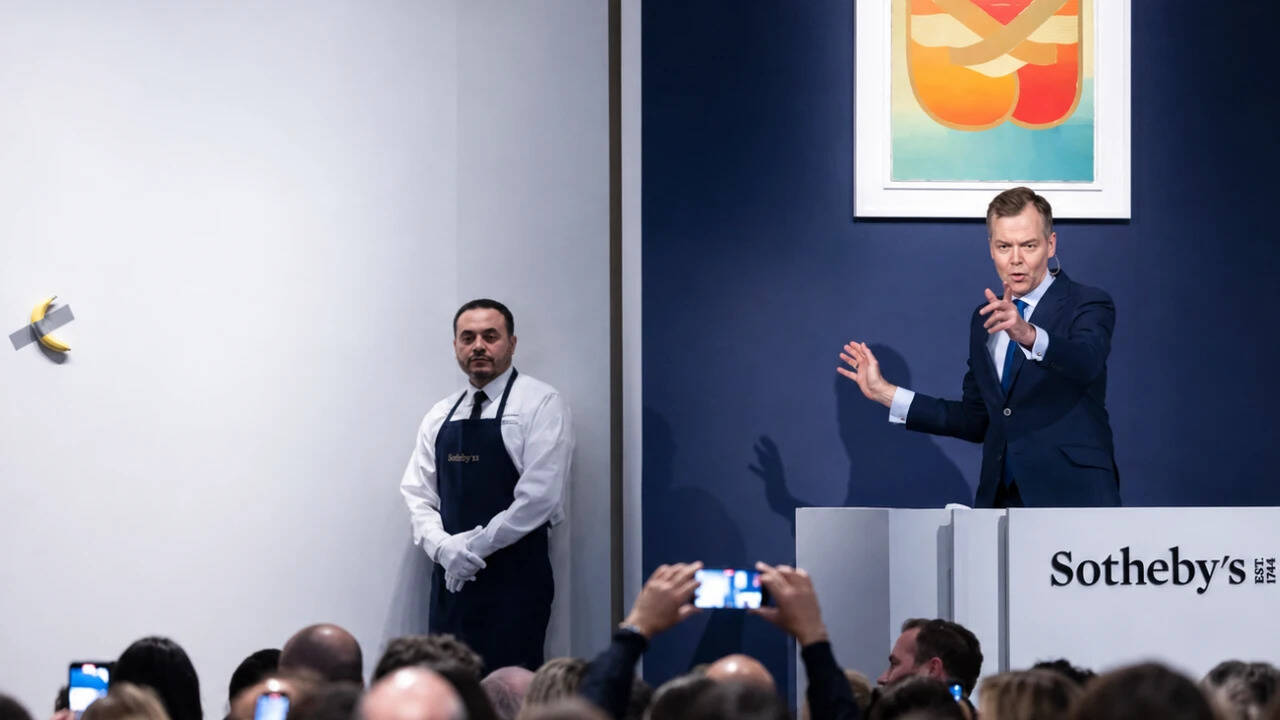
You’ve probably seen the headlines about a fresh banana stuck to a white wall with a strip of silver hardware-store duct tape selling at Sotheby's for $6.2 million. When converted, that is over Rs 50 crore for a piece of fruit that rots in less than a week. The internet erupted in a predictable wave of collective rage, confusion, and mocking laughter.
But if you think the buyer, cryptocurrency entrepreneur Justin Sun, actually spent millions of dollars on a piece of fruit that cost 25 cents from a Upper East Side street vendor, you’re missing the entire point of modern conceptual art. Read more on a related issue: this related article.
He didn't buy a banana. He bought an idea, a legal document, and a massive piece of cultural currency. Here is what is really happening inside the bizarre, hyper-inflated world of absurd art pricing.
The Certificate Of Authenticity Is The Real Artwork
The creation is titled Comedian, dreamed up by Italian satirical artist Maurizio Cattelan. It first made waves at Art Basel Miami Beach back in 2019, where early editions sold for $120,000. When Justin Sun won the fierce bidding war at Sotheby's New York, the physical banana and the tape used during the auction weren't shipped to his house in a climate-controlled crate. More reporting by GQ highlights similar perspectives on this issue.
Instead, he received a certificate of authenticity.
This document gives him the exclusive right to recreate the artwork. The certificate contains a precise, multi-page instruction manual written by Cattelan detailing exactly how the work must be installed. It specifies the angle of the tape, the height from the floor, and explicitly states that the banana must be replaced every seven to ten days.
Basically, the physical object is entirely disposable. The value lives entirely in the conceptual intellectual property. Think of it like buying a theatrical script rather than a specific performance, or buying a software license rather than a physical hard drive. You aren't paying for the carbon atoms; you're paying for the right to say you own the concept.
Art As The Ultimate Global Financial Meme
To understand how a piece of fruit reaches a multi-million dollar valuation, you have to look at who is buying it. Justin Sun didn't just tuck his certificate away in a vault. He flew to Hong Kong, called a massive press conference at the ultra-luxurious Peninsula Hotel, and ate the banana in front of dozens of cameras, claiming it tasted "much better than other bananas."
This wasn't a crazy billionaire losing his mind. It was a calculated marketing masterclass.
Sun explicitly compared conceptual art to non-fungible tokens (NFTs) and decentralized blockchain technology. In the modern financial ecosystem, attention is the most valuable asset. By purchasing a universally recognized meme, Sun bought global publicity that would cost tens of millions of dollars through traditional advertising channels.
The art market operates on a system of consensus and scarcity. When a piece becomes a global cultural touchstone, it transcends traditional aesthetic metrics. It becomes an artifact of our times. The exorbitant price tag itself becomes part of the medium. The absurdity isn't a bug; it's the core feature.
The Long History Of Buying Absolutely Nothing
While the public treats Comedian like a brand-new scam invented by elite grifters, artists have been pulling this stunt for over a century. If you're angry about the banana, you would have hated the early 20th-century avant-garde movement.
- Marcel Duchamp (1917): Bought a standard porcelain urinal from a plumbing store, signed it "R. Mutt," flipped it upside down, titled it Fountain, and submitted it to an art exhibition. It changed art history forever by declaring that art is defined by the artist’s choice, not their manual labor.
- Yves Klein (1959): Sold literal empty space in Paris. Buyers paid him in pure gold leaf for Zones of Immaterial Pictorial Sensibility. To complete the artwork, the buyer had to burn the receipt while Klein threw half the gold into the Seine River.
- Robert Rauschenberg (1953): Asked the famous painter Willem de Kooning for a drawing specifically so he could spend weeks completely erasing it. The blank, smudged paper became Erased de Kooning Drawing.
Cattelan is operating in this exact lineage. He is holding up a mirror to the extreme wealth concentration of the ultra-rich, mocking the very institutions that enrich him. The fact that billionaires eagerly line up to pay millions for the joke just makes the performance art even more successful.
How To Read The Absurd Art Market Yourself
If you want to navigate or understand these high-profile art market stunts without throwing your hands up in despair, stop looking at the object and start asking three specific questions.
First, look at the artist's track record. Cattelan isn't a random amateur; he is the guy who created a fully functioning 18-karat solid gold toilet titled America and hooked it up to the plumbing at the Guggenheim Museum. He has spent decades building a reputation as a master provocateur, meaning his jokes carry massive financial weight.
Second, trace the provenance and context. A banana taped to a wall in your kitchen is just breakfast. A banana taped to a wall at Sotheby’s, backed by a blue-chip gallery like Perrotin, is a validated financial asset. The institution provides the infrastructure of trust that allows wealthy buyers to trade abstract concepts like currency.
Finally, ignore the physical material entirely. When evaluating modern conceptual pieces, look at the conversation it generates. If an artwork manages to make the nightly news, spark global debates about economics, and cause a street vendor in Manhattan to weep in shock after finding out his 25-cent stock became a multi-million dollar luxury asset, the artwork has achieved its goal. It has disrupted reality.
Instead of laughing at the absurdity, realize that the high-end art market is just a hyper-pure reflection of modern capitalism, where the things we buy don't need a practical purpose to hold immense power.