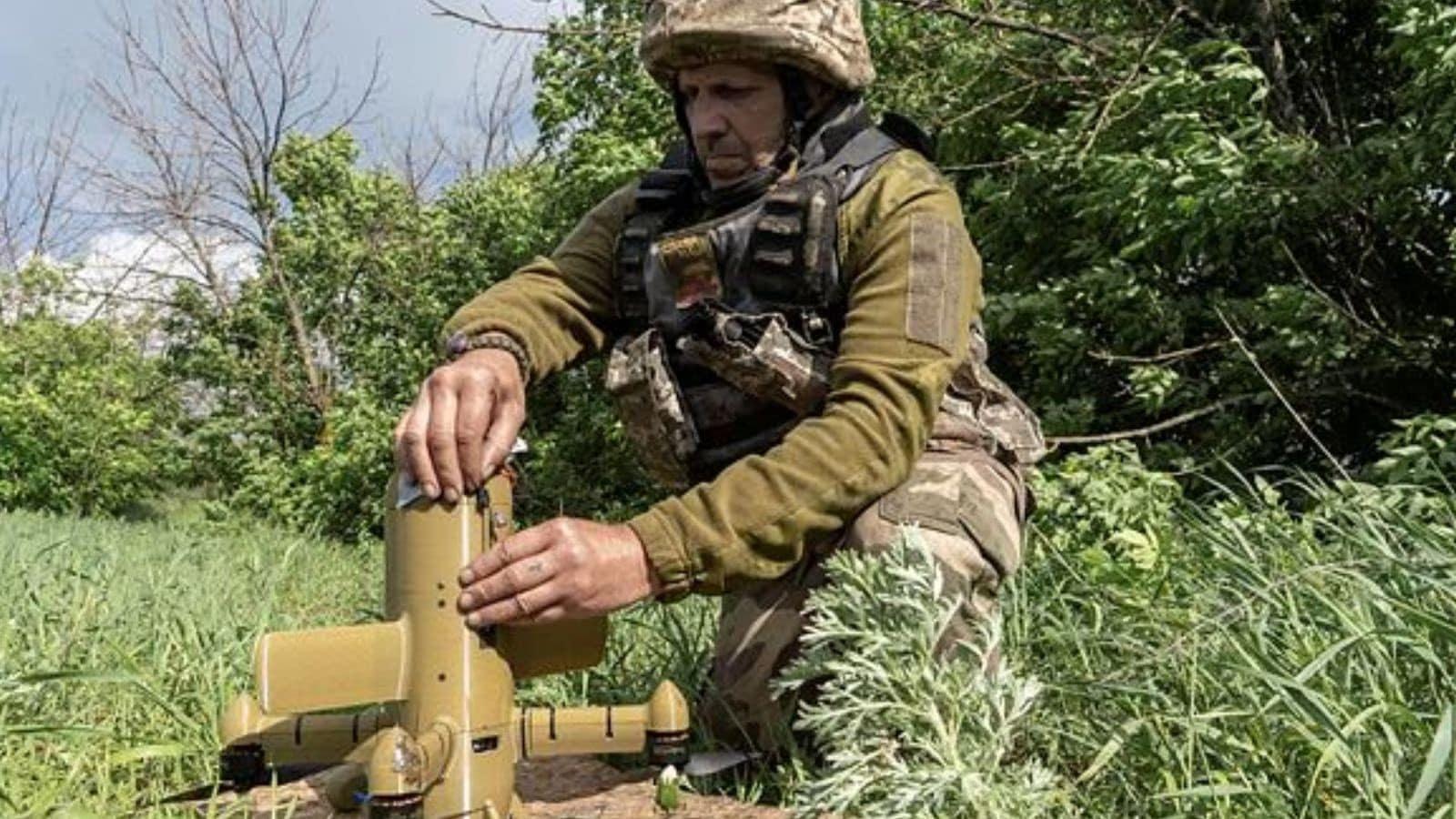
You have probably seen the sensational headlines screaming about the new era of sci-fi warfare. They paint a picture of autonomous killer machines rolling across Eastern Europe, fighting battles while humans sit back with joysticks. It sounds like a movie. But if you talk to the engineers in Kyiv or the soldiers hiding in muddy trenches near Kramatorsk, they will tell you a completely different story.
The real story isn't about Terminator-style androids winning the war on their own. It's about dirty, battered, remote-controlled steel boxes doing the most miserable, terrifying jobs imaginable so a human being doesn't have to. For another perspective, read: this related article.
Ukraine is currently executing a massive push to hand frontline operations over to machines. Through the DOT-Chain weapons marketplace, the defense ministry recently delivered over 1,000 uncrewed ground vehicles (UGVs) to frontline units. President Volodymyr Zelensky set an ambitious goal to scale domestic production up to 50,000 ground drones. This isn't a futuristic experiment anymore. It is a desperate, massive industrial effort to solve Ukraine's most critical bottleneck: manpower.
The tactical reality on the ground has forced this shift. The modern battlefield has become a kilometers-deep kill zone monitored constantly by aerial reconnaissance. If you send a traditional wheeled truck or a crewed armored transport to deliver food, ammunition, or medicine to an advanced trench position, it gets spotted instantly. Then it gets blown up by an FPV drone. The last few miles of logistics have become a suicide mission. Robots are filling that exact gap. Related insight on the subject has been shared by The Verge.
The Grunt Work of the Machine Army
Mainstream media loves focusing on the "drone tanks" bristling with machine guns. Look at the data, though, and you see that the vast majority of the 550 different UGV models developed across Ukraine aren't built for shooting. They are built for carrying stuff.
Logistics and medical evacuation platforms make up the bulk of the robotic workforce. In April alone, ground robots carried out over 10,200 frontline logistics and casualty evacuation missions. That is roughly 343 missions every single day.
Take a platform like the TerMIT, built by the Ukrainian company Tencore. It is a 620-pound tracked robot that can haul around 660 pounds of cargo. It doesn't look elegant. It is basically a rugged metal tray on tracks. But when a unit stuck under heavy artillery fire needs anti-tank missiles or fresh batteries for their radios, the TerMIT crawls through the mud to deliver them. If a soldier gets hit, that same robot carries them back to safety.
Frontline Robot Utilization By Task (Approximate Operational Share)
- Logistics and Resupply: 65%
- Casualty Evacuation (Medevac): 20%
- Mine-Laying and Clearing: 10%
- Direct Combat and Sentry: 5%
Another widely used platform is the Sirko-S, built by SkyLabUA. It is a compact, four-wheeled platform that handles similar low-profile resupply runs. Using these machines for the "last mile" transport has drastically slashed infantry casualties during resupply operations. It is a simple trade. If a Russian strike drone hits a Sirko-S, Ukraine loses a few thousand dollars worth of metal and batteries. If the drone hits a supply squad, four families lose their sons.
When the Robots Fight Back
While logistics drive the volume, combat UGVs are evolving quickly. The Ukrainian defense innovation cluster, Brave1, has cataloged more than ten distinct models of armed ground robots actively deployed in combat zones.
The Liut is a prime example of an armored wheeled robot built for direct engagement. It features a low profile, a 360-degree camera system, and a mounted tank machine gun. Operators can park the Liut at a forward intersection or a trench opening, hiding in a bunker hundreds of meters away while the robot takes the brunt of incoming fire.
We are also seeing highly specialized kamikaze ground units. The Ratel S, affectionately nicknamed the "Honey Badger," is a small, fast, wheeled vehicle designed to carry an anti-tank mine or a pack of explosives. Operators drive it directly into enemy fortifications, bunkers, or under the hulls of parked armored vehicles, detonating it remotely.
Prominent Ukrainian UGV Platforms
- TerMIT (Tencore): Heavy tracked logistics and casualty evacuation platform.
- Sirko-S (SkyLabUA): Four-wheeled low-profile supply runner.
- Liut: Armored wheeled combat robot with automatic targeting and machine gun.
- Ratel S: Small, high-speed wheeled kamikaze robot carrying anti-tank mines.
- ShaBlya (Roboneers): Remotely operated automated weapon turret.
The real technical evolution isn't the wheels or the tracks, though. It is the turret. Remotely operated fire complexes like the ShaBlya, developed by Roboneers, can be mounted on ground vehicles or placed stationary at forward sentry posts. These turrets incorporate basic machine vision and targeting algorithms.
When an enemy FPV drone or an infantry squad approaches, the turret's internal software assists with target detection, identification, and tracking. It calculates target distance, speed, and altitude, providing firing solutions to the operator. Some systems, like the devDroid TGP turret, are designed to sit flush inside a trench line, raise themselves up automatically when an enemy is detected, fire, and then retract back into safety.
The Invisible Threat That Knocks Drones Out of the Sky
The biggest challenge with ground robots has nothing to do with armor, chassis design, or ammunition capacity. The hardest problem is keeping them connected to their operators.
Airborne drones have a distinct advantage. They fly high above the trees, maintaining a clear line of sight with the controller's antenna. Ground drones operate down in the dirt, weeds, craters, and ruined buildings. Physical obstacles severely degrade radio signals. If a robot drops into a deep ravine or rolls behind a thick concrete wall, the video feed can instantly go black.
Worse, electronic warfare (EW) dominates the frontline. Both sides deploy powerful jamming systems that flood the airwaves with noise, severing the radio links between operators and their machines. If a robot loses its connection, it stops dead in its tracks. It becomes an expensive piece of junk waiting to be destroyed.
To combat this, Ukrainian developers are forced to innovate away from traditional radio frequencies. One of the most effective workarounds being tested right now by Brave1 is fiber-optic control.
Instead of broadcasting a radio signal through the air, the robot trails a spool of thin, ultra-strong fiber-optic cable behind it as it rolls forward. The connection is completely immune to electronic jamming. It cannot be intercepted or blocked. The downside is obvious: the line can snap if it catches on jagged metal or sharp rocks, making it a one-way mission tool for high-risk operations.
Why Western Tech Is Failing the Frontline Test
The intensity of this conflict has revealed a stark truth. Traditional Western defense procurement moves way too slowly for modern technological warfare.
Through the "Tested in Ukraine" program, Western arms manufacturers have started bringing their hardware to Ukraine for field testing. Many have discovered that their expensive, highly engineered systems fail almost immediately. Hardware built to standard NATO specifications often cannot handle the sheer density of electronic jamming or the brutal physical conditions of the Ukrainian steppe.
A great example involves the British startup Occam Industries, which brought an advanced AI-driven drone control system to Ukraine. The European hardware simply couldn't survive frontline conditions. Brave1 had to step in, strip the software, and integrate it directly into rugged, cheaply manufactured Ukrainian combat drones.
Ukrainian defense officials note that their domestic drone designs change and iterate roughly every three months to stay ahead of enemy countermeasures. Western defense companies typically operate on multi-year development cycles. They simply can't keep up with the pace of innovation required when the enemy adapts their electronic warfare frequencies on a weekly basis.
Step-by-Step Guide to the Tech Ecosystem
If you want to understand how Ukraine manages to field hundreds of different robot models without a centralized, multi-billion-dollar military-industrial complex, you have to look at their distributed network.
- The Brave1 Incubator: Private companies, engineers, or even hobbyists submit prototypes to Brave1. The government platform evaluates the design, provides technical feedback, and issues early-stage grants to scale production.
- The DOT-Chain Marketplace: Once a robot model is approved and certified by the Ministry of Defense, it is listed on an internal digital procurement marketplace called DOT-Chain.
- The Army of Drones Incentive: Frontline military units earn points for successfully destroying enemy targets. They can take those points, log into the marketplace, and order the exact robot models they need for their specific sector.
- Direct Deployment: The manufacturer builds the batch and delivers them directly to the brigade, bypassing traditional bureaucratic military supply chains.
This approach transforms the defense industry into something resembling a fast-moving software ecosystem. Over 280 private Ukrainian companies are now manufacturing these systems domestically, ensuring that 99% of the ground drones used on the battlefield are entirely home-grown.
The Reality of Autonomy
Don't buy into the hype that these machines are thinking for themselves. True fully autonomous combat—where a machine decides on its own to take a human life without a human in the loop—is not happening on a meaningful scale.
The vast majority of the systems deployed today are teleoperated. They are fancy, armored, highly lethal remote-control cars. While machine vision helps target a gun or track an enemy drone, human operators are still making the final decision to pull the trigger.
The push toward more autonomy is happening out of necessity, not a desire for a sci-fi future. If developers can build systems that navigate independently using GPS-denied visual tracking, they can bypass the electronic warfare jamming that cripples remote-controlled units.
If you are following the evolution of modern defense technology, stop looking at high-end fighter jets and experimental stealth tanks. The immediate future of conflict is being forged right now in small, messy workshops across Ukraine. It is built out of cheap steel, commercial batteries, agricultural GPS modules, and clever code.
Watch how these uncrewed ground systems perform over the next few months. Pay close attention to how engineers solve the connection issues through fiber optics and localized machine vision. The strategic lessons learned in the mud today will dictate exactly how global militaries organize, equip, and fight their battles for the next fifty years.
For a closer look at these machines operating in real-world conditions, you should watch this field report on Ukraine's ground robots which shows these platforms navigating the harsh terrains of the Sloviansk and Lozova directions.