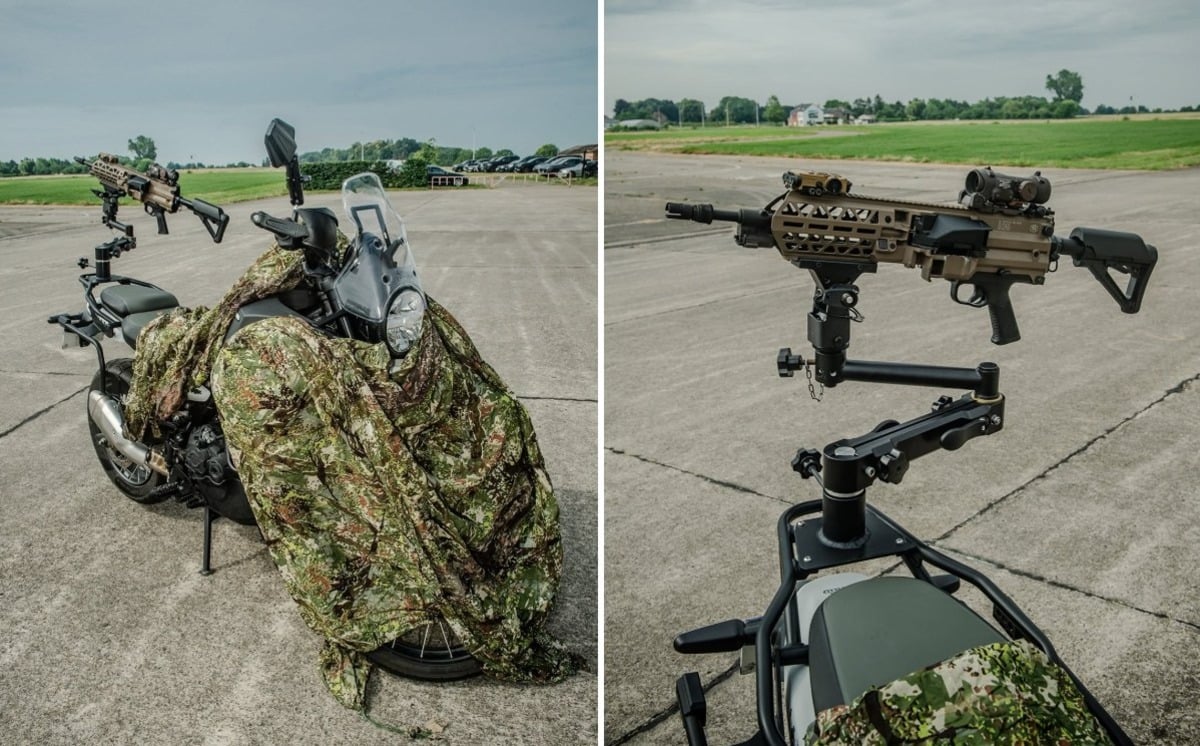
Mounting a machine gun or an anti-tank weapon to a two-wheeled vehicle sounds like something straight out of a Hollywood action movie or a video game. It looks incredible on paper. You get the speed and agility of a dirt bike combined with the devastating firepower of a military-grade weapon. When a French firm demonstrates a gun-mounted motorcycle at a defense expo, the internet immediately goes wild. People start imagining special forces units tearing through rugged terrain, firing at enemy lines while pulling off high-speed maneuvers.
The reality is completely different.
If you talk to any military engineer or combat veteran, they will tell you that sticking a heavy weapon onto a motorcycle frame is a logistical and tactical nightmare. It is a concept that armies have tried to master for over a century, yet it rarely works the way civilians think it does. The true value of a tactical motorcycle is not offensive firepower. It is rapid deployment and mobility. To understand why defense contractors keep trying to build these machines, you have to look past the cool factor and look at the brutal physics of battlefield engineering.
The Heavy History of French Military Bikes
This isn't the first time France has tried to marry small vehicles with massive firepower. Back in the 1950s, the French military faced a massive challenge during colonial conflicts. They needed a way to transport anti-tank weapons quickly across difficult terrain without relying on heavy, slow trucks. The solution they came up with remains one of the most famous and bizarre military vehicles in history, the Vespa 150 TAP.
Produced by a French firm under license, the TAP was literally a Vespa scooter fitted with an American M20 75mm recoilless rifle. The frame was heavily reinforced to withstand the brutal weight of the weapon. French paratroopers would drop these scooters out of airplanes packed into crates lined with hay to cushion the impact.
Many people look at old photographs of the Vespa TAP and assume paratroopers were riding down city streets while firing a massive cannon from between their knees. They weren't. Firing the weapon while moving would likely destroy the scooter and injure the rider. Instead, the scooter acted as a cheap, mobile cart. The troops would ride the Vespa to a strategic location, unmount the 75mm rifle, place it on a heavy tripod, and then fire it.
The modern iterations we see today follow a similar logic, even if the weapons are more advanced. When a company showcases a dirt bike with a machine gun bolted to the handlebars or a sidecar, they are trying to solve the exact same problem the French army faced in 1956. They want to move a weapon system from point A to point B as fast as humanly possible.
Engineering Nightmare of Recoil and Balance
Physics is the ultimate enemy of the gun-mounted motorcycle. When you fire a weapon, Newton’s third law ensures that the force of the bullet going forward pushes the gun backward with equal force. On a standard four-wheeled truck or an armored vehicle, that recoil is absorbed by tons of steel, heavy suspension systems, and stabilizers.
On a motorcycle, you don't have that luxury.
Imagine riding a 300-pound dirt bike on loose gravel. Now imagine firing a fully automatic machine gun that produces hundreds of pounds of rearward force. If the gun is mounted directly to the handlebars, the recoil will violently jerk the steering column. The rider will lose control instantly. Even if the gun is mounted to a fixed frame over the front wheel, the sudden rearward force will compress the front forks, alter the bike's geometry, and likely cause a catastrophic crash.
Weight distribution is another massive headache. A standard military machine gun, along with hundreds of rounds of ammunition, adds significant weight to a vehicle that relies entirely on balance to stay upright.
Putting that weight high up on the frame raises the center of gravity. This makes the bike incredibly unstable at low speeds and difficult to lean into corners. If you put the weight too far forward, the rear wheel loses traction. If you put it too far back, the front wheel lifts off the ground when you hit the throttle. Engineers have to spend months tweaking custom brackets and suspension valving just to keep the bike ridable before they even think about aiming the weapon.
Modern Special Forces and the Stealth Advantage
If shooting while riding is practically impossible, why do elite military units still use motorcycles? The answer lies in scouting, reconnaissance, and asymmetric warfare.
Special operations teams don't want to get into prolonged firefights while sitting on a motorcycle. They use highly modified, lightweight dirt bikes to slip past enemy lines undetected. These bikes are modified to be as quiet as possible. Some units use electric propulsion systems that make virtually no sound and emit almost zero thermal signature, making them invisible to infrared cameras.
A motorcycle can go where even the best 4x4 vehicles fail. They can navigate dense forests, narrow mountain passes, and fields littered with debris. A scout rider can find enemy positions, map out paths, and retreat before the enemy even realizes someone was there.
When a weapon is mounted to these modern bikes, it is usually meant for self-defense or suppression during a hasty retreat. If a scout gets ambushed, having a lightweight squad automatic weapon mounted to a quick-release swivel allows them to lay down a wall of suppressive fire to force the enemy behind cover. That gives the rider the vital seconds they need to turn the bike around and escape. It is an insurance policy, not a primary way to attack.
What Happens Next for Light Tactical Vehicles
The development of these armed bikes points to a larger trend in modern military strategy. Armies are moving away from massive, heavily armored convoys for every single mission. High-tech drones and advanced satellite surveillance mean that big trucks are easily spotted and targeted by long-range artillery or loitering munitions.
Small, fast, and cheap is the new doctrine.
Instead of deploying a multi-million dollar armored vehicle to guard a checkpoint or scout a road, military planners like the idea of using high-mobility platforms. A single transport helicopter can carry a dozen tactical motorcycles into a zone, allowing a small squad to fan out over a massive area in minutes.
We will likely see more integration of lightweight materials like carbon fiber and titanium to offset the weight of these weapon mounts. Manufacturers are also experimenting with advanced stabilization software linked to remote-controlled weapon stations. These systems use electronic actuators to counter the movement of the bike, allowing a passenger or a remote operator to keep the gun on target even when the vehicle is bouncing over rough terrain.
The next time you see a headline about a defense firm unveiling a motorcycle with a massive gun attached to it, don't picture a cinematic highway chase. Look at it for what it really is. It is a highly specialized piece of logistics equipment designed to give light infantry a fraction of a second advantage in a worst-case scenario. Mobility will always trump firepower when you only have two wheels on the ground.