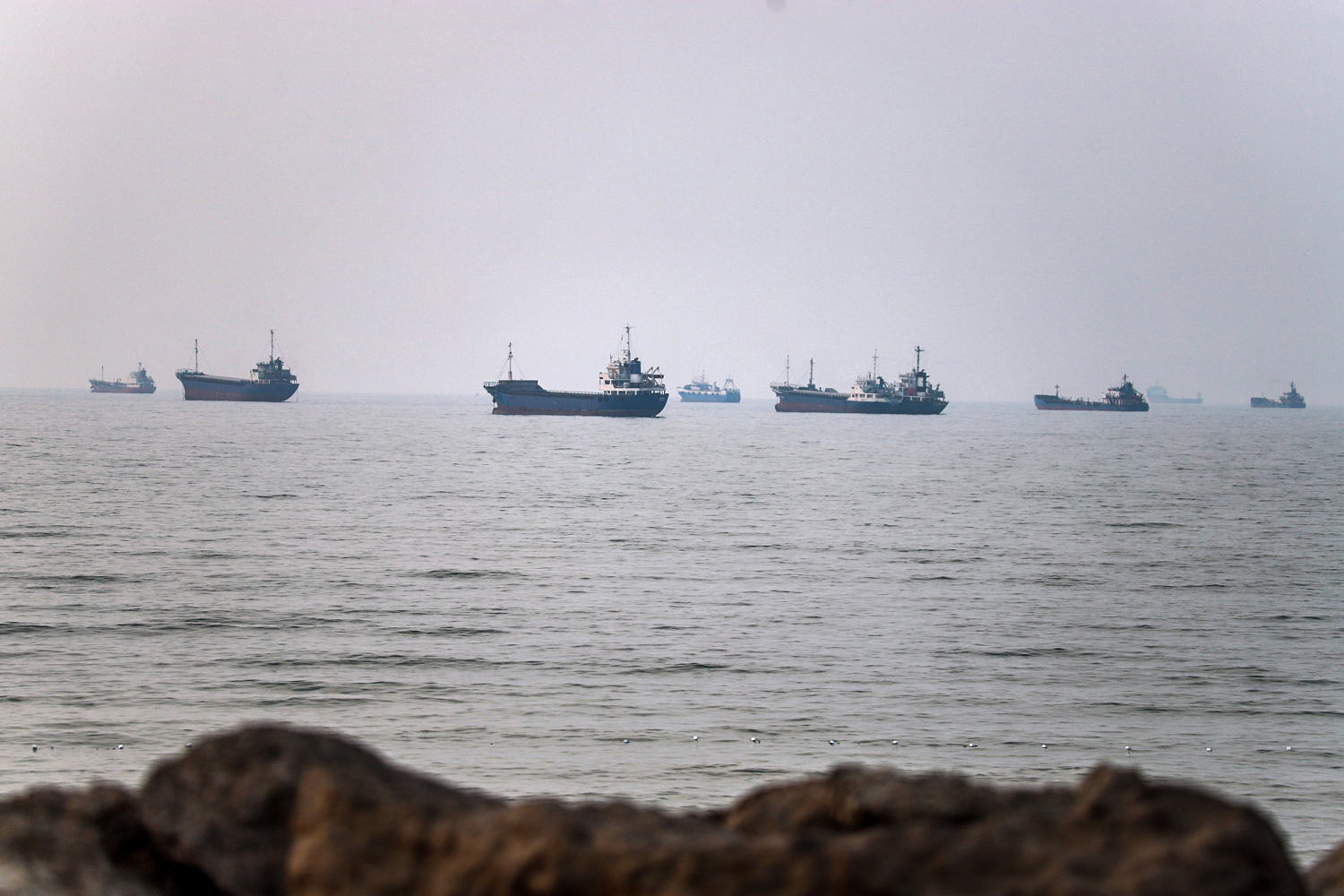
The headlines read like a broken record. Washington greenlights another round of airstrikes against Iranian-backed groups. The Pentagon releases footage of precision-guided munitions striking radar sites and drone launch pads. Media outlets parrot the official line: "U.S. launches new attacks on Iran in retaliation for attacks on commercial ships."
It sounds decisive. It looks powerful. It is entirely ineffective.
For decades, the standard playbook for maritime security has relied on the illusion of absolute deterrence. The consensus among traditional defense analysts is that if you hit a non-state actor hard enough, they will stop disrupting global trade. This logic is fundamentally flawed. By treating regional flare-ups as isolated military provocations rather than predictable symptoms of structural economic shifts, Western policy is chasing a ghost.
We need to stop asking how to stop these attacks and start asking how global supply chains can bypass the need for military escorts entirely. The era of the U.S. Navy acting as a free, taxpayer-funded security guard for global shipping conglomerates is coming to an end.
The Cost Asymmetry Failure
Look at the math. A regional militia launches a loitering munition manufactured for roughly $2,000. To counter it, a Western destroyer fires a pair of interceptor missiles costing upwards of $2 million each.
I have watched logistics firms and defense contractors navigate these cost structures for years. The math does not scale. You cannot achieve long-term security when your defensive economic calculus is inverted by a factor of 1,000.
Military commanders boast about high interception rates, but interception rates are a vanity metric. If the adversary's goal is to drain Western defense inventories and spike maritime insurance premiums, they are winning every time a multimillion-dollar missile is deployed to destroy a fiberglass drone. The current strategy treats a systemic economic war as a series of tactical target sets.
The defense establishment remains fixated on striking launch infrastructure. But in modern asymmetric warfare, the infrastructure is mobile, easily concealed, and cheap to replace. When you destroy a launch site, another opens three miles away within hours.
The Illusion of Freedom of Navigation
The foundational myth of modern global trade is that the oceans are inherently safe because international law declares them so. The reality is that maritime chokepoints—the Bab el-Mandeb, the Strait of Hormuz, the Malacca Strait—are chokeholds.
[Chokepoint Disruption] ➔ [Insurance Premium Spike] ➔ [Cape of Good Hope Re-routing] ➔ [Global Inventory Delay]
When a crisis hits, shipping giants immediately re-route vessels around the Cape of Good Hope. This add-on adds 10 to 14 days to a transit and burns hundreds of tons of fuel per voyage. Yet, the industry treats this as a temporary anomaly.
It isn't an anomaly. It is the new baseline.
The traditional approach tries to force open unstable waterways through naval presence. This is an obsolete solution to a permanent reality. Instead of burning billions of dollars trying to secure shipping lanes that run directly through volatile geopolitical crossfires, the global logistics network must adapt to a fractured world.
The Flawed Questions Dominating the Debate
If you read mainstream policy briefs, the questions are always the same. "How can the coalition strengthen maritime task forces?" "What targets will deter further escalation?"
These are the wrong questions. They assume that the goal of the disruptive actors is a conventional military victory. It isn't. The goal is friction. The goal is forcing a choice between exorbitant insurance rates or extended transit times, both of which drive inflation in Western economies.
Let’s answer the questions that actually matter.
Can naval escorts protect commercial shipping in narrow straits?
No. In confined waterways, the reaction time required to defend against swarm attacks, anti-ship ballistic missiles, and underwater sea drones approaches zero. A warship can protect itself effectively; protecting a 150,000-ton container ship with a civilian crew sailing half a mile behind it is a statistical gamble that data shows commercial carriers will eventually refuse to take.
Will targeting regional command nodes stop the disruption?
It hasn't for thirty years. The command structure of modern proxy networks is decentralized. Decisions are localized, and supply chains for low-tech weaponry are insulated from conventional air campaigns.
The Reality of Supply Chain Decoupling
The hard truth that shipping executives refuse to admit publicly is that certain maritime routes are no longer economically viable for high-value goods. The solution is not more warships. The solution is infrastructure decoupling.
We are seeing the limits of the hyper-optimized, just-in-time supply chain model. For thirty years, companies sacrificed resilience for efficiency, assuming the U.S. Navy would secure every mile of the ocean. That assumption is dead.
The shift must move toward regional manufacturing redundancy and land-based intercontinental freight corridors, even if it means higher initial capital expenditure. Relying on a fragile blue-water pipeline that can be disrupted by a group of militants with off-the-shelf technology is corporate negligence.
The downside to this contrarian approach is obvious: it costs money, redraws trade maps, and increases the price of consumer goods in the medium term. But the alternative is worse. The alternative is pretending that a few more airstrikes will magically return the Middle East to a state of calm that allows unescorted commercial shipping to pass through unhindered.
Stop looking at the map of the world as a static grid of open highways. The highways are closing. Build something else.