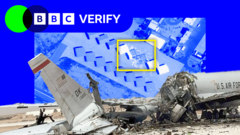
The official narrative surrounding American air defenses in the Middle East is unraveling, and it only took a few commercial satellites to pierce the fog of war. For months, official briefings downplayed the impact of regional hostilities. We heard about interceptions, minor shrapnel damage, and high operational readiness. The reality on the ground looks vastly different.
A detailed forensic analysis of satellite imagery reveals that Iranian airstrikes have damaged or destroyed at least 228 structures and pieces of equipment across 15 U.S. military sites since the outbreak of the conflict on February 28. These aren't random, desperate volleys hitting empty sand dunes. The imagery tells a story of geometric precision. From hangar roofs to satellite dishes, the strikes show zero evidence of random cratering. They hit exactly what they intended to hit.
If you think our regional installations are impenetrable fortresses, you're looking at outdated maps and obsolete doctrine. The Pentagon underestimated how modern drone and missile capabilities have evolved, leaving critical assets exposed to a highly sophisticated adversary.
The True Scale of the Damage Hidden in Plain Sight
When the war started, Washington quietly pressured commercial satellite providers to restrict or delay high-resolution imagery of the conflict zone. This made independent verification nearly impossible for corporate media outlets. Iranian state media filled the vacuum, regularly posting high-resolution orbital captures on social media to showcase their hits.
Most Western analysts dismissed these images as cheap propaganda or deepfakes. They were wrong. A major investigation by The Washington Post cross-referenced 109 of those Iranian-released images with European Union Copernicus satellite logs and independent Planet Labs data. The result? Zero manipulation. The Iranian images were authentic, and the level of destruction was far higher than anything admitted by the administration.
The damage is spread across 15 different installations in Kuwait, Bahrain, Qatar, Jordan, Saudi Arabia, and the United Arab Emirates. We aren't talking about a few broken windows. The strikes successfully targeted:
- Command Infrastructure: Satellite communication arrays at al-Udeid Air Base in Qatar and a vital satellite dish at the U.S. Navy’s 5th Fleet headquarters in Bahrain.
- Air Defense Systems: Patriot missile batteries in Bahrain and Kuwait, alongside THAAD-related radar gear in Jordan and the UAE.
- Logistics and Fuel: Nine massive fuel bladders at Ali al-Salem Air Base in Kuwait, alongside power plants and bulk storage hubs at Camp Buehring.
- Soft Targets: Dozens of troop barracks, gyms, and dining halls, proving that Tehran intentionally targeted personnel areas to maximize operational disruption.
So far, seven American service members have lost their lives in these attacks—six in Kuwait and one in Saudi Arabia—while over 400 have suffered injuries. To prevent a massive mass-casualty event, commanders had to pull personnel back from exposed bases, heavily restricting regular operations.
Why Our Air Defenses Are Failing the Tech Test
How does a military spending nearly a trillion dollars a year let an adversary punch through multi-layered defense shields? The answer lies in numbers and saturation.
For decades, American defense planning assumed regional adversaries would fire a handful of crude, inaccurate ballistic missiles that Patriot batteries could easily swat out of the sky. Instead, Iran deployed a mixed-arsenal strategy. They launch cheap, low-flying loitering munitions alongside precision-guided ballistic missiles and cruise missiles.
When thirty drones and ten missiles arrive at the same coordinate simultaneously, the math breaks. Air defense radars get overwhelmed. Fire control computers must prioritize targets in seconds, and defensive interceptors run out before the attack wave ends.
Worse, our infrastructure wasn't built for this. Look at the open-air flight lines at Ali al-Salem or Camp Arifjan. Millions of dollars of sensitive equipment sit under soft-skinned tents or light metal hangars. These structures offer zero protection against a drone carrying a shaped-charge warhead. Satellite data shows that the Iranian strikes specifically targeted the exact centers of these buildings.
Military experts reviewing the data note that the complete lack of miss-craters around these installations proves Iran possesses highly accurate terminal guidance systems. They aren't guessing anymore. They have eyes on our coordinates, reportedly aided by commercial and acquired satellite assets.
The Operational Fallout and Next Steps
This structural destruction hasn't halted the American bombing campaign, but it has fundamentally altered how the military must operate in the region. You can't run an efficient logistical hub when your fuel depots are burning and your command staff is hiding in bunkers fifty miles away.
Continuing with business as usual is a recipe for disaster. If you want to protect personnel and maintain regional stability, defensive strategy needs an immediate, aggressive overhaul.
First, stop relying solely on million-dollar interceptor missiles to fight off five-thousand-dollar drones. The Pentagon needs to accelerate the deployment of directed-energy weapons and high-power microwave systems that offer an infinite magazine and a near-zero cost per shot.
Second, the military must abandon the concept of giant, centralized mega-bases. These sprawling installations are just massive targets for modern rocketry. Spreading assets across smaller, disguised, and hardened dispersed sites makes targeting significantly harder for enemy scouts.
Finally, build real concrete hardening. Soft-sided hangars and exposed fuel bladders are relics of an era when America held total monopoly over the skies. That era is officially over. If the infrastructure holding our tech isn't wrapped in reinforced concrete, it won't survive the next volley.