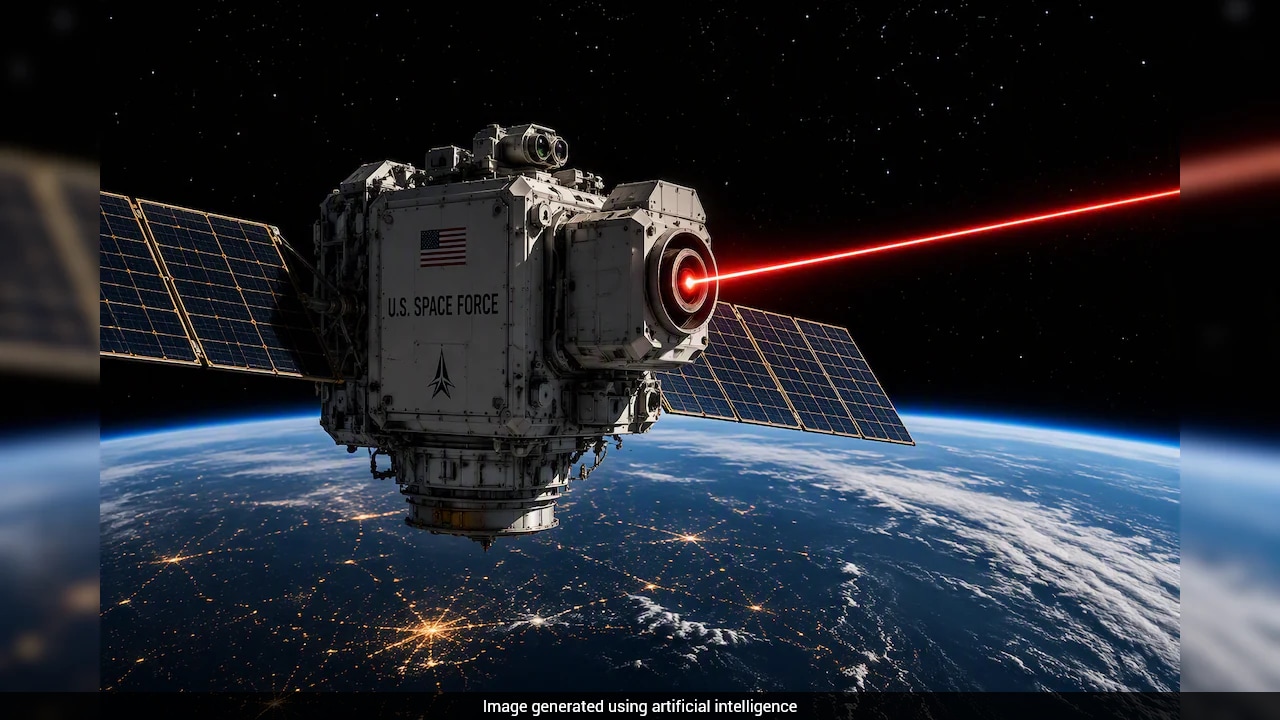
The quiet diplomacy of the celestial frontier is officially dead. For decades, Washington maintained a carefully manicured fiction that the vacuum of space remained untainted by active armaments, bound by the gentlemanly restraints of international treaties and strategic ambiguity. That illusion shattered during a high-profile industry gathering in Maryland, when U.S. officials casually confirmed what strategists have whispered behind closed doors for years. The United States has officially deployed its first operational on-orbit space control weapons, marking a profound militarization of Earth's upper envelope.
The admission, delivered by senior Air Force leadership, did not come packaged with schematics or orbital coordinates. Instead, it arrived wrapped in the cold, transactional language of modern military deterrence. The hardware is already up there. It is circling quietly above our heads, integrated into a silent architecture designed to protect American military assets from aggressive peer competitors like China and Russia.
To understand the weight of this disclosure, one must abandon Hollywood visions of orbital laser battles and kinetic dogfights. Real orbital warfare is far more subtle, highly technical, and exponentially more terrifying.
Space control missions generally divide into two distinct categories: kinetic and non-kinetic. Kinetic systems involve physical interceptors—objects designed to smash into adversarial satellites at hyper-velocity, turning expensive multi-billion-dollar reconnaissance nodes into expanding clouds of lethal shrapnel. Every piece of debris created in low Earth orbit threatens every other satellite in that band, civilian or military alike, creating a cascading chain reaction known as the Kessler syndrome.
Because of that catastrophic ecological risk, military analysts suspect the newly acknowledged systems rely heavily on non-kinetic methods. We are talking about advanced electronic warfare packages, highly directional radio-frequency jammers, cyber intrusion payloads, and directed-energy tools capable of blinding optical sensors or temporarily disabling an adversary's communications link without leaving a trail of physical shrapnel.
A hypothetical example illustrates the mechanical reality: if an adversarial reconnaissance satellite maneuvers close enough to intercept secure U.S. military command signals, an orbiting defensive asset could interdict the threat stream through targeted electromagnetic interference, blinding the target's sensors until it drifts safely away from the protected zone.
The rationale driving this deployment is rooted in simple, brutal geometry. Modern military operations on Earth are utterly dependent on what happens four hundred miles above. GPS guides precision munitions, satellite communications coordinate global troop movements, and overhead infrared sensors provide early warning against ballistic missile launches. Blind the constellation, and a modern military force is suddenly fighting in the dark.
For years, Washington watched defensively as Moscow and Beijing tested co-orbital inspector satellites capable of maneuvering dangerously close to American assets. The public acknowledgment of U.S. offensive-capable hardware in orbit signals a shift from passive vulnerability to active, forward-deployed posture. The Pentagon has decided that deterrence in the space domain requires the capacity to strike back from the high ground before an adversary can disable allied lifelines.
Yet this disclosure opens a Pandora's box of strategic instability. When nations place offensive weapons on permanent, unblinking tracks around the planet, reaction times shrink to zero. If a satellite suddenly changes its orbit or activates a directional sensor, an automated defense system or a nervous command crew on the ground has mere minutes to determine whether the action is routine station-keeping or the opening salvo of a disabling first strike.
The arms race in Earth's orbit is no longer an invisible projection of future capabilities. It is an operational reality currently circling overhead at seventeen thousand miles per hour. The sky is no longer a sanctuary.


