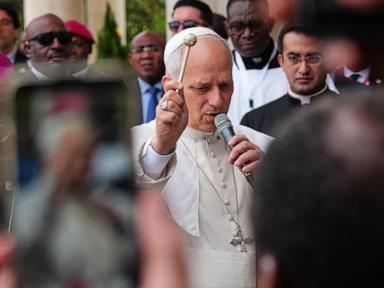
When the Pope stands before a golden altar in Malabo, he isn’t just delivering a sermon to the faithful; he is stepping into one of the most starkly divided economies on the planet. Equatorial Guinea remains a place where private jets sit on the tarmac within sight of neighborhoods lacking reliable running water. The recent Papal visit highlights a friction that has defined this West African nation for decades—the gap between a tiny, hyper-wealthy ruling class and a population that sees almost none of the country's massive oil revenue.
The core of the issue is not a lack of resources but a systemic failure of distribution. While the presidential family sat in the front pews, the message of economic justice was a direct challenge to the status quo. To understand why this tiny nation remains a developmental paradox, one has to look past the diplomatic handshakes and examine the mechanics of how oil wealth disappears before it reaches the street. Also making news lately: The Geopolitical Cost of Rhetoric Analyzing the New Zealand India FTA Stagnation.
The Crude Reality of a Petrostate
Equatorial Guinea is the third-largest oil producer in sub-Saharan Africa. Since the discovery of massive offshore reserves in the 1990s, the country’s GDP per capita has technically skyrocketed, often rivaling European nations on paper. However, these statistics are a lie. They represent a mathematical average that ignores the reality that the vast majority of that wealth is concentrated in the hands of the Obiang family and their inner circle.
The infrastructure tells the story. You will find gleaming highways that lead to nowhere and massive government complexes in the jungle, yet the healthcare system remains so underfunded that the country has some of the highest infant mortality rates in the region. This is "prestige spending." It creates the illusion of a modern state while the fundamental building blocks of a middle class—education, small business credit, and property rights—remain ignored. More insights into this topic are detailed by TIME.
The oil industry here operates in a vacuum. Most of the technical labor is imported, and the supply chains are managed by foreign firms or entities owned by the ruling elite. This prevents the "multiplier effect" that usually happens when a nation discovers a natural resource. Instead of a rising tide lifting all boats, the tide is diverted into private reservoirs.
Wealth Concentration and the Global Financial Web
The Papal call for closing the income gap isn't just a moral plea; it is an indictment of how international finance enables local corruption. For years, the wealth of Equatorial Guinea has flowed out of the country as quickly as the oil is pumped. Investigative records from US and French courts have documented hundreds of millions of dollars spent on luxury real estate, supercars, and Michael Jackson memorabilia by the country’s elite.
This isn't just a local problem. It requires a network of bankers, lawyers, and realtors in Paris, Geneva, and Malibu. When we talk about the income gap in Malabo, we are also talking about the complicity of the global financial system. Every time a luxury penthouse is bought with funds diverted from a national oil company, a school in Bata goes without books.
The Myth of Trickle Down in Africa
Economists often argue that foreign direct investment (FDI) eventually creates a middle class. In Equatorial Guinea, this theory has been thoroughly debunked. The FDI goes into the extractive sector, which is capital-intensive rather than labor-intensive. It requires drills and pipelines, not thousands of workers.
Without a government willing to tax that extraction fairly and reinvest the proceeds into human capital, the money remains at the top. The "resource curse" is often framed as an accident of geography, but in Malabo, it is a deliberate policy. Control the oil, control the army, and you control the people.
The Church as a Risky Mediator
The Catholic Church holds immense cultural power in Equatorial Guinea. This makes the Pope’s presence a double-edged sword for the administration. On one hand, the government uses the visit to gain international legitimacy. It looks good on the global stage to be seen hosting the Pontiff. It suggests stability and a certain level of moral standing.
On the other hand, the Church is one of the few institutions that can speak truth to power without being immediately silenced. When the Pope speaks about the "shameful" gap between the rich and the poor, he is using a vocabulary that the regime cannot easily dismiss as foreign political interference. He is speaking to the soul of the nation, and that makes him dangerous to the status quo.
However, we must be realistic about the impact of words. Moral suasion rarely changes the minds of those who have spent forty years building a dynasty. The presidential family’s presence at the Mass was a masterclass in political theater. They listen, they nod, they pray—and then they return to the palace where the accounts remain offshore and the dissenters remain in prison.
Why Reform Remains a Ghost
True reform would require the dismantling of the patron-client system that keeps the current administration in power. In Equatorial Guinea, loyalty is bought. The civil service, the military, and the local governors all depend on the "donations" filtered down from the presidency.
To close the income gap, the government would have to:
- Establish a transparent sovereign wealth fund that is audited by independent international bodies.
- Remove the barriers to entry for small businesses that are currently forced to give "shares" to well-connected officials.
- Invest in the agricultural sector, which used to be the backbone of the economy before oil made everyone lazy and dependent on imports.
None of these things are likely to happen under the current leadership because each one would diminish their absolute control. The income gap is not a bug in the system; it is the system's primary feature.
The Shadow of Succession
The tension during the Papal visit was also fueled by the looming question of what happens next. The President is the world's longest-serving non-royal leader. His son, the Vice President, has already been convicted in absentia in foreign courts for "ill-gotten gains."
The people of Equatorial Guinea are waiting. They are waiting for the oil to run out, or for a transition of power that might—just might—lead to a different way of doing business. But history suggests that when dynasties are built on oil, they don't go quietly. They tighten their grip.
The Pope’s visit provided a brief moment of hope, a flash of light on a dark economic landscape. It forced the world to look at Malabo for something other than a shipping manifest. Yet, as the Papal plane departs, the reality remains. The oil rigs continue to hum offshore, the money continues to move into secret accounts, and the people in the pews are left with a prayer for a justice that has yet to arrive on their shores.
The world watches the "Kuwait of Africa" and wonders if the wealth will ever belong to the many, or if it will forever be the inheritance of the few. The income gap isn't just a statistic in Equatorial Guinea; it is a wall. And despite the holy water and the sermons, that wall is getting higher every year.
Investors and diplomats who engage with the country often hide behind the "neutrality" of business. They claim they are just there for the oil. But there is no such thing as neutral business in a country where the state and the family are the same entity. Every barrel of oil extracted is a choice. Every contract signed is a validation of the current distribution of wealth. If the gap is ever to close, it will require more than just words from a pulpit; it will require a fundamental shift in how the international community values human rights against the price of Brent Crude.