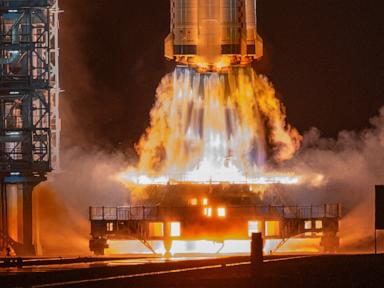
China just broke its own rules in orbit. For years, the Tiangong space station operated as an exclusive club for Chinese taikonauts, even while Beijing publicly promised international cooperation. That changes with the announcement that a Pakistani astronaut will board Shenzhou 24 and become the very first foreign visitor to live and work aboard China's orbital outpost.
This isn't just a symbolic handshake or a quick photo op in microgravity. It's a massive geopolitical shift in how human spaceflight works in 2026. While NASA and its partners wrestle with the aging International Space Station and commercial replacements, China is actively opening its doors to developing space nations.
Let's be clear about what's happening here. The China Manned Space Agency (CMSA) and Pakistan's Space and Upper Atmosphere Research Commission (SUPARCO) signed a bilateral agreement that puts a Pakistani payload specialist directly into the Shenzhou 24 flight manifest. If you follow orbital mechanics and international diplomacy, you know this has been brewing since Pakistan sent plant seeds to Tiangong aboard Shenzhou 14 back in 2022. Now, they're sending a human.
What the Shenzhou 24 Mission Actually Involves
Most casual news coverage treats this like a simple passenger ticket. It isn't. Spaceflight doesn't work like buying a seat on a commercial airliner, especially when you're docking with a modular space station traveling at 17,500 miles per hour.
The selected Pakistani astronaut won't pilot the Shenzhou spacecraft. That job belongs strictly to the seasoned People's Liberation Army Astronaut Corps commander and operator. Instead, the Pakistani crew member will fly as a payload specialist—a role specifically designed for scientists and engineers who run dedicated experiments in orbit.
Here's what the training and mission profile actually demand from a foreign payload specialist:
- Intense language immersion. Every single button, manual, emergency checklist, and ground-control callout on Tiangong is in Mandarin. You don't get translated sticky notes on the instrument panel when a cabin pressure alarm goes off.
- Survival and centrifuge training. Candidates undergo months of brutal physical conditioning in China, including underwater neutral buoyancy training to simulate spacewalks and high-G centrifuge runs to handle launch and reentry forces.
- Short-duration versus long-duration stays. Unlike the core Chinese crew who stay for six months, early international flights on Shenzhou typically follow a short-duration handover model, meaning the Pakistani astronaut will likely spend several days to a few weeks aboard Tiangong during a crew rotation before returning to Earth with the outgoing crew.
Honestly, the physical toll alone filters out 99% of applicants. Pakistan's military and scientific establishments had to screen candidates with impeccable medical records, STEM backgrounds, and the psychological grit to spend months away from home learning complex orbital systems in a second language.
Why China Picked Pakistan First Over European Partners
If you've tracked Tiangong's history, this choice might surprise you. Back in 2017, the European Space Agency (ESA) actually sent astronauts Matthias Maurer and Samantha Cristoforetti to Yantai, China, to train alongside Chinese taikonauts in sea survival exercises. Everyone assumed a European would be the first non-Chinese human on Tiangong.
Then geopolitics killed that plan. In early 2023, ESA Director General Josef Aschbacher flatly stated that Europe had neither the budget nor the political green light to send astronauts to the Chinese station. Rising tensions between Western nations and Beijing froze European cooperation in its tracks.
China didn't wait around for Europe to change its mind. Beijing pivoted immediately toward its closest strategic allies and partners within the Belt and Road Initiative. And nobody fits that profile better than Pakistan.
Think about the history between these two countries. Their space partnership goes back decades. China launched Pakistan's first communication satellite, PAKSAT-1R, in 2011. More recently, Pakistan became one of the very first nations to join China's International Lunar Research Station (ILRS) project, even placing a miniature cube satellite called ICUBE-Q aboard China's Chang'e-6 lunar sample-return mission in 2024.
Putting a Pakistani citizen on Shenzhou 24 is the logical next step in an alliance that Beijing calls an "all-weather strategic cooperative partnership." By choosing Pakistan, China proves to the Global South that it delivers on its promises without the heavy political preconditions or massive financial buy-ins that Western space agencies often require.
The Technical Reality of Flying on a Shenzhou Spacecraft
Let's talk hardware, because the engineering behind this mission matters just as much as the politics. The Shenzhou spacecraft looks superficially similar to Russia's Soyuz—both feature a three-module design with an orbital module, a reentry capsule, and a service module. That's where the similarities end.
Shenzhou is noticeably larger than Soyuz, giving the three-person crew significantly more habitable volume during the rendezvous phase with Tiangong. When the Long March 2F rocket lifts off from the Jiuquan Satellite Launch Center in the Gobi Desert, the crew sits inside a modernized digital cockpit that China has continuously upgraded since Shenzhou 5 flew in 2003.
For a foreign payload specialist, the flight profile breaks down into three distinct phases:
- The automated fast-rendezvous. Modern Shenzhou missions use a rapid automated docking profile that gets the crew from the launchpad to Tiangong's radial or forward docking port in roughly 6.5 hours. During this time, the payload specialist monitors systems while strapped into a custom-molded seat liner.
- Life inside the Tianhe, Wentian, and Mengtian modules. Tiangong is a T-shaped station roughly one-fifth the mass of the International Space Station, but it's brand new. The internal racks are cleaner, quieter, and packed with modern microgravity research cabinets. The Pakistani astronaut will conduct experiments focused on Pakistani scientific priorities—likely involving agriculture, medicine, and Earth observation over South Asia.
- The ballistic reentry. Returning to Earth means undocking, firing deorbit engines, and enduring up to 4 Gs of deceleration before parachutes deploy over the Dongfeng landing site in Inner Mongolia.
One common misconception I see online is that China is somehow risking its national security by letting a foreigner aboard. That's nonsense. Modern space stations are compartmentalized by design. Just as NASA and Roscosmos restrict access to certain proprietary hardware and communications terminals on the ISS, CMSA controls exactly which experiment racks and data networks a visiting payload specialist touches.
How This Reshapes the New Space Race in 2026
You can't look at Shenzhou 24 in isolation. Look at the broader orbital picture right now.
The International Space Station is entering its twilight years, with NASA actively planning its controlled deorbit via SpaceX's US Deorbit Vehicle at the end of the decade. Commercial stations like Axiom Space's modules, Orbital Reef, and Starlab are racing to launch before the ISS retires, yet delays and funding gaps remain a constant headache.
Meanwhile, Tiangong is already fully operational, staffed continuously, and actively expanding its international roster.
For countries in Asia, Africa, and Latin America, the barrier to entry for human spaceflight used to be insurmountable. Unless you were willing to pay tens of millions of dollars to a private broker like Axiom Space for a seat on a SpaceX Crew Dragon, your national flag wasn't going to orbit. China is offering an alternative model—bilateral state-to-state agreements where scientific collaboration, geopolitical alignment, and shared data replace pure cash transactions.
Pakistan gets an instant boost to its domestic STEM sector, massive national pride, and real microgravity research data that SUPARCO couldn't generate on its own. China gets undeniable proof that Tiangong is a truly international space station, directly challenging NASA's Artemis Accords coalition for global influence.
What You Should Watch Next as Launch Approaches
If you want to follow this mission beyond the surface-level headlines, pay attention to the specific milestones leading up to liftoff at Jiuquan.
First, watch for the official announcement of the primary and backup Pakistani astronauts. Just like NASA and Roscosmos, China never trains a single individual for a historic flight without a fully qualified backup ready to step in if someone catches a cold a week before launch. The biographical details of those two finalists will tell you everything about what experiments Pakistan plans to run in orbit—if they're botanists or aerospace engineers, you'll know immediately what's inside their cargo manifest.
Second, track the experiment manifest released by SUPARCO and CMSA. The real scientific value of Shenzhou 24 lies in the payloads going up inside the orbital module, particularly any joint China-Pakistan biological or remote-sensing hardware.
Finally, keep an eye on which country China announces next. Pakistan is opening the door, not closing it. Once Shenzhou 24 proves that CMSA can smoothly integrate, train, and fly non-Chinese crew members, expect nations from the Middle East, Southeast Asia, and Latin America to line up for future Tiangong manifests. Follow the official CMSA mission briefings and SUPARCO technical updates over the coming months to see how quickly Beijing turns this historic first into a regular international rotation.