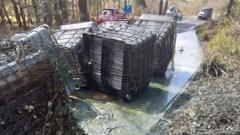
The sight of blue plastic drums leaking unidentified sludge into a ditch makes for a great local news segment. It is visceral. It is ugly. It is the perfect villain for a society that loves a clear-cut morality play. The "lazy consensus" surrounding the recent spate of roadside liquid waste dumping focuses entirely on the "criminality" of the act. We demand bigger fines, more cameras, and longer jail sentences for the low-level haulers.
But if you think catching the guy in the high-vis vest with the leaky truck solves the problem, you are being played. Discover more on a similar topic: this related article.
Roadside dumping isn't a failure of policing. It is a predictable market reaction to a broken regulatory architecture. We have created a system that makes legal disposal so prohibitively expensive and bureaucratically dense that we have essentially subsidized the black market. The sludge in the ditch is just the physical manifestation of a supply chain that has snapped under the weight of its own inefficiency.
The Cost of Compliance is a Tax on Honesty
I have watched industrial firms burn through seven-figure budgets just to navigate the permit process for basic aqueous waste treatment. When the cost of doing things "the right way" exceeds the profit margin of the project, the market doesn't stop producing waste. It just stops reporting it. Additional analysis by Reuters Business explores similar views on this issue.
The current regulatory framework treats every gallon of liquid byproduct as if it were weapons-grade plutonium. This lack of nuance forces small-to-medium enterprises (SMEs) into a corner. They cannot afford the $50,000-a-month compliance overhead, so they hire "independent contractors" who promise to take the problem away for a fraction of the price.
Everyone in the room knows where that waste is going. The CEO knows. The plant manager knows. But as long as the paperwork says "Disposed of by XYZ Logistics," their hands are clean. The guy dumping the drums by the roadside isn't the mastermind; he’s the fall guy for an entire industry that can no longer afford to be legal.
The Myth of the Infinite Sink
People ask: "Why can't they just recycle it?"
The premise of the question is flawed because it assumes "recycling" is a magic wand. In the world of industrial liquid waste—think PFAS-contaminated runoff, metal plating acids, or concentrated saline—recycling often requires more energy and produces more carbon emissions than the original manufacturing process.
We are obsessed with the "circular economy," but the laws of thermodynamics are not up for negotiation.
$S \geq 0$
Entropy always wins. You cannot purify a complex chemical cocktail without a massive input of energy. When we mandate "green" disposal methods that are physically and economically impossible for the average business to sustain, we create a vacuum. That vacuum is filled by white vans and midnight trips to rural bypasses.
By demanding "zero waste" without providing the physical infrastructure to handle the reality of industrial chemistry, the public is effectively ordering the very dumping they claim to hate.
Data Over Drama: The Real Volume
The media fixates on the 50-gallon drum because it fits in a camera frame. In reality, the "micro-dumping" seen by the roadside represents less than 1% of the illicit waste movement. The real volume is moving through "ghost manifests"—waste that is logged as treated at a facility that doesn't have the capacity to treat it, then quietly pumped into municipal sewers under the cover of a rainstorm.
If we actually wanted to stop this, we would stop obsessing over the ditch and start auditing the flow meters at treatment plants. But we don't. Why? Because auditing the meters would reveal that our entire municipal infrastructure is being subsidized by the illegal discharge of industrial chemicals. If the cities had to actually treat what’s being put into the pipes, your water bill would triple overnight.
We allow the roadside villain to exist because he provides a convenient distraction from the systemic failure of our aging sewage and treatment grids.
Stop Chasing Trucks and Start Fixing Incentives
The solution isn't "more oversight." Oversight just adds another layer of bribes and paperwork. If you want to clear the roadsides, you have to make the legal path the path of least resistance.
- Decentralized Treatment Credits: Instead of forcing waste to travel 500 miles to a centralized "certified" facility (burning diesel and increasing the risk of spills along the way), we should provide tax credits for on-site pre-treatment.
- The "No-Questions-Asked" Drop-off: We do it for needles and prescription drugs. Why don't we do it for industrial liquids? If a hauler can drop a drum at a state-run facility for free, they won't risk a felony by dumping it in a creek.
- Chemical Fingerprinting: Every major industrial batch should have a unique chemical signature. If it shows up in a ditch, you don't arrest the driver; you seize the assets of the corporation that birthed the molecule.
The Bitter Truth of the Trade-off
The contrarian reality is that we might have to accept a higher level of "authorized" pollution in exchange for eliminating the "unauthorized" dumping that destroys local ecosystems. It is a brutal trade-off. You can have a perfect, pristine set of laws that are ignored by everyone, or you can have a pragmatic, "dirty" set of laws that are actually followed.
Currently, we have chosen the former. We get to feel morally superior because our laws are "strict," while our groundwater is being poisoned by the very people the laws were meant to stop.
Stop looking for the truck. Look at the balance sheet. The drums in the ditch aren't a crime scene; they are a symptom of a market that has been regulated into insanity. If you want the dumping to stop, you have to make it cheaper to be a saint than it is to be a criminal. Until then, keep your boots on; the sludge isn't going anywhere.