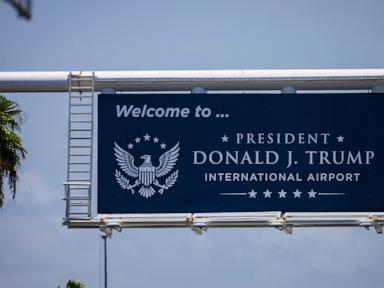
The renaming of Palm Beach International Airport to President Donald J. Trump International Airport represents a rare intersections of state legislative intervention, federal aviation coordination, and complex logistical re-indexing. Beyond the political discourse surrounding the event, the transition forces a significant recalibration of infrastructure, technology systems, and financial allocations. For an airport serving approximately 8.6 million passengers annually, changing a primary identity requires a multi-phased deployment plan to decouple physical public-facing branding from backend aeronautical data layers.
Understanding the mechanics of this transformation requires breaking down the process into three core operational vectors: legislative preemption, global distribution system synchronization, and Capital Improvement Plan realignment.
The Legislative and Governance Framework
The institutional mechanism that initiated the transition was Section 332.0075 of the Florida Statutes, signed into law on March 30, 2026. This statute established a new legal precedent by preempting the authority to name major commercial service airports to the State of Florida, bypassing traditional localized municipal input.
This governance shift alters the naming authority while leaving operational and financial liabilities unchanged:
- Operational Control: Palm Beach County retains 100% of the ownership, policy control, and financial liability of the asset. The infrastructure asset remains a department of the local county government.
- Intellectual Property: Because the new name involves a protected personal brand, the Palm Beach County Board of County Commissioners executed a Naming Rights and License Agreement on May 5, 2026. This contract establishes the legal boundaries for commercial use, trademark protection, and limits indemnity for the municipal operator.
System-Wide Aeronautical Re-Indexing
The most technical hurdle of an airport rebranding project is the asymmetrical transition of database keys. In global aviation, an airport is defined by distinct data codes administered by different governing bodies. The misalignment of these schedules creates a temporary dual-identity window.
[July 9, 2026]
   ├── Law takes effect
   ├── FAA LID changes to DJT
   └── ICAO Identifier changes to KDJT
       │
       └── (40-Day System Gap)
           │
           └── [August 18, 2026]
                  └── IATA Code transitions to DJT
Federal Aviation Administration (FAA) Realignment
On July 9, 2026, the FAA Locational Identifier (LID) transitioned from PBI to DJT, and the International Civil Aviation Organization (ICAO) code changed to KDJT. This update instantly affected pilot charts, air traffic control routing software, and automated weather reporting systems. The velocity of this change was rapid due to federal regulatory approval being cleared on May 15, 2026.
International Air Transport Association (IATA) Delay
While air traffic control operates on the FAA/ICAO matrix, commercial airline reservation systems, global distribution systems, baggage routing sorting software, and consumer ticketing platforms rely on the three-letter IATA code. The IATA transition from PBI to DJT will not take effect until August 18, 2026—exactly 40 days after the legal name change.
This structural lag introduces short-term friction. Passenger tickets, global booking engines, and interline baggage tags will continue to display "PBI" during peak summer travel, while physical airport signage and air traffic operations reference "DJT."
The Friction Cost Matrix
Rebranding a medium-hub international airport introduces immediate capital expenditure and prolonged operational friction. The estimated baseline cost for this transition stands at $5.5 million. This allocation can be categorized into three distinct operational cost buckets.
Physical Wayfinding and Static Asset Depreciation
The immediate removal of legacy "Palm Beach International Airport" assets and the deployment of new physical signage span across roadside access markers, terminal facades, terminal wayfinding, and highway directional markers. Because the transition is state-mandated but county-operated, these costs require a realignment of the airport's immediate cash-flow priorities until state appropriations are finalized.
Digital Systems Overhaul
The structural change requires updates across multiple disconnected digital environments, including:
- Local Flight Information Display Systems (FIDS)
- Local baggage handling system (BHS) scanning logic
- Multi-User Flight Information Display systems tied to specific airline gates
- Municipal web infrastructure, network domains, and digital public-facing channels
The Airline IT Bottleneck
Commercial air carriers operating out of the terminal face internal cost functions to map the new IATA code. Legacy airline reservation databases must update their scheduling algorithms to prevent ticketing system mismatches where an inbound flight targets "PBI" but the global registry records "DJT."
Strategic Forecast
The operational success of the transition depends entirely on how effectively system administrators manage the 40-day dual-code window between July 9 and August 18. Airport management must run parallel ticketing workflows to minimize baggage misrouting.
Financially, the $5.5 million deployment expenditure will likely exert downward pressure on the airport's net operating income for the fiscal year unless offset by direct state grants. Over the long term, clear data updates within international flight systems will normalize operations, rendering the transition a case study in how centralized state policy can disrupt municipal asset infrastructure.