The deep ocean does not care about our poetry.
To us, the abyss is a metaphor for loneliness, a freezing, pitch-black void two miles beneath the waves where the pressure is enough to instantly crush a human skull. We think of it as a desert. For decades, even the marine biologists who spent their lives staring into the monitors of remote-operated vehicles viewed the abyssal plain as a vast, muddy waiting room where very little happens, and even less survives.
Then, the camera light catches a rib cage.
It belongs to a blue whale, a creature that may have sung its last low-frequency song a century ago. When a titan of the ocean dies, it does not simply vanish. It falls. This event, known with quiet reverence among scientists as a whale fall, is a slow-motion plunge through the water column that can take days.
When that body hits the seafloor, the desert transforms.
The Submerged Metropolis
Imagine standing on a barren, wind-scraped salt flat in the dead of night. Suddenly, a skyscraper full of food drops from the sky.
That is the sheer scale of disruption a dead whale brings to the seafloor. A single whale carcass introduces as much organic carbon to the deep ocean overnight as would normally drift down from the surface in two thousand years. It is a massive, concentrated injection of life into a world starved for it.
But scientists recently discovered something that shattered their understanding of how these deep-sea ecosystems function. They didn't just find a whale fall. They found a graveyard.
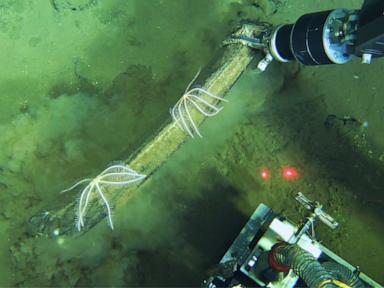
While exploring a previously unmapped underwater mountain range in the Pacific, a research expedition deployed a high-definition submersible camera into the gloom. The monitor on the ship above flickered with real-time telemetry: depth 3,200 meters, temperature barely above freezing, oxygen levels minimal. The screen showed the usual expanse of grey silt.
Then came the bones. Not one skeleton, but a cluster of them, resting in the darkness like a forgotten fleet.
To understand why this discovery left seasoned researchers weeping in the control room, you have to understand the sheer mathematical impossibility of it. The ocean is vast beyond human comprehension. Finding a single whale fall is already akin to dropping a needle into a haystack the size of Texas and finding it on the first try. Finding a concentration of them—a natural mausoleum where multiple giants came to rest over decades or even centuries—is statistically absurd.
It was not a place of mourning. It was a carnival.
Three Acts of a Ghost Story
The lifecycle of a whale fall moves in distinct, theatrical stages, each supporting an entirely different cast of characters that seem dreamed up by a science fiction writer.
First comes the mobile scavenger phase. The moment the carcass touches down, the scent of fat and protein radiates through the water, carried by the faint abyssal currents. Within hours, sharks, giant isopods—creatures resembling terrifying, cat-sized woodlice—and hagfish arrive. Hagfish are primitive, jawless marvels that look like prehistoric eels. They burrow into the soft tissue, rasping away at the flesh from the inside out, producing gallons of thick slime to deter competitors. This initial frenzy is violent and efficient. It can last for up to two years, stripping the mountain of flesh down to the bare bone.
Once the sharks leave, the opportunists move in. This second stage belongs to the crabs, small crustaceans, and bizarre worms that colonize the enriched sediment surrounding the bones. The ground itself becomes alive, saturated with the rich oils that leaked from the carcass during the feast.
But the final act is the most haunting. It is called the sulfophilic stage, and it can last for a century.
When only the skeleton remains, a unique genus of bone-eating worms called Osedax takes over. They have no eyes, no mouths, and no stomachs. Instead, they sprout green, root-like structures that secrete acid to dissolve the hard calcium, allowing symbiotic bacteria inside the worms to feast on the fats locked deep within the whale bones.
The bones do not just feed these creatures; they power an alternative engine of life. As bacteria break down the lipids inside the skeleton, they release hydrogen sulfide. This toxic, rotten-egg gas would kill a human instantly. Here, it is the spark of life. Specialized microbes convert this chemical energy into food through chemosynthesis, completely independent of the sun.
The Human Blindspot
We have spent trillions of dollars mapping the cratered, dead surface of the moon and the rusted deserts of Mars. Yet, we are still blind to the bottom of our own home.
The technology required to witness a whale graveyard is staggering. The deep-sea submersibles used by modern research teams must withstand pressures exceeding eight tons per square inch. The engineering is so complex that there are fewer vessels capable of reaching the deep ocean floor than there are spacecraft capable of carrying humans into orbit.
Every time we send these mechanical eyes into the deep, they challenge our fundamental assumptions about how life works. We used to believe that all life on Earth was a downstream product of sunlight. The plants capture the sun, the herbivores eat the plants, the predators eat the herbivores, and the scraps fall to the floor.
The whale graveyard proves that life is far more stubborn than that. It shows that even when the sun's influence is reduced to a faint, forgotten memory, the planet finds a way to build a metropolis out of a carcass.
Consider the fragile connection between the surface and the abyss. The whales we see breaching off the coast of California or migrating past the shores of Australia are the vital lifelines for creatures we will never see. When commercial whaling wiped out nearly three million whales in the twentieth century, we didn't just silence the oceans above. We starved the oceans below.
We cut the supply lines to an entire civilization.
A Soft Hum in the Dark
The discovery of the graveyard alters the baseline of marine ecology. It suggests that these deep-sea oases are not isolated, freak occurrences. Instead, they may form a vast, interconnected network—a highway of stepping stones across the barren seafloor that allows specialized species to disperse, colonize, and thrive across thousands of miles of darkness.
The scientists aboard the research vessel eventually had to recall the submersible. Batteries drain, ships run out of fuel, and human attention spans have a ceiling.
As the remote vehicle began its long, vertical ascent back to the world of air and light, the high-definition cameras tilted upward for one last look. The lights flickered across the rib cages, casting long, dancing shadows into the gloom. Thousands of pink worms swayed in the current. Golden crabs scurried across ivory vertebrae.
Down there, in the crushing cold, the feast continues. It will continue long after our current civilization has written its own history, a silent, thriving testament to the beautiful, terrifying economy of nature, where nothing is wasted, and death is merely the opening argument for life.