The legal battle in London’s High Court between Nord Stream AG and its insurers over a €400 million payout exposes a critical divergence between contractual liability and subsea engineering realities. While insurers argue that the policies are voided by conflict exclusions or that the damage constitutes a total loss outside the scope of partial repair coverage, court filings reveal an underlying technical blueprint for restoration. A rigorous analysis of these documents demonstrates that the physical repair of the Nord Stream 1 and 2 pipelines is technically feasible within a three-year timeframe, governed entirely by three operational variables: internal seawater corrosion dynamics, heavy-equipment mobilization constraints, and international maritime sanctions.
The core dispute hinges on a fundamental question: Can a subsea pipeline ruptured by high-order explosive detonations be structurally rehabilitated, or does the chemical and physical degradation of the unsealed infrastructure render it a permanent write-off? By breaking down the engineering constraints and the economic structures outlined in the litigation, we can map the exact pathway required to return these assets to operational status.
The Three Pillars of Subsea Pipeline Degradation
Evaluating the viability of a three-year repair timeline requires assessing the immediate physical damage against the long-term environmental degradation of the asset. The explosion did not merely sever the steel conduits; it exposed the internal architecture of the pipeline to a highly corrosive marine environment.
Internal Anoxic and Oxic Corrosion Economics
The Nord Stream pipelines are constructed from carbon steel with an internal friction-reducing epoxy lining. Under normal operating conditions, they transport dry, treated natural gas. The introduction of millions of gallons of Baltic Sea water introduces a severe corrosion function.
- The Oxygen Depletion Phase: Initially, the oxygen trapped inside the flooded pipe sections reacts with the steel, causing localized pitting. Once this localized oxygen is consumed, the system enters an anoxic state.
- Microbiologically Influenced Corrosion (MIC): In anoxic seawater, sulfate-reducing bacteria (SRB) thrive, producing hydrogen sulfide ($H_2S$). This compound accelerates sulfide stress cracking and pitting corrosion in carbon steel.
- The Flow Velocity Problem: As long as the water remains stagnant inside the pipe, the corrosion rate is somewhat predictable. However, tidal shifts near the rupture sites introduce fresh, oxygenated water, resetting the high-rate oxic corrosion cycle.
Concrete Weight Coating Delamination
Nord Stream pipelines utilize a heavy concrete weight coating (CWC) to ensure negative buoyancy and protect against hydrodynamic forces. The explosive shockwaves generated a high-velocity pressure wave through the steel wall, causing a mismatch in acoustic impedance between the steel and the concrete. This creates a high probability of widespread delamination—where the concrete shears away from the steel tube. Without the CWC, sections of the pipeline risk destabilization, buckling under current movements, or suffering catastrophic stress concentration at the boundary of the undamaged section.
Structural Deformation and Soil Mechanics
The force of the blasts displaced the seabed, altering the bathymetry around the impact zones. The pipelines now feature unsupported spans where the seabed washed away. These free spans are highly vulnerable to vortex-induced vibrations (VIV) caused by deep-sea currents. Over months and years, VIV induces fatigue damage, exponentially reducing the fatigue life of the remaining intact steel segments.
The Operational Cost Function of Subsea Repair
To execute a repair within the three-year window cited in court documents, operators must deploy a hyper-specific sequence of marine engineering protocols. The total cost function is not a linear distribution of labor and materials; it is heavily weighted toward mobilization, hyperbaric welding infrastructure, and environmental stabilization.
Phase 1: Environmental Stabilization and Dewatering
Before any structural steel work can begin, the internal environment of the pipeline must be stabilized to arrest further corrosion.
- Pigging and Isolation: Operators must deploy specialized internal isolation plugs (high-pressure pigs) via remote operated vehicles (ROVs). These plugs are launched into the pipe from land-based terminals or specialized vessels to isolate the flooded, damaged zones from the intact, gas-filled segments deeper inland.
- Dewatering via High-Pressure Nitrogen: Massive compressor spreads on offshore support vessels pump chemically treated fresh water (containing corrosion inhibitors and biocide) into the line to displace the raw seawater, followed by continuous nitrogen purging to dry the steel surfaces below the critical 30% relative humidity threshold where atmospheric corrosion ceases.
Phase 2: Structural Remediation and Hyperbaric Tie-Ins
Because of the depth (approximately 50 to 80 meters) and the pipe diameter (48 inches), standard mechanical repair clamps are structurally insufficient for long-term operations. The repair demands hyperbaric dry-habitat welding.
+-----------------------------------------------------------------+
|              Hyperbaric Repair Sequence Pipeline                |
+-----------------------------------------------------------------+
|                                                                 |
|  1. Subsea Excavation  -->  2. Concrete Coating Removal         |
|         |                               |                       |
|         v                               v                       |
|  [Dredge seabed under]      [Hydro-demolition of CWC]           |
|         |                               |                       |
|         +-------------------------------+                       |
|                         |                                       |
|                         v                                       |
|  3. Pipe Cutting and Beveling                                   |
|         |                                                       |
|         v                                                       |
|  [ROV-guided mechanical saws remove damaged ends]               |
|         |                                                       |
|         v                                                       |
|  4. Habitat Deployment & Tie-In                                 |
|         |                                                       |
|         v                                                       |
|  [Lower dry-welding habitat over pipeline gap]                  |
|         |                                                       |
|         v                                                       |
|  5. Hyperbaric Welding & NDT                                    |
|         |                                                       |
|         v                                                       |
|  [Diver-welders execute automated orbital welds]                |
|  [Radiographic non-destructive testing validation]              |
|                                                                 |
+-----------------------------------------------------------------+
This process requires lowering a massive, sealed chamber over the pipeline segment. The water is evacuated using gas mixtures, creating a dry environment at ambient subsea pressure. Specialist diver-welders or automated orbital welding systems are then lowered into the habitat to weld a new spool piece (a replacement section of pipe) to the cut and prepared ends of the existing pipeline.
Market Bottlenecks and Geopolitical Constraints
The three-year repair timeline outlined in the London litigation assumes unconstrained access to global supply chains and specialized vessels. This assumption fails to account for structural bottlenecks in the offshore engineering market.
The Vessel Scarcity Bottleneck
There are fewer than ten vessels globally equipped with the necessary dynamic positioning systems (DP3), heavy-lift cranes, and hyperbaric saturation diving spreads capable of executing 48-inch pipeline tie-ins. The vast majority of these vessels are owned by Western European or American oilfield service companies (such as Saipem, Subsea 7, and TechnipFMC). Under the current sanctions regime imposed by the European Union and the United States, these vessels are legally prohibited from providing services, technology, or equipment to Nord Stream AG or any entity associated with Russian state enterprises.
Steel and Coating Supply Chains
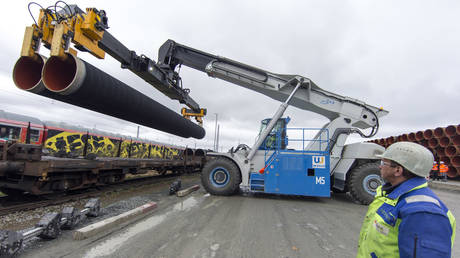
The replacement of multiple kilometers of damaged pipeline requires high-grade X70 carbon steel line pipe, engineered to withstand extreme internal pressures and external hydrostatic loads. This steel requires a specific internal epoxy lining and an external concrete weight coating.
- Lead Times: Current global rolling mill capacities for specialized thick-walled large-diameter line pipe are backlogged with transition-infrastructure projects.
- Technical Qualification: Procuring, rolling, coating, and transport testing thousands of tons of X70 pipe involves a structural lead time of 12 to 18 months before a repair vessel can even deploy an anchor.
Insurance Jurisprudence: The Total Loss Contradiction
The litigation in the London High Court centers on whether the damage constitutes a "Constructive Total Loss" (CTL) or a partial loss covered under property damage provisions. This legal distinction governs the payout structure and directly impacts whether a repair will ever be attempted.
The Insurers' Defense Mechanism
Underwriting syndicates argue that the cost of repairing the pipelines far exceeds their insured value or their post-repair economic utility, classifying the asset as a CTL. If the court rules the asset a total loss, the insurers pay out the policy limit (subject to deductibles and war/sabotage exclusions) and ownership of the ruined asset typically transfers to the insurer, or the policy terminates.
Furthermore, insurers point to the strict war exclusion clauses found in standard marine all-risk policies. If the detonations are legally classified as an act of war, state-sponsored sabotage, or hostilities by a political power, the insurers bear zero liability for the repair costs.
The Operator's Recovery Thesis
Nord Stream AG’s strategy relies on demonstrating that the pipeline is not a total loss but an asset awaiting remediation. By submitting court documents stating that the pipeline can be repaired within three years, the operator is attempting to establish that the damage is localized and technically reversible. This positioning serves a dual purpose:
- It supports a claim for partial loss recovery to fund the massive mobilization costs of the repair operation.
- It preserves the legal status of the pipeline as an active infrastructure asset rather than abandoned maritime debris, which would trigger multi-billion-dollar decommissioning liabilities under international maritime law (OSPAR convention).
Strategic Action Matrix for Asset Resolution
Based on the intersection of engineering constraints, legal positions, and market realities, the resolution of the Nord Stream infrastructure dilemma will follow a highly restricted logical path. The table below outlines the execution variables for the three possible asset scenarios.
| Scenario | Primary Engineering Requirement | Legal Implication | Timeline | Economic Viability |
|---|---|---|---|---|
| Active Remediation | Hyperbaric dry-habitat welding via sanctioned DP3 vessels. Continuous nitrogen purging. | Requires sanctions waivers from EU/US and insurer payout validation. | 36 Months | Low (dependent on geopolitical realignment and gas demand). |
| Long-Term Preservation | Internal dewatering, biocide flushing, and mechanical plug sealing. | Preserves asset status; avoids immediate decommissioning penalties. | 6–12 Months | Medium (low capital expenditure to halt active corrosion). |
| Asset Abandonment | Subsea plugging, cutting of exposed spans, and continuous environmental monitoring. | Insurers trigger war exclusions; operator faces immense decommissioning lawsuits. | Indefinite | High immediate savings; extreme long-term legal liability. |
Given the current geopolitical landscape and the strict stance of the High Court insurers, the most probable strategic move for the operator is not immediate physical repair, but rather an aggressive shift toward long-term preservation. By deploying automated nitrogen-purging pigs from the Russian land-based compressor stations, the operator can displace the oxygenated seawater and halt internal corrosion without relying on Western subsea construction vessels. This technical maneuver keeps the asset in a state of suspended animation, preserving the physical integrity of the steel for future deployment while the multi-year legal battles over liability wind through the European court systems.


